

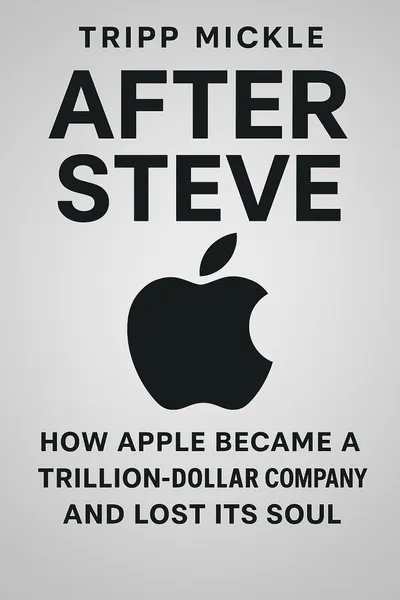
After Steve
From disruption to optimization
Description
Tripp Mickle's investigation emerges within contemporary debates surrounding corporate succession and innovation sustainability in technology sectors. The author leverages his journalistic expertise to examine Apple's institutional transformation following its founder's death, situating this transition within broader questions of leadership paradigms and corporate identity evolution. The work addresses fundamental tensions between charismatic authority and bureaucratic rationalization in late-stage capitalism.
Mickle's central research question asks: How does Apple's transformation under Tim Cook illuminate the tensions between visionary leadership and operational excellence in contemporary technology corporations? The defended thesis argues that the transition from Jobs to Cook represents a paradigmatic shift from revolutionary disruption to incremental refinement, revealing inherent contradictions between entrepreneurial innovation and corporate stability. The main stake involves demonstrating how leadership succession in technology companies reflects broader transformations in capitalist innovation models and corporate governance structures.
Mickle's comprehensive analysis demonstrates that Apple's post-Jobs transformation represents broader tensions within contemporary technology capitalism between entrepreneurial vision and corporate rationalization. The author successfully illustrates how leadership succession impacts innovation capacity, organizational culture, and market strategy, contributing to understanding corporate evolution patterns. The work's strength lies in its detailed examination of institutional transformation dynamics and their broader implications for technology sector development.
The investigation reveals how Apple's experience illuminates fundamental contradictions between charismatic leadership and bureaucratic efficiency, suggesting that technological innovation requires balancing visionary risk-taking with operational excellence. Mickle's analysis contributes to debates about corporate succession, innovation sustainability, and the relationship between leadership styles and organizational outcomes in contemporary capitalism.
Table of contents
01The Dialectic of Charismatic and Rational Authority
Mickle's analysis reveals a fundamental Weberian tension between charismatic and rational-legal authority within Apple's organizational transformation. The author demonstrates how Jobs's charismatic leadership model, characterized by intuitive decision-making and aesthetic perfectionism, necessarily conflicts with Cook's rational-bureaucratic approach emphasizing operational efficiency and market predictability. This transition illuminates broader questions about the institutionalization of innovation within corporate structures.

02Market Rationalization and Innovation Constraints
The author's examination of Apple's market strategy under Cook reveals significant tensions between shareholder value maximization and technological risk-taking. Mickle demonstrates how Cook's focus on market expansion, particularly in emerging economies, necessitates product standardization and incremental improvements rather than revolutionary breakthroughs. This strategic shift reflects broader transformations in technology capitalism toward risk aversion and predictable revenue streams.
03Organizational Culture and Creative Tensions
Mickle's exploration of Apple's internal cultural transformation reveals profound tensions between collaborative decision-making and visionary leadership models. The author demonstrates how Cook's consensual management style, while promoting organizational stability and employee satisfaction, potentially undermines the creative friction that generated Apple's most innovative products. This analysis contributes to understanding how organizational cultures evolve following charismatic leadership transitions.
04Technological Legacy and Ethical Implications
The author's analysis extends to examine the ethical and societal consequences of Apple's transformation, particularly regarding privacy, labor practices, and technological accessibility. Mickle demonstrates how Cook's emphasis on social responsibility and ethical positioning represents both genuine commitment and strategic brand management, revealing complex relationships between corporate values and market positioning. This examination illuminates broader questions about technology companies' societal responsibilities.
The investigation suggests that Apple's ethical positioning under Cook reflects broader transformations in corporate capitalism toward stakeholder capitalism models, while simultaneously serving strategic market differentiation purposes. Mickle's analysis reveals how technological companies increasingly navigate tensions between profit maximization and social responsibility, contributing to debates about corporate ethics in contemporary capitalism. These dynamics reflect broader questions about technology's role in social transformation.