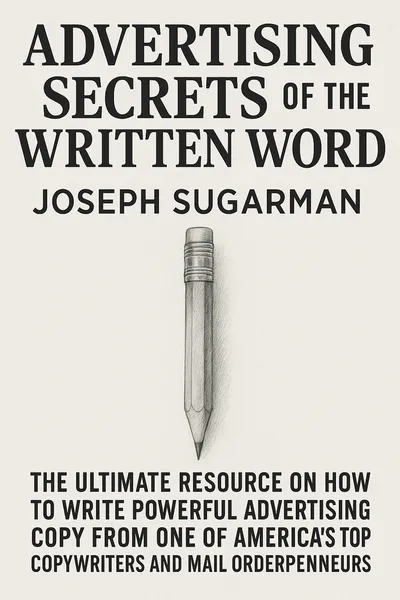
Advertising Secrets of the Written Word
Emotion before reason sells
Description
Joseph Sugarman's "Advertising Secrets of the Written Word" presents a systematic approach to copywriting grounded in consumer psychology and direct marketing experience. The work's central thesis positions effective advertising copy as a psychological slide that systematically removes barriers to purchase through emotional engagement and logical persuasion techniques.
Drawing from decades of practical experience in direct marketing through his company JS&A Group, Sugarman attempts to transform advertising from artistic intuition to scientific methodology. His framework conceptualizes advertising as an engineered psychological process rather than creative expression, suggesting that consumer responses can be predicted and controlled through systematic application of psychological triggers. This mechanistic approach reflects broader twentieth-century tendencies toward scientific management of human behavior, echoing Taylor's industrial rationalization applied to emotional and cognitive processes.
The book's fundamental contribution lies in its systematic deconstruction of persuasive elements, revealing debt to classical rhetoric while adapting these principles to mass-mediated consumer culture. Sugarman's emphasis on emotional engagement preceding logical justification inverts traditional rational decision-making models, suggesting that affect drives cognition rather than vice versa. This approach aligns with contemporary neuroscientific findings about decision-making processes, though the formulation predates and lacks the empirical sophistication of modern behavioral economics.
Central to Sugarman's methodology is the concept of eliminating "barriers to purchase" through credibility-building mechanisms and trust establishment. His techniques for building authority and authenticity represent a commodification of interpersonal trust, transforming genuine human connections into manufactured marketing assets. The emphasis on storytelling and personal narrative as persuasion tools anticipates the rise of brand narratives and lifestyle marketing, suggesting that products must be embedded within identity-forming stories rather than evaluated on functional merits alone.
Table of contents
01 The Mechanization of Desire: From Creative Expression to Scientific Method
Sugarman's fundamental contribution lies in his conceptualization of advertising as an engineered psychological process rather than creative expression. His framework positions copywriting within behaviorist paradigms, suggesting that consumer responses can be predicted and controlled through systematic application of psychological triggers. This mechanistic approach reflects broader twentieth-century tendencies toward scientific management of human behavior, echoing Taylor's industrial rationalization applied to emotional and cognitive processes.

02 The Architecture of Persuasion: Emotion, Logic, and Classical Rhetoric
The systematic deconstruction of persuasive elements reveals Sugarman's debt to classical rhetoric while adapting these principles to mass-mediated consumer culture. His emphasis on emotional engagement preceding logical justification inverts traditional rational decision-making models, suggesting that affect drives cognition rather than vice versa. This approach aligns with contemporary neuroscientific findings about decision-making processes, though Sugarman's formulation predates and lacks the empirical sophistication of modern behavioral economics.
03 The Commodification of Trust: Authenticity as Marketing Asset
Sugarman's analysis of credibility-building mechanisms exposes the systematic exploitation of social trust relationships for commercial purposes. His techniques for establishing authority and authenticity represent a commodification of interpersonal trust, transforming genuine human connections into manufactured marketing assets. This process reflects what sociologists term the colonization of the lifeworld by instrumental rationality, where authentic social relations become resources for economic exploitation.
04 Ethical Dimensions and Social Responsibility in Persuasive Communication
The work's implicit ethical framework raises significant questions about the social responsibility of persuasion professionals. Sugarman's techniques, while potentially serving legitimate commercial interests, can equally facilitate exploitation of vulnerable populations and promotion of harmful products. The author's failure to adequately address these ethical dimensions reflects a broader tendency within marketing literature to treat persuasion as ethically neutral technology rather than socially consequential practice.
05 Critical Assessment and Contemporary Implications
The work suffers from several significant limitations that constrain its theoretical and practical value. First, Sugarman's psychological framework relies heavily on outdated behaviorist models that fail to account for the complexity of contemporary consumer decision-making. His emphasis on universal psychological triggers ignores significant cultural, demographic, and contextual variations in persuasion effectiveness. Additionally, the work lacks empirical validation of its claims, relying primarily on anecdotal evidence from the author's specific commercial context.
Sugarman's contribution represents a significant systematization of direct marketing knowledge, transforming intuitive copywriting practices into codified methodology. The work successfully bridges practitioner experience with psychological theory, offering insights valuable for understanding contemporary persuasion dynamics. However, the analysis reveals fundamental tensions between the author's claimed consumer service orientation and the manipulative implications of his techniques.
Related books