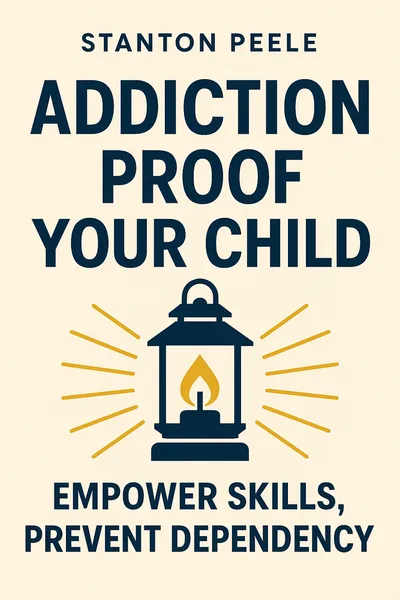
Addiction Proof Your Child
Empower skills, prevent dependency
Description
Stanton Peele's "Addiction Proof Your Child" emerges from his decades-long critique of mainstream addiction treatment paradigms. The work addresses contemporary parental anxieties about substance use while challenging prevailing prevention strategies rooted in prohibition and scare tactics. Peele situates his analysis within broader debates about adolescent development, risk behavior, and family dynamics in modern society.
The central research question asks: How can parents effectively prevent their children from developing addictive behaviors without relying on traditional abstinence-only approaches? Peele's defended thesis argues that addiction prevention succeeds through fostering children's intrinsic motivation, emotional intelligence, and values-based decision-making rather than external control mechanisms. The main stake involves demonstrating that prevention strategies emphasizing personal agency and critical thinking prove more effective than fear-based or authoritarian approaches.
Peele fundamentally reconceptualizes addiction prevention by rejecting biological determinism and embracing social learning theory. His framework positions addictive behaviors as learned responses to environmental stressors rather than inevitable outcomes of genetic predisposition or moral failing. The author challenges the prevalent medicalization of addiction, arguing that disease-model thinking inadvertently disempowers both parents and children. By framing addiction as an immutable biological condition, traditional approaches create fatalistic attitudes that undermine prevention efforts.
The work's prevention philosophy centers on cultivating intrinsic values that naturally resist addictive behaviors, contrasting sharply with external control mechanisms typically employed by parents and institutions. Peele argues that children develop resistance to addiction through meaningful engagement with activities that provide genuine satisfaction and purpose. This values-based approach extends beyond individual psychology to encompass family dynamics and community structures, requiring parents to model healthy coping strategies while creating environments that reward authentic self-expression.
A central tension emerges between Peele's emphasis on critical thinking and traditional abstinence-based prevention models. The author advocates teaching children to evaluate risks and benefits independently while acknowledging that experimentation often occurs despite parental disapproval. This approach distinguishes between use and abuse, arguing that blanket prohibitions fail to teach meaningful discrimination. Finally, Peele's analysis extends beyond family dynamics to examine broader social determinants of addiction vulnerability, critiquing individualistic prevention approaches that ignore structural inequalities and environmental factors contributing to substance abuse.
Table of contents
01 Beyond the Disease Model: Reframing Addiction as Social Learning
Peele fundamentally reconceptualizes addiction prevention by rejecting biological determinism and embracing social learning theory. His framework positions addictive behaviors as learned responses to environmental stressors rather than inevitable outcomes of genetic predisposition or moral failing. This theoretical shift carries profound implications for parental strategies.
The author challenges the prevalent medicalization of addiction, arguing that disease-model thinking inadvertently disempowers both parents and children. By framing addiction as an immutable biological condition, traditional approaches create fatalistic attitudes that undermine prevention efforts. Peele's alternative framework emphasizes human agency and environmental modification, suggesting that addiction represents a complex interaction between individual vulnerability and social circumstances.

02 Values-Based Prevention: Cultivating Intrinsic Motivation
Peele's prevention philosophy centers on cultivating intrinsic values that naturally resist addictive behaviors. This approach contrasts sharply with external control mechanisms typically employed by parents and institutions. The author argues that children develop resistance to addiction through meaningful engagement with activities that provide genuine satisfaction and purpose.
The work emphasizes how modern society often fails to provide adolescents with authentic sources of meaning and accomplishment. Consumer culture and academic pressures create environments where young people seek artificial stimulation through substances or behaviors. Peele contends that prevention requires creating alternative pathways for achievement and self-expression.
03 Critical Thinking and Harm Reduction: Empowering Informed Decisions
A central tension emerges between Peele's emphasis on critical thinking and traditional abstinence-based prevention models. The author advocates teaching children to evaluate risks and benefits independently rather than accepting prohibitions without question. This approach acknowledges that experimentation often occurs despite parental disapproval, necessitating harm reduction strategies.
Peele's framework recognizes the developmental inevitability of risk-taking during adolescence while providing tools for minimizing negative consequences. This position creates significant challenges for parents socialized within zero-tolerance paradigms. The author must navigate between promoting informed decision-making and avoiding perceived endorsement of substance use.
04 Social Context and Prevention: Beyond Individual Responsibility
Peele's analysis extends beyond family dynamics to examine broader social determinants of addiction vulnerability. The work critiques individualistic prevention approaches that ignore structural inequalities and environmental factors contributing to substance abuse. This sociological perspective highlights how community resources, educational opportunities, and social support networks influence addiction risk.
The author argues that effective prevention requires addressing social conditions that create vulnerability to addiction. Poverty, social isolation, academic failure, and limited opportunities all contribute to environments where addictive behaviors appear attractive. Peele suggests that parents must advocate for systemic changes while developing family-level strategies.
05 Critical Analysis and Future Directions
Peele's analysis suffers from several significant limitations that constrain its practical applicability. His critique of disease models, while theoretically sound, may underestimate the utility of medical frameworks for severe cases requiring professional intervention. The work risks creating false dichotomies between biological and social explanations when integrated approaches might prove more effective.
The author's emphasis on parental empowerment may inadvertently increase anxiety among parents lacking resources or expertise to implement complex prevention strategies. His recommendations assume relatively privileged family circumstances with sufficient time, education, and stability to engage in nuanced conversations about risk and values. This limitation restricts the approach's applicability across diverse socioeconomic contexts.
Related books