

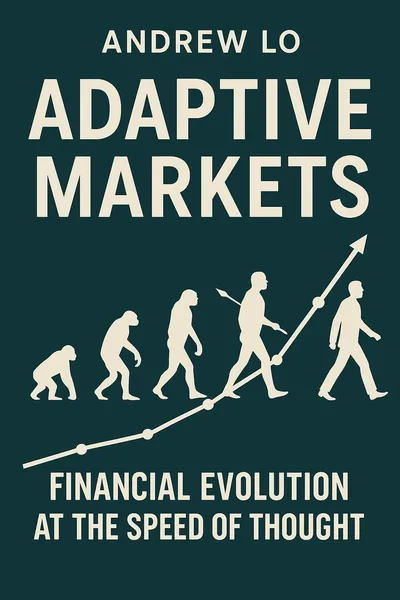
Adaptive Markets
Evolution over efficiency
Description
Andrew Lo presents a fundamental reconceptualization of financial market theory that challenges the orthodox efficient market hypothesis through an evolutionary lens. This work emerges from decades of empirical observations revealing persistent market anomalies and behavioral patterns that traditional finance theory fails to adequately explain. Lo leverages his expertise in quantitative finance to construct an alternative theoretical framework that incorporates biological, psychological, and technological dimensions of market behavior.
The central research question driving this work is: How can financial markets be better understood through evolutionary and adaptive mechanisms rather than static efficiency models? Lo defends the thesis that market efficiency is not a permanent state but an evolving condition shaped by adaptive behaviors of participants responding to environmental pressures. The main stake involves establishing a new paradigm for understanding market dynamics that integrates biological evolution with financial theory to improve investment strategies and regulatory frameworks.
Financial markets operate not according to static efficiency principles but through evolutionary adaptation mechanisms that create dynamic patterns of behavior driven by biological and psychological factors inherent in human decision-making. Lo's "Adaptive Markets" presents a comprehensive theoretical revolution that reconceptualizes financial markets as evolutionary ecosystems rather than mechanical efficiency engines. The work successfully integrates insights from multiple disciplines to construct a coherent alternative to orthodox financial theory, demonstrating how biological, psychological, and technological factors interact to create observable market patterns. The adaptive markets hypothesis provides explanatory power for numerous market phenomena that traditional theory struggles to address, from momentum effects to volatility clustering.
The intellectual contribution lies in creating a unified framework that acknowledges both the competitive and cooperative aspects of market behavior while explaining how efficiency emerges and disappears through evolutionary processes. Lo's synthesis offers practical value for investors, regulators, and researchers by providing tools for understanding market dynamics in ways that static models cannot achieve.
Table of contents
01Evolutionary Foundations of Market Behavior
Lo's theoretical contribution rests fundamentally on transposing evolutionary biology concepts into financial market analysis, creating what he terms the Adaptive Market Hypothesis. This framework posits that market participants, like biological organisms, continuously adapt their strategies in response to environmental pressures and resource competition. The author demonstrates how natural selection mechanisms operate within financial ecosystems, where successful trading strategies proliferate while ineffective approaches become extinct.

02Neurobiological Foundations of Financial Decision-Making
The integration of neuroscience into financial theory represents Lo's second major theoretical axis, examining how brain architecture influences investment behavior and market dynamics. Drawing from behavioral neuroscience research, the author demonstrates that human financial decision-making is fundamentally constrained by evolutionary programming that optimized survival in ancient environments but often proves maladaptive in modern financial contexts.
03Technological Evolution and Market Transformation
Lo examines how technological advancement fundamentally alters market ecosystems through the introduction of algorithmic trading systems and artificial intelligence platforms. This analysis reveals a paradigm shift from human-dominated to hybrid human-machine market environments, where traditional behavioral patterns interact with algorithmic strategies to create entirely new forms of market dynamics.
04Regulatory and Ethical Implications
The adaptive markets framework generates significant implications for financial regulation and systemic risk management. Lo argues that traditional regulatory approaches, based on static market assumptions, prove inadequate for governing dynamic adaptive systems. Instead, regulatory frameworks must themselves become adaptive, evolving in response to changing market conditions and participant behaviors.
05Critical Assessment and Future Directions
Despite its theoretical innovation, Lo's framework suffers from several conceptual limitations. The biological metaphor, while illuminating, risks oversimplifying the unique characteristics of financial markets, particularly the role of reflexivity and conscious strategic behavior that distinguishes human markets from natural ecosystems. The work occasionally conflates correlation with causation when linking neurobiological findings to market behavior, potentially overstating the deterministic influence of brain chemistry on investment decisions.
Furthermore, the adaptive markets hypothesis, while more flexible than traditional efficiency theory, lacks the precise predictive power that practitioners require for systematic application. The framework's emphasis on continuous adaptation may paradoxically lead to analytical paralysis, as it suggests that any observed pattern may quickly become obsolete through evolutionary pressure.