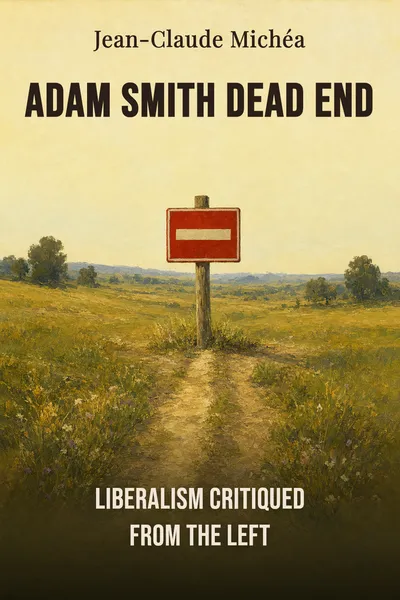
Adam Smith Dead End
Liberalism critiqued from the left
Description
In 1776, a Scottish moral philosopher named Adam Smith published The Wealth of Nations, and for the next two and a half centuries almost everyone agreed on what to do with him. The right adopted him as the prophet of free markets, the invisible hand, the butcher and the baker who feed us not out of kindness but out of self-interest. The left treated him as the enemy — the man who dressed up greed as economics. Jean-Claude Michéa, a French philosopher who spent his career as a discreet high-school teacher in Montpellier, thinks both sides misread the same book, and misread it in the same direction.
His argument, laid out in Adam Smith Dead End, is deliberately awkward for everyone. Michéa comes from the left — the old workers' left of solidarity, dignity and suspicion toward money. But he refuses the idea that the left's job is to complete the liberal project by extending it, making it fairer, more inclusive, more universal. Because for him, liberalism was never only an economic doctrine. It was a moral wager: that a society could hold together without asking its members to be good, relying instead on rules, contracts, and the quiet arithmetic of self-interest.
Smith is the pivot of that wager. And a wager, once you name it, can be lost. Michéa reads Smith not as the founder of a triumphant system but as the marker of a dead end — a road that looked like liberation and turned out to have a wall at the far end of it. The question is what he saw coming, and why he thinks the people who claim to oppose the market have quietly signed the same contract as the people who worship it.
The question we’re asking : What did liberalism actually promise when it decided a society could function without any shared idea of the good — and what did that promise cost?What we’ll see : How a reading of Adam Smith turns into an argument that the left and the right share one blind spot, and that the way out runs through the ordinary morality of ordinary people.
Table of contents
01Chapter 1 — The one man who was both economists' father and moralists' hero
Before The Wealth of Nations, there was another book. In 1759, Adam Smith published The Theory of Moral Sentiments, a work about sympathy, conscience, and how people come to care what others think of them. It was a success in its day, and Smith kept revising it until the end of his life. The economist we remember was, first and for longer, a professor of moral philosophy. Michéa insists we hold both books in one hand, because the second cannot be understood without the first.
The awkward fact most readings skate over is that these two Smiths sound like different people. In one, we are creatures moved by fellow-feeling, wired to imagine ourselves into the shoes of others. In the other, the grocer serves us out of calculation and society runs on the pursuit of advantage. Generations of scholars called this the Adam Smith Problem and spent a lot of effort explaining it away. Michéa's move is to refuse the reconciliation. The tension is not a puzzle to solve; it is the whole story.

02Chapter 2 — Where the left and the right are the same idea
Here is the claim that makes Michéa unclassifiable, and it is the spine of the book. Liberalism, he argues, is not the political tradition of the right against a socialist left. It is a single project with two faces. There is an economic liberalism — free markets, private property, minimal interference — usually coded as right-wing. And there is a cultural or political liberalism — individual rights, tolerance, the steady removal of any collective moral authority — usually coded as left-wing. Michéa's provocation is that these are not opposites. They are the same operation applied to two domains.
Both begin from the same founding refusal: the conviction that a society must never impose a shared vision of the good life. After the religious wars of early modern Europe, this looked like wisdom, even like peace. If people slaughter each other over rival conceptions of the good, then build institutions that stay silent on the good altogether. Let the market arbitrate the economy; let neutral law and individual choice arbitrate everything else. Nobody is asked to agree on what a decent life is. They are only asked to follow the rules.
03Chapter 3 — A society that runs without asking anyone to be good
What does a society organized entirely around exchange actually feel like from inside? Michéa's answer is that it feels, increasingly, like a place where nothing is owed and everything is negotiated. The relations that used to run on obligation, gift, and mutual recognition are steadily rewritten as transactions. This is not a moral panic about consumerism. It is a structural point: once you decide that no shared idea of the good may govern public life, the only remaining coordinator is the contract, and the only universal language is money.
Smith's wager assumed a stock of inherited morality it did not have to produce. The grocer who serves us for profit still, in Smith's world, refrained from poisoning the flour — not because the contract forbade it, but because he was raised in a community with shared expectations of honesty. Liberal society, Michéa argues, spends this inheritance without replenishing it. It treats moral capital as a free-standing resource, drawing it down generation after generation while dismantling the very forms of life — trades, neighborhoods, churches, unions, families of a certain kind — that once renewed it.
04Chapter 4 — The decency the market cannot manufacture
If the dead end is real, Michéa needs something to point to that is not simply nostalgia. He finds it in a phrase he borrows from George Orwell: common decency. Orwell, writing about the English working class, kept returning to an ordinary, unheroic morality — the reflex that makes people help a neighbor, share what little they have, keep their word, and feel disgust at cruelty and greed. Not a philosophy, not a doctrine, but a set of instincts carried by ordinary people who never read a book of ethics. Michéa builds his positive case on it.
Common decency matters to his argument because it is exactly what liberalism cannot generate and does not know how to value. It comes from below, from shared life and inherited practice, not from contracts or declarations of rights. It assumes precisely the things liberalism forbids public institutions to assume: a common sense of what is owed, a shared idea, however rough, of a good person. Where the market sees preferences to be satisfied and the liberal state sees rights to be protected, common decency sees obligations that no one signed and everyone recognizes.
05Conclusion
Two hundred and fifty years after The Wealth of Nations, we still argue about Adam Smith as if the only question were how much market to allow. Michéa's reading changes the register of the argument. Smith mattered not because he loved markets but because he formulated, with unusual clarity, a bargain that Western societies then spent centuries carrying out: hold people together through exchange and rules, and stay silent on the good. The right kept the economic half of that bargain, the left kept the cultural half, and both mistook their shared premise for a quarrel.
Related books