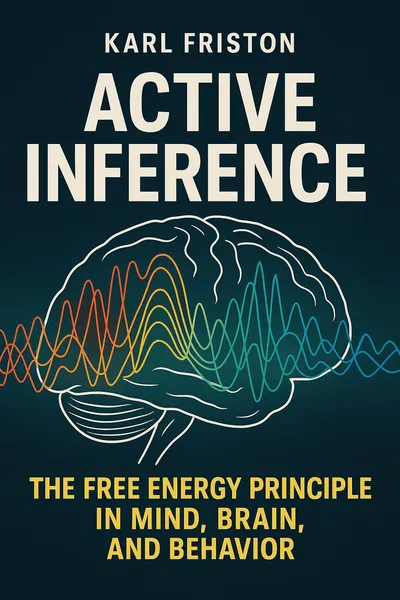
Active Inference
Life's blueprint, rewritten
Description
Karl Friston's "Active Inference" emerges within the contemporary landscape of computational neuroscience as an ambitious attempt to unify diverse phenomena under a single theoretical umbrella. Building upon decades of research in neuroimaging and theoretical biology, this work positions itself at the intersection of neuroscience, artificial intelligence, and philosophy of mind. The treatise represents Friston's mature synthesis of his free energy principle, extending its implications beyond neural computation to encompass fundamental questions about life, consciousness, and adaptive behavior.
The central research question driving this work asks: How do living systems maintain their organization and adapt to environmental uncertainty through predictive mechanisms that minimize surprise? Friston's defended thesis proposes that active inference serves as a universal principle governing biological systems, wherein organisms actively sample their environment to confirm predictions and minimize free energy. The main stake is to establish active inference as the foundational framework for understanding cognition, perception, and action across all scales of biological organization.
Friston's "Active Inference" presents a remarkably ambitious and theoretically sophisticated framework that attempts to unify diverse phenomena under a single mathematical principle. The work's strength lies in its rigorous mathematical foundation and its ability to generate novel predictions across multiple domains of inquiry. The reconceptualization of the brain as a prediction machine offers fresh perspectives on longstanding problems in neuroscience and cognitive science.
The theoretical coherence of the framework is impressive, demonstrating how perception, action, learning, and attention can emerge from a single optimization principle. This parsimony represents a significant intellectual achievement, particularly given the complexity of the phenomena under consideration. The work successfully bridges multiple levels of analysis, from molecular mechanisms to social behavior, suggesting genuine explanatory power.
Table of contents
01The Predictive Brain Paradigm
Friston's theoretical architecture fundamentally challenges the traditional stimulus-response paradigm that has dominated neuroscience for decades. His conception of the brain as a prediction machine represents a paradigmatic shift from reactive to proactive models of cognition. This reconceptualization draws heavily from Bayesian statistics and information theory, positioning the nervous system as a hierarchical inference engine that constantly generates hypotheses about sensory input.
The theoretical framework rests upon the notion that biological systems exist in a state of dynamic equilibrium, perpetually working to maintain their structural integrity against environmental perturbations. This homeostatic imperative translates into a computational principle whereby organisms must minimize their free energy—a quantity that bounds the surprise associated with sensory encounters. The elegance of this formulation lies in its ability to subsume perception, learning, and action under a single optimization objective.

02Action as Epistemic Exploration
The revolutionary aspect of Friston's framework lies in its treatment of action not merely as a response to perception but as an integral component of the perceptual process itself. This dissolution of the traditional perception-action boundary reflects a deeper commitment to embodied cognition, wherein movement and sensing become inextricably intertwined aspects of a unified process.
Active inference posits that organisms possess two fundamental strategies for minimizing prediction error: updating their internal models or changing their sensory input through action. This dual mechanism creates a dynamic interplay between epistemic actions—behaviors aimed at gathering information—and pragmatic actions directed toward achieving specific outcomes. The framework thus provides a principled account of exploratory behavior, explaining why organisms actively seek novel experiences even when they increase immediate uncertainty.
03Hierarchical Organization and Temporal Dynamics
The sophistication of Friston's model emerges through its hierarchical architecture, which mirrors the laminar organization of cortical structures. Higher levels of the hierarchy encode increasingly abstract and temporally extended predictions, while lower levels handle moment-to-moment sensory processing. This multi-scale organization allows the framework to account for both immediate perceptual phenomena and long-term planning and memory.
The temporal dimension introduces additional complexity, as organisms must not only predict current sensory states but anticipate future configurations of their environment. This predictive capacity enables proactive behavior and strategic planning, distinguishing adaptive systems from purely reactive mechanisms. The framework's treatment of time reflects sophisticated concepts from dynamical systems theory, positioning organisms as attractor states that actively maintain their trajectory through state space.
04Implications for Artificial Intelligence and Society
The extension of active inference principles to artificial systems represents both a promising avenue for technological development and a source of ethical concerns. Friston's framework suggests design principles for autonomous agents that could exhibit more flexible and adaptive behavior than current AI systems. The emphasis on uncertainty quantification and exploratory behavior offers potential solutions to fundamental challenges in machine learning, particularly in domains characterized by distributional shift and novel environments.
05Critical Assessment and Future Directions
Despite its theoretical elegance, active inference faces several fundamental limitations that constrain its explanatory scope. The framework's heavy reliance on Bayesian optimization assumes computational resources and representational capacities that may exceed those available to biological systems. The mathematical idealization inherent in the approach risks overlooking the messy, resource-bounded nature of real-world cognition.
Moreover, the universality claims remain largely programmatic rather than empirically substantiated. While the framework can accommodate diverse phenomena, it often does so through post-hoc parameter adjustment rather than genuine prediction. The theory's flexibility, while intellectually appealing, raises questions about falsifiability and empirical content.
Related books