
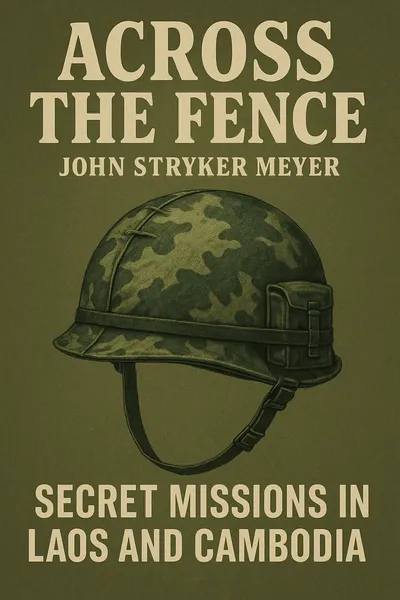
Across The Fence
Secret missions in Laos and Cambodia
Description
John Stryker Meyer's "Across the Fence" emerges from the intersection of military memoir and historical documentation, positioned within the broader discourse on America's clandestine warfare capabilities during the Cold War period. The author leverages his direct operational experience to examine the most classified aspects of American military engagement in Southeast Asia, contributing to scholarship on unconventional warfare and intelligence operations.
The central research question driving this work examines how covert cross-border operations fundamentally altered the nature and understanding of American military engagement in Southeast Asia. Meyer defends the thesis that SOG operations constituted a shadow war that operated beyond traditional military and political constraints, revealing both the potential and limitations of special operations warfare. The main stake of this analysis is to demonstrate how classified military operations challenged established doctrinal frameworks while exposing the ethical complexities of clandestine warfare.
Meyer's comprehensive analysis establishes SOG operations as a paradigmatic example of how Cold War imperatives fundamentally transformed American military practices. The work demonstrates that these clandestine activities represented more than tactical innovations, constituting a systematic departure from established principles of democratic military oversight and international law compliance. The intellectual contribution lies in documenting how special operations became instruments for implementing foreign policy objectives that could not be pursued through conventional diplomatic or military channels, revealing the institutional mechanisms through which democratic societies adapt to prolonged conflict conditions while maintaining official policy coherence.
The overarching thesis posits that the clandestine cross-border operations conducted by SOG forces in Laos and Cambodia represented a parallel war that fundamentally challenged conventional military doctrine while revealing the complex moral and strategic contradictions inherent in America's Southeast Asian intervention.
Table of contents
01The Architecture of Clandestine Warfare: Organizational Structures Beyond Convention
Meyer's analysis reveals how SOG operations represented a radical departure from conventional military structures, operating within a framework that deliberately obscured command responsibility and operational accountability. The organizational architecture described suggests a military apparatus designed to function beyond traditional oversight mechanisms, creating what the author presents as a parallel command structure. This institutional arrangement reflects broader Cold War imperatives that prioritized operational flexibility over transparency, revealing how national security concerns fundamentally reshaped military organizational principles.

02Cross-Border Operations and Sovereignty Violations: Military Necessity vs. International Law
The examination of cross-border incursions into Laos and Cambodia illuminates the complex relationship between military necessity and international law during the Vietnam conflict. Meyer's account demonstrates how operational requirements systematically transcended legal and diplomatic boundaries, creating what emerges as a deliberate policy of plausible deniability. These operations reveal the tension between declared American foreign policy positions and actual military practices, highlighting how special operations became instruments for circumventing political constraints.
03Combat Effectiveness and Strategic Paradox: Tactical Success Within Strategic Ambiguity
The work explores the paradoxical nature of SOG effectiveness, presenting operations that achieved tactical success while contributing to strategic ambiguity. Meyer's analysis reveals how small-unit operations, despite their tactical sophistication, remained constrained by broader political and strategic limitations that precluded decisive military outcomes. The examination of casualty rates and mission success parameters demonstrates the human cost of maintaining operations that existed in a strategic vacuum, disconnected from achievable political objectives.
04Moral Implications and the Burden of Secrecy: Ethics of Clandestine Warfare
The ethical dimensions of clandestine warfare emerge as central concerns in Meyer's treatment of SOG operations, particularly regarding the psychological and moral burden placed upon individual soldiers. The analysis reveals how classified operations created unique forms of veteran experience, characterized by enforced silence and official non-recognition that complicated post-war reintegration processes. The work demonstrates how the secrecy surrounding these operations extended beyond operational security requirements to encompass broader questions of democratic accountability and civilian oversight of military activities.
05Critical Assessment and Contemporary Implications
Meyer's analysis, while empirically rich, exhibits limitations in theoretical framework application, particularly regarding the broader implications of clandestine warfare for democratic governance. The work tends to focus on operational details rather than examining the systemic effects of institutionalized secrecy on civil-military relations. Additionally, the analysis lacks comparative perspective on similar operations conducted by other nations, limiting its contribution to broader scholarship on covert warfare.