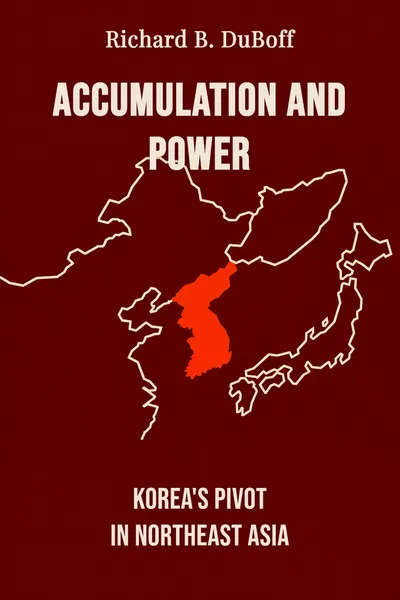
Accumulation and Power
Korea's pivot in Northeast Asia
Description
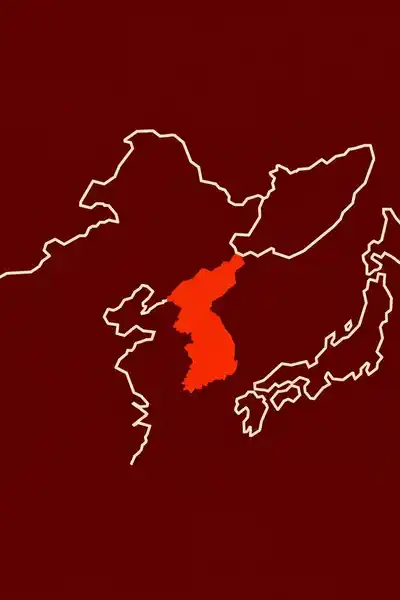
Look at a map of Northeast Asia and the eye goes straight to the big players. China to the west, an economy that reorganized the global supply chain in a single generation. Japan to the east, the postwar miracle that taught everyone else how it was done. Russia to the north, vast and resource-heavy. And then, wedged between them, a peninsula barely the size of a mid-range European country, split down the middle since 1953 by one of the most heavily armed borders on the planet. The instinct is to read Korea as the place where the giants' interests collide — a buffer, a flashpoint, a problem to be managed.
Richard DuBoff, an economic historian who spent his career studying how accumulation and power feed each other, reads the same map differently. In Accumulation and Power, he argues that Korea's location at the geographic center of Northeast Asia is not a vulnerability but a function — the same centrality that makes it dangerous makes it indispensable. A region as economically dense as this one cannot integrate by leaving its middle empty. Someone has to occupy the hinge, and the South Korean economy, built almost from nothing after the war, grew into exactly the kind of player a hinge requires.
That reframing changes the stakes. The usual conversation about Korea is about security: missiles, summits, the unfinished war. DuBoff's conversation is about economics, and about what happens when a country that should have been a junior partner ends up holding the position everyone else has to route through. The peninsula becomes less a fault line than a pivot — and pivots, by definition, are where the movement of much larger things gets decided.
The question we’re asking : How does a small, divided peninsula end up as the key to integrating one of the world's most powerful economic regions?What we’ll see : How geography, a startling industrial rise, and the stubborn refusal of neighbors to integrate on their own combine to put Korea at the center of Northeast Asia's century.
Table of contents
01 Chapter 1 — A peninsula in the middle of giants
The first thing DuBoff insists on is that geography is not destiny, but it is a starting hand, and Korea's hand is unusual. The peninsula juts down from the Asian mainland into the seas that separate China from Japan, with Russia's Pacific edge just to the north. Whatever moves between these economies — goods, capital, energy, people — moves through or near this space. For most of modern history that centrality was a curse. Korea was the corridor through which larger powers marched at each other, annexed by Japan in 1910, then carved in two as the Cold War froze around it.
DuBoff is careful not to romanticize the position. Being in the middle of strong neighbors meant, for the better part of a century, being acted upon rather than acting. The peninsula's history is full of moments when its fate was decided in capitals other than its own. The 1953 armistice that ended the open fighting of the Korean War left the country split roughly along the line where the armies had stalled, and that line hardened into a border that still defines the region's security map.

02 Chapter 2 — The economic engine that surprised everyone
The transformation of the South Korean economy is one of the genuinely startling stories of the twentieth century, and DuBoff treats it as the thing that turned geographic centrality into actual leverage. In the early 1960s South Korea was among the poorest countries on earth, with income levels comparable to the poorest parts of Africa and an economy that depended heavily on foreign aid. Within roughly three decades it had become an industrial power producing ships, steel, cars, and electronics for the world. The speed of the change had no real precedent at that scale.
DuBoff, as an economic historian of accumulation, is interested less in the miracle framing than in the mechanism. The growth was state-directed. Government planners channeled capital toward chosen industries, protected them while they grew, and pushed them relentlessly toward export markets. Large industrial conglomerates — the chaebol — were built up as the vehicles of this strategy, financed cheaply on the condition that they performed abroad. It was accumulation organized from the top, deliberately and sometimes brutally, and it worked in the narrow sense of producing rapid industrial capacity.
03 Chapter 3 — The hinge of a region that won't integrate on its own
Northeast Asia, DuBoff observes, is one of the most economically interconnected regions on earth and one of the least politically integrated. The trade among China, Japan, and Korea is enormous; the trust among their governments is thin. History sits heavily here — Japan's occupations, wartime grievances, territorial disputes over islands and waters, the residue of the Cold War. The economies are woven together while the states keep their distance, and that gap is the central problem of regional cooperation.
This is where Korea's double centrality becomes decisive in his account. China and Japan are too large, too rivalrous, and too burdened by history to lead a regional bloc together; neither will accept the other at the head of the table. A region that cannot integrate around its biggest member has to integrate around something else, and the natural candidate is the player in the middle that is big enough to matter but not big enough to dominate. Korea, DuBoff argues, is that player — substantial enough to carry weight, contained enough not to threaten.
04 Chapter 4 — What a small country at the center teaches about power
Step back from Korea specifically and DuBoff's larger thesis comes into view: power in an interconnected economy is not only a matter of size. The whole arc of his work argues that accumulation and power are entangled — that economic weight converts into political leverage — but the Korea case adds a refinement. Position matters as much as scale. A medium-sized economy at the structural center of a region can hold leverage that a larger economy on the periphery cannot, because everything has to pass through the middle.
This is a different picture of power than the one that dominates most thinking about Northeast Asia, where the question is usually framed as a contest between the two giants. DuBoff's framing suggests the more interesting variable is not who is biggest but who is unavoidable. Korea's value lies precisely in its in-between status — large enough that its participation counts, small enough that its leadership does not frighten. It can convene what the giants cannot, because it threatens no one's primacy. Being in the middle is its own form of strength.
05 Conclusion
The map that opens the book still shows the same thing at the end — a small peninsula pressed between far larger neighbors. What has changed is how we read it. The instinct to see Korea as a buffer or a flashpoint captures only the security story. DuBoff's economic story runs alongside it: the same centrality that made the peninsula a battlefield makes it, in an era of dense trade and political distance, the natural pivot of the region. Accumulation gave it the weight; geography gave it the place.
Related books