

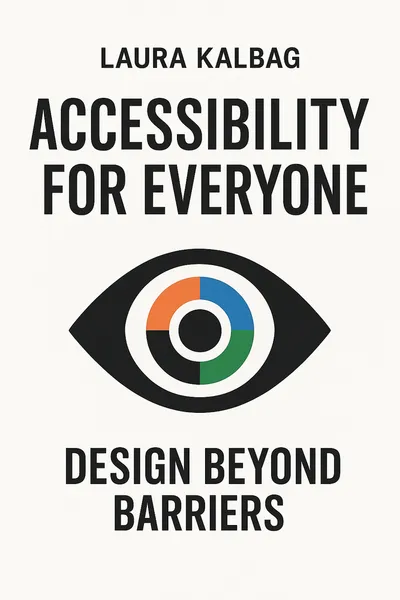
Accessibility for Everyone
Design beyond barriers
Description
Laura Kalbag presents a comprehensive examination of digital accessibility that challenges prevailing industry attitudes toward inclusive design. Writing from her extensive experience as a design practitioner and educator, she addresses the persistent marginalization of accessibility considerations in contemporary digital product development. The work emerges within a broader context of increasing legal scrutiny, evolving technological capabilities, and growing awareness of disability rights, positioning accessibility as both a moral imperative and practical necessity for organizations operating in digital spaces.
Kalbag's central research question explores how design professionals and organizations can transform accessibility from an afterthought into an integral component of their creative and business processes. Her defended thesis argues that sustainable accessibility requires fundamental shifts in professional education, organizational culture, and design methodologies rather than superficial compliance measures. The main stake of her work involves demonstrating that inclusive design practices enhance user experiences universally while addressing systemic barriers that exclude disabled individuals from digital participation.
The work fundamentally challenges the medical model of disability that has historically dominated design thinking, advocating instead for a social model that recognizes environmental barriers as the primary source of exclusion. This theoretical reorientation represents a significant departure from traditional approaches that view accessibility as accommodation for deficiency rather than response to systemic inadequacy. Kalbag employs disability studies frameworks to demonstrate how conventional design processes perpetuate ableist assumptions about user capabilities and preferences.
Kalbag constructs a compelling argument for fundamental transformation in how design professionals, organizations, and industries approach accessibility challenges. The work successfully integrates theoretical frameworks from disability studies with practical guidance for implementation, creating a comprehensive resource that addresses both conceptual understanding and operational requirements. The central contribution lies in demonstrating that accessibility represents not a constraint on creativity but an expansion of design possibilities that benefits all users while addressing historical exclusions. The intellectual coherence of the work emerges through its consistent application of social model disability theory to practical design challenges, revealing how seemingly technical problems reflect deeper cultural and institutional biases.
Table of contents
01Reconceptualizing Disability and Design Paradigms
Kalbag fundamentally challenges the medical model of disability that has historically dominated design thinking, advocating instead for a social model that recognizes environmental barriers as the primary source of exclusion. This theoretical reorientation represents a significant departure from traditional approaches that view accessibility as accommodation for deficiency rather than response to systemic inadequacy. The author employs disability studies frameworks to demonstrate how conventional design processes perpetuate ableist assumptions about user capabilities and preferences.

02Legal Frameworks and Organizational Transformation
The examination of regulatory environments reveals the inadequacy of compliance-driven approaches to accessibility implementation. Kalbag demonstrates how legal requirements, while necessary, function as minimum standards that fail to address the full spectrum of user needs and organizational responsibilities. The analysis reveals tensions between legal mandates focused on measurable outcomes and design practices requiring cultural transformation and sustained commitment.
03Methodology and Practice Integration
The tension between accessibility standards and creative expression emerges as a central concern in Kalbag's analysis of contemporary design practice. Rather than accepting this as an inevitable conflict, the work reframes accessibility constraints as creative opportunities that can enhance rather than limit design innovation. This perspective challenges widespread assumptions about the relationship between aesthetic ambition and functional accessibility.
04Ethical Implications and Social Responsibility
The work addresses profound ethical questions about professional responsibility and social justice within design practice. Kalbag argues that accessibility failures represent not merely technical shortcomings but ethical violations that perpetuate systemic discrimination. This framing elevates accessibility from optional enhancement to moral obligation, challenging designers to consider the broader social consequences of their professional decisions.
05Critical Analysis and Future Directions
While Kalbag's work provides valuable insights into accessibility theory and practice, several limitations constrain its analytical scope. The focus on individual and organizational transformation may underestimate structural economic forces that prioritize efficiency over inclusion. The work could benefit from deeper engagement with political economy perspectives that examine how market pressures and competitive dynamics shape accessibility implementation decisions.
Additionally, the emphasis on design professional education and awareness may not adequately address power imbalances between designers, developers, project managers, and corporate decision-makers. The analysis might strengthen through greater attention to how accessibility advocacy intersects with labor organizing, professional unionization, and collective bargaining processes that could institutionalize inclusive design practices.