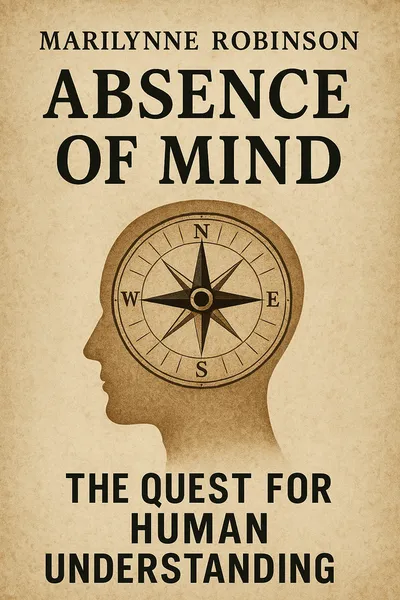
Absence of Mind
The quest for human understanding
Description
Robinson's *Absence of Mind* emerges from her tenure as a visiting professor at Yale University, where she delivered lectures confronting the intellectual climate dominated by scientific materialism. The work positions itself as a counter-narrative to the New Atheist movement, particularly challenging figures like Richard Dawkins and Daniel Dennett. Robinson, drawing upon her dual expertise in literature and theology, offers a sustained critique of reductive scientism while defending the epistemological validity of religious experience and consciousness studies.
The central research question driving this work asks: How has scientific materialism impoverished contemporary intellectual discourse by dismissing consciousness and religious experience as legitimate domains of inquiry? Robinson defends the thesis that the reduction of human experience to purely material explanations represents a philosophical overreach that contradicts science's own methodological principles. The main stake involves restoring intellectual respectability to religious consciousness and subjective experience within academic discourse.
Robinson's argument achieves remarkable coherence by demonstrating how scientific materialism's apparent strength—its claim to rational superiority—actually represents its fundamental weakness. By refusing to acknowledge the limits of empirical methodology, materialist philosophy becomes dogmatic and anti-scientific. Authentic scientific reasoning requires intellectual humility, openness to mystery, and recognition of consciousness as a genuine phenomenon requiring explanation rather than elimination.
The work successfully challenges the false dichotomy between science and religion, arguing instead for their potential complementarity. Robinson suggests that both domains address fundamental questions about reality, knowledge, and human experience, though through different methodological approaches. The intellectual task involves neither subordinating one to the other nor maintaining rigid separation, but rather developing more sophisticated frameworks capable of honoring both empirical rigor and existential depth.
Table of contents
01The Epistemological Foundations of Scientific Materialism
Robinson's analysis reveals how contemporary scientific materialism has transformed from methodological approach into dogmatic worldview. She demonstrates that figures like Dawkins and Harris conflate scientific methodology with philosophical materialism, creating what she terms an "absence of mind" regarding consciousness itself. This conflation represents a fundamental category error, where empirical methods designed to study physical phenomena are inappropriately extended to dismiss non-material aspects of human experience.

02The Cultural Consequences of Reductive Materialism
Robinson examines how scientific materialism has generated profound cultural impoverishment, particularly in educational and intellectual institutions. She argues that the systematic dismissal of religious traditions has severed contemporary society from rich intellectual resources accumulated over millennia. This cultural amnesia manifests in the inability to engage seriously with philosophical questions about human nature, moral reasoning, and existential meaning.
03Consciousness and the Problem of Subjective Experience
Robinson addresses the "hard problem" of consciousness, demonstrating how materialist explanations consistently fail to account for subjective experience, qualia, and the unity of consciousness. She argues that consciousness represents an irreducible aspect of reality that cannot be eliminated through reductive explanation. The phenomenology of consciousness—its immediacy, intentionality, and qualitative richness—resists integration into purely physical models of reality.
04Religious Experience and the Recovery of Meaning
Robinson's final analytical movement focuses on rehabilitating religious experience as a legitimate domain of human knowledge. She argues that religious consciousness provides access to dimensions of reality unavailable through purely empirical methods. Religious traditions offer sophisticated frameworks for understanding meaning, purpose, and transcendence that cannot be reduced to neurobiological processes without remainder.
05Critical Assessment and Contemporary Relevance
Robinson's analysis occasionally suffers from insufficient engagement with sophisticated materialist positions. Her critique targets popular New Atheist figures while neglecting more nuanced philosophical materialists who acknowledge consciousness as a genuine problem. Additionally, her defense of religious experience sometimes lacks specificity regarding which religious claims deserve intellectual credibility and which methodological criteria might adjudicate between competing religious traditions.
The work also displays certain cultural limitations, focusing primarily on Western Christian traditions while underexploring how other religious systems might contribute to her argument. This narrowness potentially weakens her broader claims about religion's epistemological significance.
Related books