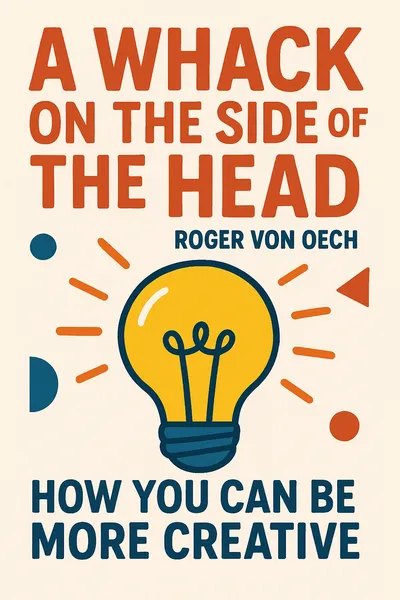
A whack on the side of the head
Breaking the rules that cage us
Description
Creativity brings joy, profitability, necessity, and possibility when we're willing to think differently. Fundamentally, creative thinking means going past what worked before to generate new solutions.
We block our creativity by always being practical, rule-following, mistake-avoidant, and closed off to outside inspiration. To get our creative juices really flowing, we sometimes need a metaphorical knock upside the head. This shock can lead us to profitable, original, and innovative ideas that bring enjoyment.
When we think creatively without limits, we can find thrilling new business solutions.
Table of contents
01 Solitary response
Our minds are naturally equipped with a filtering capacity that allows us to focus on a single voice in a noisy room, demonstrating our ability to find what we seek. Formal education teaches us important concepts and research skills, but it also conditions us to stop looking once we find a single correct answer. This approach works for mathematics, which has clear-cut solutions, but life often requires us to choose between multiple "correct" options. If we stop at the first answer, we may miss better alternatives.
Flexibility is crucial in the real world. Always opting for the first solution can lead to missed opportunities. The more options we have, the better our decisions can be. Often, the next correct answer is the key to a creative solution. To encourage multiple correct answers, we can rephrase the question to guide our thinking in different directions. We should look for multiple solutions, expecting many answers and persisting until we find them. We should also be open to unusual or unconventional ideas.

02 Not reasonable hence unhelpful
The process of generating new ideas involves two primary stages. The first is the imaginative phase, where ideas are freely generated and explored without any restrictions or rules. This phase encourages breaking the norms and examining problems from various perspectives, allowing for the intermingling of ideas from different fields. The second phase is the practical one, where ideas are scrutinized and implemented. This phase focuses on meeting deadlines and achieving tangible results. Both phases are crucial and have their unique strengths and weaknesses. They are suitable at different stages of any project. Limiting the imaginative phase to logical and established ideas only results in known solutions. Conversely, introducing ambiguity into the practical phase leads to impractical outcomes.
Society, particularly the education system, tends to favor logical thinking, often discouraging non-logical or creative thinking. Metaphors serve as an effective tool to stimulate creative thinking. They help us understand a concept by comparing it to another, examining their similarities or differences. Metaphors are essentially mental maps that simplify complex processes or ideas, providing a fresh perspective on both familiar and unfamiliar concepts. They are particularly useful in the creative thinking process. When you attempt to create a metaphor for a challenge, you start to devise innovative ways to approach the goal. This process brings the benefits of an unrelated discipline to the problem at hand, leading to the generation of the most useful creative ideas.
03 Abide by community guidelines
The human mind is adept at recognizing patterns, which often guide our lifestyles. However, original thinking often requires us to look beyond these patterns. Many advancements in human civilization have come from individuals willing to challenge the status quo and seek innovative solutions. Creative thinkers often defy established norms, understanding that solutions to problems are not fixed but negotiable.
Societal pressure often encourages conformity, which can limit creative thinking. Breaking the rules doesn't necessarily mean doing something illegal or unethical, but rather challenging unwritten social norms and practices. This approach may not always work, but it's often worth trying.
04 Be practical
Imagination and creativity are uniquely human traits that have led to groundbreaking innovations. By thinking beyond reality, we can envision ideas and solutions that would otherwise seem impossible. This ability allows visionaries, inventors, and pioneers to make revolutionary breakthroughs.
To stimulate creativity, we can ask ourselves hypothetical "what if" questions. These questions encourage us to suspend disbelief and logical constraints, opening up new avenues of possibility. For instance, we could ask: What if the laws of physics didn't apply? What if a famous historical figure faced this problem? These scenarios, while fanciful, allow for radical new connections and ideas to form.
Another tactic is to use imaginative "stepping stones"—impractical ideas that can lead to more viable solutions. For example, an engineer might imagine an impractical new machine, but in analyzing why it wouldn't work, they gain key insights leading to a feasible design.
05 Fun is trivial and time consuming
Playfulness and humor are key ingredients for unlocking creativity in any setting. When people feel free to experiment and fail without fear of consequences, their minds open up to explore ideas more freely. Practical creativity often emerges from first playing around with concepts in a fun, failure-safe environment. Later, the most promising ideas can be evaluated for real-world applications.
Many breakthrough innovations and inventions trace their origins back to play. For example, computer architects frequently cite play as central to their creative process for designing new hardware and software. It is often only after a period of playful experimentation that the practical upsides of early ideas become clear. The takeaway for any organization is straightforward: maximize creativity by cultivating an atmosphere of fun and humor. The increased productivity will outweigh any tradeoffs.
06 Outside my expertise
Specialization is an integral part of the modern world. Without intense focus in specific areas, it would be impossible to achieve the depth of knowledge required to make meaningful advances. However, while specialization enables expertise, it can also lead to narrow perspectives that hinder creativity. The most innovative ideas often emerge not from digging deeper into one field, but from crossing boundaries between fields and transplanting successful concepts from one area into another. The key is maintaining an exploratory mindset that activey seeks out new ideas to bring back to your specialty. History shows that groundbreaking innovations frequently come from people with interdisciplinary exposure who make connections that specialists might miss.
So how can you spur creative thinking by building bridges between different realms of knowledge? Here are some suggestions:
Immerse yourself in fiction and novels. Imaginative works excite new neural pathways that lend themselves to innovation. Study the strategies of consistently high-performing sports teams and unsuccessful ones. What principles can you extract about motivation, collaboration, leadership, and perseverance under pressure? Examine natural phenomena and the cosmos. How does nature solve problems, and how might those solutions translate to your field? Delve into history for influential ideas that have shaped human events. Peruse the classified ads. What do people want to discard, and why? Does this reveal any societal shifts or untapped needs you could address?
07 Ambiguity must be avoided
Injecting ambiguity into the planning process can stimulate creativity by leaving room for imagination. The world's inherent ambiguity, when noticed and questioned, can lead to creative ideas.
While ambiguity often leads to communication issues and is generally avoided, it can, in creative contexts, provide a space for imagination to thrive in ways detailed instructions cannot. For instance, ambiguous directions can lead to creative solutions unforeseen with specific instructions.
Sources of ambiguity useful for stimulating creativity include paradoxes, which challenge assumptions and encourage creative thinking. The wave-particle duality in physics is an example where resolving the paradox led to quantum mechanics breakthroughs.
08 Don't act foolishly. Follow rules.
Society exists to encourage cooperation and conformity. However, new ideas are not born from conformity. To escape groupthink, one needs the perspective of a fool unbound by societal pressures. The fool's role is to shake habitual thinking patterns. Surprisingly, the fool's perspective helps decision-makers more than yes-men. The fool suggests ideas counter to convention, stimulating fresh thinking.
Though the fool's ideas may not all be useful, they suggest new answers. The fool encourages continually seeking better solutions. So what if a fool is unavailable? You must grant yourself temporary foolishness. Try reversing your viewpoint - study the opposite result, reverse order, switch objectives, disagree with those you normally agree with. Any such action allows discovering things previously unnoticed.
09 Errors are undesirable
Society often views failure negatively, but it plays a crucial role in creativity and innovation. Success and failure are not opposites but products of the same process - effort. Failure should be seen not as an endpoint but as feedback for new approaches. When we only seek socially accepted answers, we bypass the imaginative thinking required for innovation. History shows that errors often lead to innovations. Columbus discovered America while seeking a route to India, and Edison tested over 1,800 unsuccessful filaments before finding the right one for the lightbulb.
10 I lack creativity
The concept that our thoughts shape our reality is widely recognized in various fields. In business, investors' confidence in a market can lead to its prosperity. In education, students identified as gifted often outperform their peers. In sales and athletics, those who visualize success tend to achieve superior results. This principle also applies to creativity.
Research has shown that individuals who perceive themselves as creative tend to be more creative, while those who see themselves as uncreative are less so. This suggests that self-perception plays a crucial role in unlocking creative potential. The first step to becoming more creative is to envision oneself as a creative individual. This self-fulfilling prophecy can lead to a mindset that encourages the identification and pursuit of creative insights.
Related books