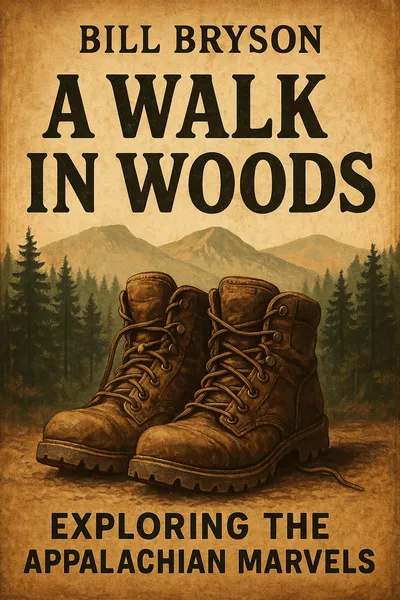
A Walk in the Woods
Exploring the Appalachian marvels
Description
Published in 1998, "A Walk in the Woods" represents Bill Bryson's ambitious attempt to reconcile contemporary American society with its wilderness heritage through the lens of personal experience. Drawing upon his expertise as a cultural observer and his journalistic background, Bryson transforms what could have been a simple hiking memoir into a broader meditation on environmental degradation, historical amnesia, and the psychological necessity of nature in modern life. The work emerges from a period of heightened environmental consciousness in the 1990s, when debates about conservation, urban sprawl, and the commodification of natural spaces dominated public discourse.
Through the metaphor of hiking the Appalachian Trail, Bryson argues that modern Americans have become dangerously disconnected from their natural environment, requiring both physical and intellectual effort to rediscover their relationship with the wilderness that shaped their national identity. The central research question driving the work is: How can modern Americans reconnect with the wilderness that fundamentally shaped their national character and identity? Bryson defends the thesis that the physical and intellectual journey through America's natural spaces reveals both the profound disconnection of contemporary society from its environmental foundations and the urgent necessity of rebuilding this relationship. The main stake is to demonstrate that environmental awareness cannot emerge from abstract knowledge alone but requires direct, embodied experience of natural spaces, even when mediated by failure and comedy.
Bryson's intellectual contribution lies in his demonstration that environmental consciousness requires embodied experience rather than abstract knowledge. His synthesis of historical analysis, ecological information, and personal narrative creates a model for environmental writing that acknowledges both human limitations and the urgent necessity of reconnecting with natural systems. The work's coherence emerges from its consistent focus on the gap between contemporary American environmental rhetoric and the reality of widespread ecological illiteracy. The argument ultimately suggests that environmental crisis stems not from lack of information but from the systematic disconnection of daily life from natural processes. Bryson's solution involves neither romantic retreat to wilderness nor technological transcendence of natural limits, but rather the difficult work of rebuilding practical knowledge of natural systems through direct experience.
Table of contents
01The Commodification of Wilderness Experience
Bryson's narrative strategy reveals a fundamental tension between authentic wilderness encounter and the commodified outdoor recreation industry. His analysis of hiking culture exposes how the very attempt to return to nature has been transformed into a consumer experience, complete with specialized equipment, guidebooks, and predetermined routes that paradoxically distance participants from genuine environmental engagement. The author's own preparation process becomes a critique of how consumer capitalism has colonized even the most basic human relationship with the natural world.

02Historical Amnesia and Environmental Degradation
The work's second analytical axis examines how contemporary Americans have systematically forgotten both the ecological richness that once characterized their landscape and the environmental destruction that has accompanied national development. Bryson's historical digressions function not as mere background information but as archaeological excavations of lost environmental knowledge. His documentation of extinct species and vanished ecosystems serves as an indictment of a society that has chosen progress over preservation.
03The Psychology of Physical Challenge
Perhaps most significantly, Bryson explores how physical challenge in natural settings functions as a necessary corrective to the psychological deformations of contemporary urban life. His portrayal of hiking's physical demands reveals exercise not as mere fitness activity but as a fundamental requirement for psychological health and environmental awareness. The body's encounter with natural terrain creates forms of knowledge unavailable through purely intellectual engagement.
04Community and Solitude in Natural Spaces
The final analytical dimension of Bryson's work examines how wilderness experience both requires and creates new forms of human community. His relationship with his hiking companion Katz illustrates how natural challenges can strengthen social bonds while simultaneously revealing the limits of urban social relationships when transplanted to wilderness settings. The trail community that emerges among hikers represents a temporary alternative to the competitive individualism that characterizes contemporary American society.
Related books