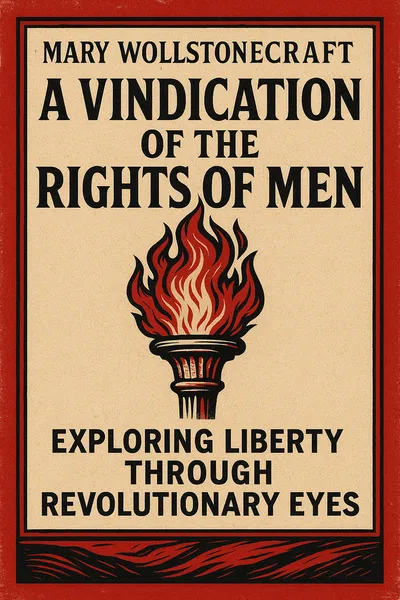
A Vindication of the Rights of Men
Exploring liberty through revolutionary eyes
Description
Mary Wollstonecraft's seminal work emerges from the intellectual ferment of revolutionary Europe, positioning itself as a direct counter-argument to Edmund Burke's conservative "Reflections on the Revolution in France." Written in 1790, this treatise represents one of the earliest and most cogent defenses of revolutionary principles from a perspective that synthesizes Enlightenment rationalism with emerging democratic ideologies. Wollstonecraft's intervention in this pivotal political debate demonstrates her sophisticated understanding of natural law theory, social contract philosophy, and the tension between tradition and progress that defined late eighteenth-century political discourse.
The central research question driving this work asks: How can natural rights theory provide a more just foundation for political authority than traditional hierarchical systems based on inherited privilege and customary law? Wollstonecraft's defended thesis argues that universal human rights, grounded in rational nature rather than social convention, offer the only legitimate basis for political organization and social justice. The main stake is to demonstrate that Burke's defense of aristocratic privilege represents a fundamental betrayal of human dignity and rational principles, while establishing natural rights as the foundation for legitimate political reform.
Wollstonecraft argues that natural rights are universal human entitlements that transcend social hierarchy, directly challenging Edmund Burke's defense of traditional aristocratic privilege and inherited authority. Her vindication of natural rights represents a sophisticated synthesis of Enlightenment political philosophy that successfully challenges Burke's conservative alternative while establishing foundations for more radical democratic possibilities. Her argument demonstrates internal coherence through its systematic application of rational principles to political questions, while maintaining practical relevance through sustained attention to concrete social and economic arrangements. The intellectual contribution of this work extends beyond its immediate polemical context to establish enduring frameworks for evaluating political legitimacy and social justice. Wollstonecraft's integration of individual rights with social responsibility anticipates later developments in democratic theory while avoiding both libertarian individualism and collectivist authoritarianism.
Table of contents
01Natural Rights versus Traditional Authority: Philosophical Foundations
Wollstonecraft constructs her argument through a systematic deconstruction of Burke's reverence for traditional institutions, revealing the philosophical contradictions inherent in defending privilege through appeals to custom and antiquity. Her analysis penetrates beyond surface political disagreements to expose fundamental epistemological differences regarding the source of legitimate authority. Where Burke locates political wisdom in accumulated tradition and inherited institutions, Wollstonecraft grounds legitimacy in universal rational principles accessible to all human beings regardless of social position.

02Economic Justice and Social Critique: Material Foundations of Equality
The economic implications of Wollstonecraft's political philosophy emerge through her sustained analysis of how traditional authority structures perpetuate material inequality and social injustice. Her critique extends beyond abstract philosophical disagreement to examine concrete ways that Burke's cherished institutions function to concentrate wealth and power among privileged classes while systematically excluding others from meaningful participation in political life.
Wollstonecraft's economic analysis reveals sophisticated understanding of how legal and political arrangements serve particular class interests rather than universal human welfare. Her examination of property relations, inheritance laws, and commercial privileges demonstrates how supposedly neutral institutional arrangements actually embed specific power relationships that benefit established elites. This materialist dimension of her critique anticipates later socialist analyses while remaining grounded in liberal natural rights theory.
03Reason, Emotion, and Political Discourse: The Battle of Ideas
Wollstonecraft's engagement with Burke's rhetorical strategy reveals deeper tensions within Enlightenment thought regarding the relationship between rational argument and emotional persuasion in political discourse. Burke's appeal to sentiment, tradition, and aesthetic beauty represents more than mere stylistic choice; it embodies a comprehensive alternative to rationalist approaches to political questions that threatens to undermine the entire Enlightenment project.
04Individual Liberty and Social Transformation: The Revolutionary Vision
The transformative potential of Wollstonecraft's political vision emerges through her analysis of how natural rights principles might reshape social relationships beyond the formal political sphere. Her critique of Burke's organic social metaphors reveals how apparently natural social arrangements actually represent contingent historical developments that can be consciously reformed through human agency guided by rational principles.
This emphasis on human perfectibility through education and institutional reform places Wollstonecraft within the optimistic strand of Enlightenment thought that emphasizes progressive social development. Her vision extends beyond negative liberty—freedom from external constraint—to encompass positive liberty involving the cultivation of human rational and moral capacities through appropriate social conditions.
05Critical Assessment and Contemporary Relevance
Despite its significant achievements, Wollstonecraft's analysis exhibits certain limitations that reflect both the historical constraints of her period and theoretical tensions within her philosophical framework. Her reliance upon natural law theory, while strategically effective against Burke's traditionalism, raises unresolved questions about the source and content of universal moral principles that continue to challenge political philosophers.
The work's focus on formal political arrangements tends to underestimate the persistence of informal power structures that may survive institutional reform, particularly those rooted in cultural and social practices rather than legal frameworks. Additionally, while Wollstonecraft gestures toward the economic dimensions of political freedom, she does not fully develop the analysis of capitalism that would become central to later radical critiques.
Related books