
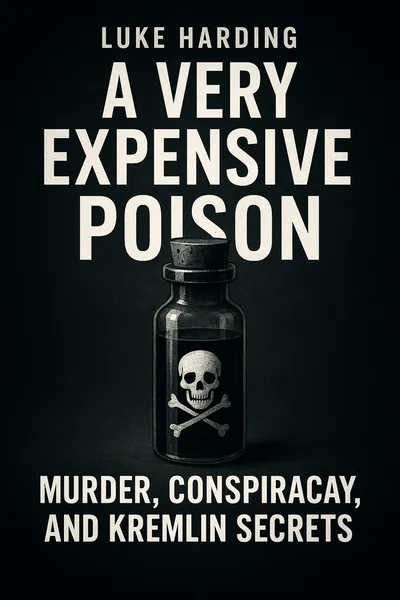
A Very Expensive Poison
Murder, conspiracy, and Kremlin secrets
Description
Luke Harding's 'A Very Expensive Poison' presents a paradigmatic case of state-sponsored terrorism that reveals the systematic weaponization of poison as a tool of political control and international intimidation by the Putin regime. Drawing upon extensive journalistic experience and access to intelligence sources, the author reconstructs the complex web surrounding the Litvinenko affair, positioning this case study within broader patterns of authoritarian statecraft. The work operates at the intersection of investigative journalism and political analysis, offering insights into contemporary mechanisms of state violence and international relations.
The central research question explores how the Litvinenko assassination illuminates the operational methods and strategic objectives of Putin's regime in eliminating political dissidents. The defended thesis demonstrates that the poisoning represents a calculated demonstration of state power that transcends individual elimination to constitute systematic intimidation. The main stake involves revealing the transformation of assassination into a normalized instrument of contemporary Russian foreign policy.
Harding constructs a compelling argument demonstrating how the Litvinenko assassination represents a watershed moment in contemporary international relations, marking the emergence of assassination as normalized instrument of state policy. The work successfully integrates individual case study with broader analysis of authoritarian evolution, revealing systematic patterns underlying apparent isolated incidents. The investigation's strength lies in its demonstration of connections between tactical innovations and strategic objectives, showing how method serves message in contemporary political violence. The author's synthesis reveals the profound implications of allowing such operations to proceed without decisive response, suggesting that tolerance of state-sponsored assassination constitutes tacit acceptance of authoritarian norm erosion.
Table of contents
01 The Theater of State Violence: Instrumentalization of Terror
Harding's analysis reveals the sophisticated integration of murder into statecraft, demonstrating how the Putin administration has elevated assassination from clandestine operation to semi-public spectacle. The polonium poisoning emerges not merely as elimination technique but as carefully orchestrated theater designed to maximize psychological impact. This theatrical dimension transforms individual murder into collective intimidation, creating what the author conceptualizes as a culture of fear extending far beyond immediate targets.

02 Global Networks of Authoritarian Violence
The investigation exposes the sophisticated infrastructure supporting state-sponsored assassination, revealing extensive networks spanning multiple jurisdictions and institutional domains. Harding demonstrates how the Litvinenko case illuminates the erosion of traditional diplomatic boundaries, as intelligence operations increasingly penetrate supposedly sovereign spaces. The work reveals the systematic cultivation of criminal networks, corrupt officials, and compromised institutions necessary to execute such operations.
03 Disinformation and the Weaponization of Doubt
Harding's work examines the sophisticated disinformation apparatus deployed to obscure responsibility and muddy investigative waters. The analysis reveals how contemporary authoritarian regimes have perfected the art of plausible deniability, creating multiple competing narratives that fragment public understanding and political response. This represents an evolution beyond traditional propaganda toward what might be termed 'epistemic warfare' targeting the very foundations of truth and evidence.
04 Democratic Institutions Under Assault
The investigation exposes fundamental weaknesses in democratic societies' capacity to respond effectively to novel forms of state terrorism. Harding's analysis reveals how legal frameworks designed for conventional interstate relations prove inadequate when confronting regimes that systematically blur boundaries between diplomacy and criminality. The work demonstrates how democratic institutions' commitment to procedural justice can be exploited by actors operating according to entirely different normative frameworks.
05 Critical Assessment and Future Implications
While Harding's investigative work provides invaluable documentation of authoritarian methods, the analysis occasionally suffers from excessive focus on individual personalities at the expense of systematic institutional analysis. The work's journalistic origins sometimes prioritize narrative drama over theoretical sophistication, potentially limiting its contribution to academic understanding of contemporary authoritarianism. Additionally, the analysis could benefit from greater comparative perspective, situating Russian practices within broader patterns of authoritarian innovation.
Related books