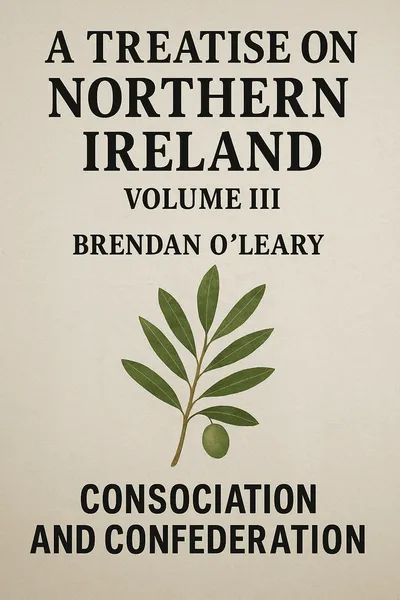
A Treatise on Northern Ireland, Volume III
Institutions that end division
Description
This third volume of O'Leary's comprehensive treatise represents a mature synthesis of decades researching Northern Ireland's political evolution. The author, drawing upon his established expertise in comparative politics and constitutional design, presents an ambitious theoretical framework for understanding how deeply divided societies can achieve sustainable peace through institutional innovation. The work emerges from contemporary scholarly debates about consociational democracy's viability and the transferability of the Northern Ireland experience to other conflict zones.
The central research question examines how institutional arrangements can transform ethnic conflict from zero-sum competition into cooperative governance. O'Leary's defended thesis argues that Northern Ireland's constitutional settlement demonstrates that consociational democracy, when properly implemented, can successfully regulate ethnic conflict and establish legitimate shared governance. The main stake involves validating institutional engineering as a viable path toward sustainable peace in divided societies globally.
O'Leary constructs a compelling case for institutional engineering as a viable approach to conflict transformation. His analysis demonstrates how carefully designed constitutional arrangements can create stable foundations for democratic governance in divided societies. The Northern Ireland experience, as interpreted through O'Leary's framework, validates the potential for creative institutional solutions to apparently intractable conflicts. The intellectual contribution lies not merely in documenting Northern Ireland's success but in developing theoretical frameworks that can inform similar efforts elsewhere. O'Leary's sophisticated analysis of the relationship between institutional design and political behavior provides valuable insights for comparative political science and practical peacebuilding efforts.
Table of contents
01 Consociational Architecture and Democratic Innovation
O'Leary's theoretical foundation rests upon a sophisticated reinterpretation of consociational democracy that transcends Lijphart's original formulation. The author demonstrates how Northern Ireland's institutional architecture represents an evolutionary advance in power-sharing design, incorporating elements of territorial autonomy, proportionality mechanisms, and mutual veto rights within a broader framework of democratic accountability. This analysis reveals how traditional consociational theory required adaptation to accommodate the complex realities of a society emerging from prolonged violent conflict.

02 Territorial Dimensions and Constitutional Flexibility
The territorial aspects of Northern Ireland's settlement receive sophisticated treatment as O'Leary examines how constitutional arrangements accommodate competing national aspirations without requiring definitive resolution of sovereignty questions. This analysis reveals how institutional creativity can defer potentially intractable issues while establishing functional governance mechanisms that serve immediate citizen needs.
O'Leary's examination of the North-South and East-West institutional dimensions demonstrates how constitutional ambiguity, rather than representing weakness, constitutes a strategic resource for managing competing loyalties. The author shows how these arrangements allow different communities to maintain their preferred constitutional interpretations while participating in shared institutions. This analysis challenges conventional assumptions about the necessity of clear sovereignty arrangements for effective governance.
03 Identity Politics and Institutional Transformation
O'Leary's analysis of identity transformation reveals the complex relationship between institutional arrangements and communal boundaries. Rather than simply managing existing ethnic divisions, the author demonstrates how institutional innovation can gradually reshape the political salience of ethnic identities without requiring their abandonment. This process involves creating new forms of political identification that transcend traditional ethnic categories while respecting their continued significance for participants.
04 International Dimensions and Normative Implications
The international context emerges as fundamental to understanding Northern Ireland's transformation. O'Leary's analysis reveals how external actors, particularly the European Union, British and Irish governments, and international mediators, created essential conditions for successful institutional innovation. This examination demonstrates how domestic constitutional arrangements require supportive international frameworks to achieve sustainability.
The normative implications extend beyond Northern Ireland's specific circumstances to broader questions about democratic theory and practice. O'Leary's work challenges liberal democratic assumptions about majority rule and individual rights by demonstrating how group-based arrangements can enhance rather than undermine democratic legitimacy. This analysis contributes to evolving debates about multiculturalism, minority rights, and democratic inclusion in diverse societies.
05 Critical Assessment and Future Directions
Despite its theoretical sophistication, O'Leary's analysis exhibits certain limitations. The emphasis on institutional solutions may underestimate the role of broader social and economic transformations in Northern Ireland's evolution. The decline of industrial employment, demographic changes, and generational replacement arguably contributed as much to conflict transformation as formal institutional arrangements.
Additionally, the transferability of lessons to other contexts remains questionable given Northern Ireland's unique characteristics: developed democratic institutions, rule of law, and proximity to supportive international frameworks. The author's optimism about institutional engineering may not account adequately for contexts lacking these favorable conditions.
Related books