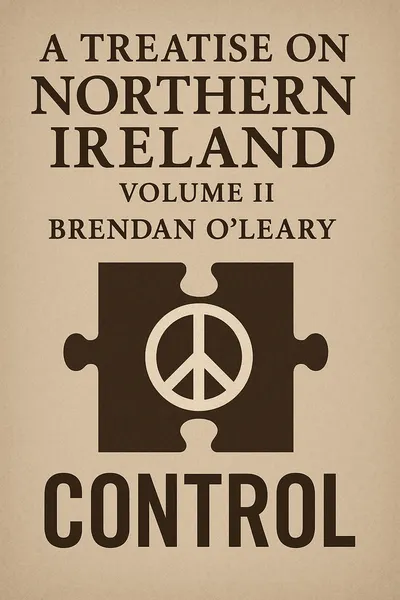
A Treatise on Northern Ireland, Volume II
Power-sharing as conflict resolution
Description
O'Leary's treatise emerges from decades of scholarly engagement with Northern Ireland's constitutional evolution, positioning itself as a comprehensive analysis of post-Agreement governance structures. The work synthesizes extensive empirical research with sophisticated theoretical frameworks, examining how institutional design can mediate deeply entrenched communal conflicts. This volume represents the culmination of O'Leary's longstanding intellectual project to understand how democratic innovations can stabilize divided societies while preserving their complex identities.
The central research question focuses on how the institutional arrangements established by the Belfast Agreement function to manage ethno-national divisions while maintaining democratic legitimacy. O'Leary defends the thesis that the Belfast Agreement creates a unique form of consociational democracy that ingeniously balances competing national aspirations through sophisticated power-sharing mechanisms. The main stake involves demonstrating that constitutional engineering can successfully transform intractable ethnic conflicts into manageable political competitions.
O'Leary's treatise establishes the Belfast Agreement as a paradigmatic example of successful constitutional engineering in deeply divided societies. The work demonstrates how sophisticated institutional design can transform seemingly intractable conflicts into manageable political competitions while preserving democratic principles and community identities. The Agreement's innovations in power-sharing, territorial arrangements, and legitimacy mechanisms offer transferable lessons for other divided societies seeking democratic solutions to ethnic conflicts.
The analysis reveals how the Agreement's success stems from its comprehensive approach, addressing simultaneously institutional, territorial, and symbolic dimensions of division. This multifaceted strategy creates mutually reinforcing mechanisms that encourage moderation, cooperation, and democratic participation across ethnic boundaries. O'Leary's examination illuminates how constitutional creativity can transcend traditional limitations of democratic theory and practice.
Table of contents
01 Constitutional Architecture and Democratic Innovation
O'Leary's analysis reveals the Belfast Agreement as a masterpiece of institutional creativity, transcending conventional models of democratic governance. The work demonstrates how the Agreement's architects crafted mechanisms that simultaneously accommodate unionist desires for union maintenance and nationalist aspirations for Irish unity. This constitutional architecture operates through what O'Leary conceptualizes as "double protection" - safeguarding both communities' fundamental interests while creating space for democratic competition.

02 Power-Sharing Dynamics and Political Transformation
The examination of power-sharing mechanisms reveals how institutional constraints can reshape political behavior and elite incentives. O'Leary demonstrates that the Agreement's requirements for cross-community support fundamentally altered the logic of political competition, encouraging moderation and coalition-building across ethnic boundaries. This transformation extends beyond mere elite accommodation to encompass broader changes in political discourse and civic engagement.
03 Territorial Pluralism and Sovereignty Reimagined
O'Leary's treatment of territorial arrangements reveals the Agreement's radical reimagining of sovereignty concepts. The work demonstrates how the principle of consent operates alongside recognition of Irish national identity, creating what the author characterizes as "nested sovereignty." This configuration allows Northern Ireland to remain within the United Kingdom while acknowledging its Irish dimensions and maintaining institutional connections to the Republic of Ireland.
04 Democratic Legitimacy and Community Recognition
The exploration of legitimacy mechanisms reveals how the Agreement addresses competing claims to democratic authority. O'Leary demonstrates that the parallel consent requirements - from both Northern Ireland and Republic of Ireland populations - create dual sources of democratic validation. This arrangement acknowledges the contested nature of Northern Ireland's status while providing clear procedures for potential constitutional change.
05 Critical Analysis and Future Implications
O'Leary's analysis, while comprehensive, exhibits certain theoretical limitations that merit consideration. The work's strong emphasis on institutional success may underestimate persistent social divisions and economic inequalities that continue to influence political behavior. The author's optimistic assessment of consociational mechanisms sometimes overlooks their potential for institutionalizing ethnic boundaries rather than transcending them. Additionally, the focus on elite-level arrangements may insufficient address grassroots dynamics and popular attitudes that ultimately determine institutional sustainability.
The work's theoretical framework, while sophisticated, relies heavily on formal institutional analysis that may miss informal practices and unintended consequences of the Agreement's implementation. O'Leary's emphasis on constitutional engineering success may also underplay ongoing challenges related to paramilitary activity, segregation, and intergenerational trauma that continue to affect Northern Ireland's political landscape.
Related books