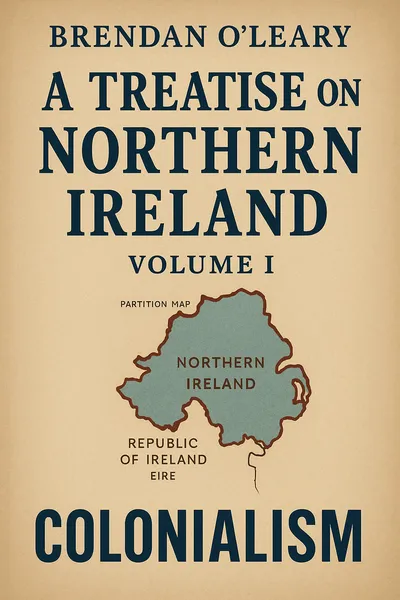
A Treatise on Northern Ireland, Volume I
Power-sharing beyond the impasse
Description
O'Leary's treatise emerges as a monumental scholarly endeavor addressing one of Europe's most enduring constitutional puzzles. Drawing upon decades of academic expertise in comparative constitutional design, the author presents a comprehensive analysis of Northern Ireland's unique political architecture. This work situates itself within broader debates concerning post-conflict governance, consociational democracy, and territorial management in ethnically divided societies, offering both historical perspective and contemporary relevance.
The central research question asks: How do complex constitutional arrangements manage ethno-national divisions while maintaining democratic legitimacy and institutional stability? O'Leary defends the thesis that Northern Ireland's institutional framework represents an innovative model of shared sovereignty that successfully accommodates competing national identities through sophisticated power-sharing mechanisms. The main stake involves demonstrating that constitutional creativity can transcend zero-sum ethno-national conflicts and establish sustainable democratic governance in deeply divided societies.
Northern Ireland's constitutional settlement represents a sophisticated experiment in managing ethno-national division through innovative institutional arrangements that transcend traditional sovereignty paradigms. O'Leary's analysis presents Northern Ireland as a laboratory for constitutional innovation in managing ethno-national division. The work demonstrates how creative institutional design can transcend zero-sum thinking about sovereignty and territory, establishing governance arrangements that accommodate competing identities while maintaining democratic legitimacy and effective administration. The analysis reveals how Northern Ireland's complex constitutional architecture offers insights applicable to other divided societies confronting similar challenges of managing difference while maintaining unity.
Table of contents
01 Constitutional Innovation and Sovereignty Redefinition
O'Leary's analysis reveals how Northern Ireland challenges conventional understandings of sovereignty and statehood. The author demonstrates that traditional Westphalian concepts prove inadequate when confronting societies characterized by competing national allegiances. Through examining the Good Friday Agreement's architectural complexity, O'Leary illuminates how constitutional designers crafted mechanisms enabling simultaneous British and Irish identities within a single territorial framework.

02 Consociational Democracy and Power-Sharing Dynamics
The examination of power-sharing arrangements exposes the sophisticated mechanisms designed to ensure cross-community representation and consensus-building. O'Leary analyzes how consociational principles translate into practical governance structures, revealing both the potential and limitations of institutionalized cooperation between former adversaries.
03 Identity Politics and Constitutional Accommodation
O'Leary's treatment of identity politics reveals how constitutional arrangements can accommodate competing national narratives without requiring their resolution or synthesis. The analysis demonstrates how institutional design can create space for multiple identity expressions while maintaining territorial integrity and democratic legitimacy.
04 International Dimensions and External Governance
The analysis extends beyond domestic arrangements to examine how international actors and institutions shape Northern Ireland's constitutional evolution. O'Leary demonstrates how British-Irish intergovernmental cooperation, European Union membership, and broader international involvement create external constraints and opportunities that influence internal political dynamics.
05 Critical Assessment and Future Implications
Despite its analytical sophistication, O'Leary's analysis exhibits certain limitations that warrant consideration. The work's emphasis on institutional design potentially understates the role of broader social and economic factors in enabling accommodation. The analysis might benefit from greater attention to how material conditions, demographic changes, and generational shifts influence the operation of constitutional arrangements beyond their formal design features.
Additionally, the treatise's focus on elite-level institutional arrangements could be enhanced by more extensive consideration of how these mechanisms translate into everyday political practice and citizen experience. The gap between constitutional theory and political reality deserves more sustained attention.
Related books