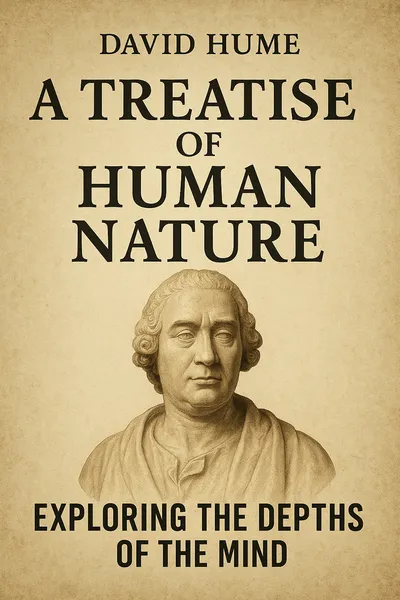
A Treatise of Human Nature
Exploring the depths of the mind
Description
Hume's monumental work emerges within the broader context of Enlightenment empiricism, representing a radical departure from scholastic and rationalist traditions. The philosopher's expertise in moral philosophy and epistemology converges in this comprehensive examination of human cognitive mechanisms. Written during a period of intense intellectual ferment, the Treatise challenges established philosophical orthodoxies by proposing an observational science of human nature as the foundation for all philosophical inquiry.
The central research question driving Hume's investigation is: How do human beings form fundamental concepts and beliefs about reality through experience alone? His defended thesis maintains that human knowledge consists entirely of impressions and ideas derived from sensory experience, with reason serving merely as a servant to the passions. The main stake of this argument is to demonstrate that traditional philosophical certainties about causation, identity, and existence are unfounded constructions of human psychology rather than objective truths.
Hume's systematic deconstruction of fundamental philosophical concepts creates a comprehensive skeptical worldview grounded in empirical psychology. His analysis reveals knowledge, identity, causation, and morality as human constructions rather than objective realities, transforming philosophy from metaphysical speculation into descriptive science of human nature. The work's intellectual coherence emerges through consistent application of empirical methodology to philosophical problems, generating revolutionary insights about the limitations and mechanisms of human cognition.
Table of contents
01 The Dissolution of Causal Necessity
Hume's revolutionary analysis of causation dismantles centuries of philosophical assumption about necessary connections between events. His empirical investigation reveals that causal relationships, rather than representing logical necessities, emerge from psychological habits formed through repeated observation of temporal succession. This deconstruction operates through meticulous examination of how humans construct causal beliefs without ever directly perceiving causal power itself.

02 The Fragmentation of Personal Identity
The examination of personal identity reveals another profound disruption of common philosophical assumptions. Hume's introspective method uncovers no substantial self persisting through time, only a succession of perceptions connected through memory and association. This dissolution of personal identity challenges both philosophical and religious conceptions of the soul, reducing human selfhood to a bundle of experiences without underlying substance.
03 The Problem of External World
Hume's treatment of external existence exposes the precarious foundations of belief in an independent material world. His analysis demonstrates that immediate experience provides access only to perceptions, never to objects themselves, creating an unbridgeable gap between consciousness and purported external reality. This skeptical insight reveals the unfounded nature of assumptions about material substance and independent existence.
04 The Primacy of Passion over Reason
Hume's famous assertion that reason serves as slave to the passions represents perhaps his most provocative challenge to philosophical orthodoxy. His psychological analysis reveals that rational deliberation cannot independently motivate action, requiring emotional engagement to generate behavioral consequences. This inversion of traditional hierarchies places sentiment at the center of human decision-making while reducing reason to instrumental calculation.
05 Critical Assessment and Contemporary Relevance
Hume's radical skepticism, while philosophically rigorous, generates practical contradictions between theoretical conclusions and lived experience. His dissolution of causation and identity creates philosophical problems that his naturalistic psychology cannot fully resolve. The work's emphasis on habit and custom as explanatory mechanisms sometimes appears circular, using psychological concepts that themselves require philosophical justification.
Related books