

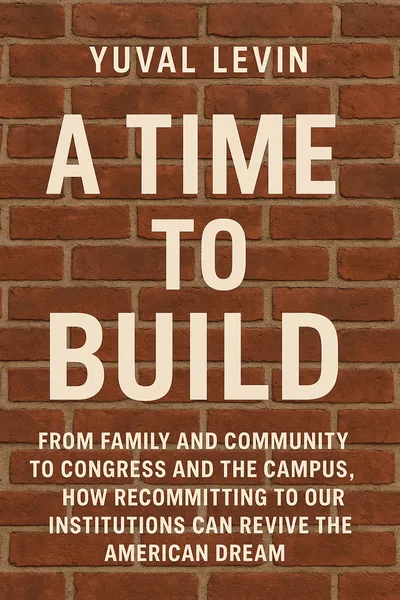
A Time to Build
Platforms eroding molds for character
Description
"A Time to Build" by Yuval Levin addresses one of contemporary America's most pressing pathologies: the systematic erosion of institutional authority and effectiveness. Writing against the backdrop of deepening social fragmentation and declining public trust, Levin diagnoses a fundamental shift in how Americans relate to their institutions. Rather than viewing them as formative spaces that shape character and channel collective action, citizens increasingly treat institutions as mere platforms for self-expression and personal advancement. This transformation, Levin argues, lies at the heart of American democratic dysfunction.
The central research question driving Levin's analysis is: Why have American institutions lost their capacity to generate social trust and political legitimacy? His defended thesis posits that the crisis stems from a cultural shift where institutions function as platforms rather than molds, undermining their formative and mediating roles. The main stake of this argument is restoring institutional authority through renewed understanding of their character-forming function and social purpose.
American society suffers from a crisis of institutional degradation where citizens and leaders alike treat institutions as platforms for personal advancement rather than molds for character formation and collective purpose. This fundamental shift has profound implications for democratic legitimacy, social cohesion, and moral formation in American society.
Table of contents
01The Platform-Mold Dialectic
Levin's fundamental contribution lies in his conceptual distinction between institutions as platforms versus molds. This binary captures a profound anthropological shift in American culture. The platform model treats institutions instrumentally—as neutral spaces for individual expression and advancement. Universities become venues for ideological performance, corporations serve primarily as profit-maximizing entities divorced from broader social responsibility, and political offices transform into stages for personal branding.

02Democratic Legitimacy and Institutional Mediation
Levin's analysis extends beyond cultural observation to examine political consequences. Democratic legitimacy depends on institutions capable of aggregating diverse interests into coherent policy directions. When institutions function primarily as platforms, they amplify rather than moderate social divisions. Political parties become ideological echo chambers, media organizations prioritize audience engagement over informational accuracy, and legislative bodies transform into theaters for performative conflict.
03Elite Responsibility and Institutional Stewardship
A particularly incisive dimension of Levin's argument concerns elite behavior within degraded institutions. Rather than serving as institutional stewards committed to preserving and strengthening organizational capacity, contemporary elites increasingly exploit institutional positions for personal advancement. This phenomenon spans political, economic, and cultural spheres.
Political leaders prioritize media visibility over legislative effectiveness, corporate executives focus on short-term stock performance rather than long-term institutional health, and academic administrators emphasize rankings and fundraising over educational mission. This elite comportment reflects and reinforces the platform mentality, treating institutional leadership as an opportunity for self-promotion rather than service to institutional purpose.
04Moral Formation and Social Solidarity
The deepest implications of Levin's thesis concern moral formation and social cohesion. Institutions traditionally served as schools of virtue, teaching individuals to subordinate immediate desires to longer-term collective goods. Professional associations, religious communities, civic organizations, and families all provided moral education through sustained engagement and shared responsibility.
05Critical Assessment and Future Directions
Levin constructs a compelling diagnosis of American institutional crisis, demonstrating how the platform-mold distinction illuminates seemingly disparate social problems. His argument successfully connects individual behavior, elite incentives, and systemic dysfunction within a coherent theoretical framework. The work's strength lies in its ability to explain institutional failure without resorting to partisan blame or nostalgic romanticism.
The analysis reveals institutional health as foundational to democratic functionality and social cohesion. By treating institutions as mere tools rather than formative communities, Americans have undermined the very foundations of pluralistic democracy. Levin's framework provides conceptual clarity for understanding how seemingly technical institutional problems reflect deeper cultural and anthropological transformations.