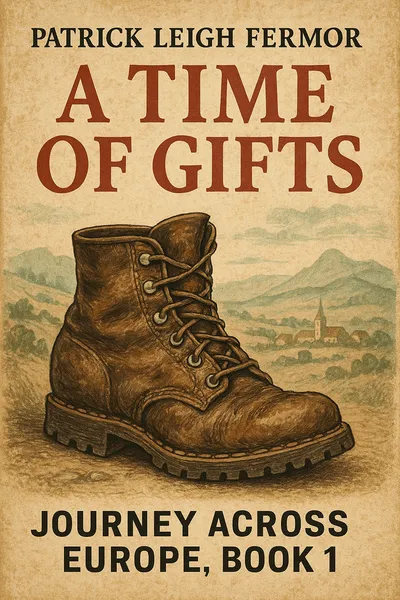
A Time of Gifts
Journey Across Europe, Book 1
Description
"A Time of Gifts" posits that authentic cultural understanding emerges through immersive pedestrian engagement with diverse European communities, revealing the fundamental interconnectedness of seemingly disparate civilizations on the eve of their irrevocable transformation. Fermor's narrative chronicles his ambitious pedestrian journey from the Hook of Holland to Constantinople, undertaken in 1933-1935 as an eighteen-year-old seeking cultural enlightenment. This autobiographical account, reconstructed decades later, captures a pivotal moment in European history when traditional social structures remained intact yet modernity's transformative forces were gathering momentum. The work transcends conventional travel literature by positioning the author's wandering as both personal bildungsroman and ethnographic documentation of a continent poised for unprecedented change.
The central research question explores how intimate pedestrian engagement with diverse European communities reveals the underlying cultural continuities that transcend national boundaries. The defended thesis demonstrates that authentic cross-cultural understanding requires immersive participation in local customs and sustained dialogue with inhabitants across social strata, with the main stake being the demonstration that meaningful cultural exchange occurs through vulnerability, curiosity, and rejection of tourist superficiality.
Fermor's intellectual achievement lies in demonstrating how individual cultural curiosity can generate profound cross-cultural understanding while simultaneously documenting broader historical processes. His walking methodology reveals Europe's fundamental cultural interconnectedness beneath apparent national divisions, challenging essentialist conceptions of cultural identity. The narrative successfully argues that authentic cultural engagement requires temporal investment, linguistic effort, and genuine vulnerability to foreign customs and perspectives. The work's lasting contribution emerges through its demonstration that cultural authenticity exists not in preserved traditions but in dynamic processes of exchange and adaptation.
Table of contents
01The Phenomenology of Pedestrian Discovery
Fermor's methodological approach fundamentally challenges conventional anthropological observation by positioning the walking body as the primary instrument of cultural investigation. His pedestrian methodology creates conditions for serendipitous encounters that would remain inaccessible through mechanized travel. The author's deliberate vulnerability—traversing unknown territories with minimal resources—generates reciprocal relationships with encountered communities who respond to his genuine curiosity rather than touristic consumption.

02Aristocratic Hospitality and Social Stratification
The narrative's extensive engagement with Central European aristocracy illuminates complex social dynamics governing interwar European civilization. Fermor's reception in Hungarian and Austrian castles reveals aristocratic culture's paradoxical position—simultaneously anachronistic and culturally vital. These encounters expose how aristocratic hospitality functions as both genuine warmth and social performance, maintaining traditional hierarchies while accommodating democratic sensibilities.
03Linguistic Plurality and Cultural Permeability
Fermor's polyglot capabilities enable profound insights into European linguistic diversity's role in cultural formation. His engagement with German, Hungarian, Romanian, and other languages reveals how linguistic boundaries create both barriers and bridges between communities. The narrative demonstrates how language acquisition functions as cultural initiation, enabling access to worldviews otherwise remaining opaque to monolingual observers.
04Temporal Consciousness and Historical Rupture
The retrospective nature of Fermor's narrative creates profound temporal complexity, as the author's mature perspective confronts his youthful observations with knowledge of subsequent historical catastrophes. This temporal layering generates acute awareness of the 1933-1935 period as a liminal moment when traditional European civilization remained intact yet harbored seeds of its own destruction.
05Critical Analysis and Contemporary Relevance
Despite its considerable achievements, Fermor's narrative suffers from significant representational limitations reflecting his privileged social position and gender. His primary access to aristocratic circles, while providing unique insights, potentially distorts broader social understanding by overemphasizing elite perspectives. The narrative's masculine adventure framework may obscure alternative modes of cultural engagement while romanticizing bohemian wandering unavailable to most travelers.
Additionally, Fermor's retrospective reconstruction raises questions about memory's reliability and the extent to which mature reflection transforms youthful experience. The temporal gap between experience and narration creates interpretive ambiguities that may compromise ethnographic accuracy while enhancing literary appeal.
Related books