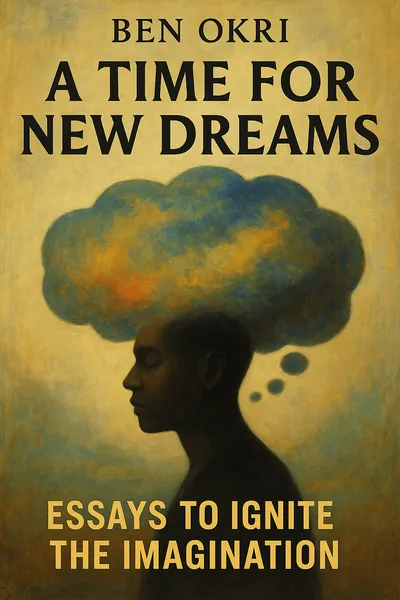
A Time for New Dreams
Essays to ignite the imagination
Description
Ben Okri's "A Time for New Dreams" emerges from the contemporary landscape of cultural criticism, positioning itself as a meditation on artistic responsibility and social transformation. The collection reflects Okri's established expertise in bridging African philosophical traditions with European literary forms, addressing urgent questions about creativity's role in political discourse. Written during a period of global upheaval, the essays engage with fundamental questions about art's capacity to generate new forms of consciousness and social understanding.
The central research question of the work asks: How can contemplative thinking and artistic imagination generate transformative responses to contemporary social and political crises? Okri defends the thesis that dreams and reflective consciousness constitute fundamental tools for cultural regeneration and political renewal in an increasingly fragmented world. The main stake of his argument is demonstrating that artistic contemplation offers pathways beyond conventional political discourse toward more profound forms of social transformation.
"A Time for New Dreams" presents a coherent vision of contemplative consciousness as the foundation for cultural and political transformation. Okri's argument demonstrates remarkable consistency in its commitment to privileging reflective awareness over ideological commitment while maintaining engagement with urgent political questions. The collection's intellectual contribution lies in its demonstration that artistic and contemplative practices offer resources for social transformation that exceed the limitations of conventional political discourse. The work's coherence emerges through Okri's sustained exploration of how individual contemplative practice connects to collective cultural transformation, revealing how seemingly private activities like reading, reflection, and artistic creation participate in broader processes of social change through their capacity to alter perceptual frameworks and imaginative possibilities.
Table of contents
01The Architecture of Contemplative Consciousness
Okri constructs a theoretical framework that privileges contemplative thinking as a radical departure from instrumental rationality. His conception of contemplation transcends mere introspection, positioning it as an active engagement with cultural forces that shape collective consciousness. The author draws upon phenomenological traditions while incorporating African philosophical concepts of consciousness that emphasize interconnectedness between individual reflection and communal transformation.

02Cultural Politics and Aesthetic Resistance
The collection's engagement with censorship and artistic freedom reveals deeper tensions between creative expression and political control. Okri examines how aesthetic practices function as forms of political resistance, arguing that art's transformative power lies not in direct political messaging but in its capacity to alter perceptual frameworks. His analysis demonstrates how censorship operates not merely through prohibition but through the subtle management of imaginative possibilities.
03Childhood, Memory, and Cultural Transmission
Okri's treatment of childhood transcends nostalgic reminiscence, presenting childhood consciousness as a model for cultural renewal. His analysis reveals how adult consciousness often loses access to the imaginative flexibility that characterizes childhood perception, suggesting that cultural transformation requires recovering certain childlike capacities for wonder and creative engagement with the world.
The essays demonstrate how memory functions not as passive retention but as active reconstruction that shapes present possibilities. Okri's approach to memory emphasizes its creative dimension, showing how recollection involves imaginative synthesis that generates new cultural meanings. This perspective challenges linear models of cultural development that position tradition and innovation as opposing forces, proposing instead that creative memory enables simultaneous preservation and transformation of cultural resources.
04Ethical Implications of Artistic Responsibility
The collection's final movement addresses fundamental questions about artistic responsibility in contexts of social crisis. Okri argues that artists bear particular obligations not to provide solutions to social problems but to maintain spaces for contemplative reflection that enable others to develop their own transformative insights. This position distinguishes his approach from both art-for-art's-sake aestheticism and instrumental approaches to cultural production.
His conception of artistic responsibility emphasizes the cultivation of perceptual capacities that enable audiences to see familiar situations from new perspectives. The essays demonstrate how this responsibility operates through negative capability—the artist's willingness to remain in uncertainty rather than rushing toward premature closure. This approach suggests that artistic responsibility lies not in advocating particular positions but in creating conditions that enable more sophisticated forms of cultural reflection.
05Critical Assessment and Future Directions
The collection's emphasis on contemplative consciousness risks reproducing certain limitations associated with idealist approaches to social change. Okri's privileging of individual reflection over collective action may underestimate structural constraints that limit the effectiveness of purely cultural interventions. His analysis occasionally lacks specificity regarding how contemplative insights translate into concrete social transformation, potentially reinforcing the gap between cultural critique and political practice.
The essays' focus on artistic and intellectual elites may limit their applicability to broader social contexts, particularly given Okri's emphasis on sophisticated forms of cultural reflection that require significant educational resources. Additionally, his treatment of African philosophical traditions sometimes risks essentializing cultural differences rather than examining how philosophical concepts emerge through specific historical processes.
Related books