
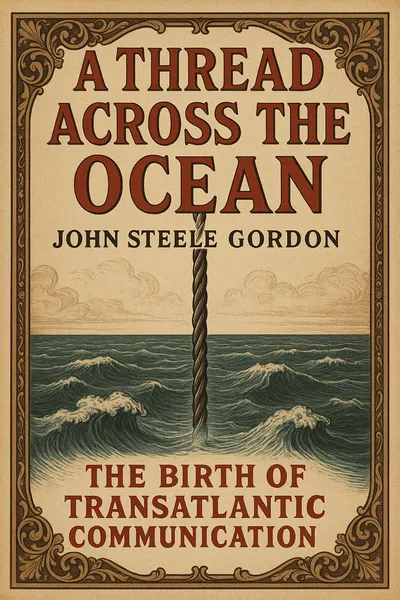
A Thread Across the Ocean
The birth of transatlantic communication
Description
John Steele Gordon, leveraging his expertise in technological and economic history, examines one of the nineteenth century's most audacious technological undertakings: the laying of the first transatlantic telegraph cable. The work situates this achievement within the broader context of Victorian-era technological optimism and the emerging global economy, demonstrating how a single technological innovation could reshape international relations and accelerate the pace of modern life.
The central research question driving Gordon's analysis is: How did the transatlantic telegraph cable transform global communication and reshape nineteenth-century international relations? In response, Gordon defends the thesis that the Atlantic cable represented a technological revolution that eliminated temporal barriers in transatlantic communication, fundamentally altering commerce, diplomacy, and social consciousness. The main stake of this work is to demonstrate how technological innovation can compress time and space, creating new forms of global interconnectedness that redefine political and economic relationships.
Gordon's work presents a compelling argument for understanding the transatlantic telegraph cable as a pivotal moment in the development of modern global communication. The analysis successfully demonstrates how a single technological innovation could catalyze broader transformations in commerce, diplomacy, and social consciousness. The work's strength lies in its ability to connect technological development with broader social and economic changes, revealing the complex relationships between innovation and social transformation. The intellectual contribution of the work lies in its demonstration of how communication technologies can serve as agents of historical change, reshaping fundamental aspects of human social organization and offering valuable insights into the relationship between technological innovation and social transformation.
Table of contents
01Technological Determinism and Imperial Communication Networks
Gordon's analysis reveals a profound engagement with technological determinism, positioning the telegraph cable as a catalyst for broader social transformation. The work demonstrates how technological innovation operates not merely as a tool but as a force capable of restructuring fundamental human relationships with time and space. The author's treatment of the cable project illuminates the tension between human ambition and natural obstacles, presenting technology as both liberating and constraining.

02Economic Networks and Market Integration Revolution
The second analytical axis explores how the telegraph cable facilitated unprecedented market integration across the Atlantic. Gordon's examination reveals how information asymmetries had previously created opportunities for arbitrage and speculation, while the cable's instantaneous communication capabilities fundamentally altered market dynamics. This transformation extends beyond mere efficiency gains to represent a qualitative shift in the nature of transatlantic commerce.
03Diplomatic Revolution and Political Communication Transformation
Gordon's third analytical focus examines how instantaneous communication transformed diplomatic practice and international relations. The work reveals how the cable's ability to transmit information across the Atlantic within minutes rather than weeks fundamentally altered the tempo of diplomacy and crisis management. This acceleration of diplomatic communication created new possibilities for international coordination while simultaneously increasing the potential for rapid escalation of conflicts.
04Social Consciousness and the Transformation of Temporal Experience
The final analytical axis addresses how the telegraph cable transformed social consciousness and collective experience of time. Gordon's work suggests that instantaneous transatlantic communication contributed to an emerging sense of global simultaneity, enabling populations to experience distant events as immediate and proximate. This transformation represents a fundamental shift in human temporal experience, compressing psychological as well as physical distance.
05Critical Analysis and Contemporary Relevance
Despite its compelling narrative, Gordon's work exhibits certain theoretical limitations that constrain its analytical depth. The analysis tends toward technological determinism without adequately addressing how social and political forces shaped the cable's development and implementation. The work would benefit from greater attention to the resistance and adaptation that accompanied this technological transformation, as well as more sophisticated engagement with communication theory and media studies scholarship.
Additionally, Gordon's focus on Anglo-American perspectives limits the work's global scope, potentially overlooking how the cable's implementation affected other regions and populations. The analysis would be strengthened by greater attention to the cable's role in reinforcing or challenging existing patterns of global inequality and imperial control.
Related books