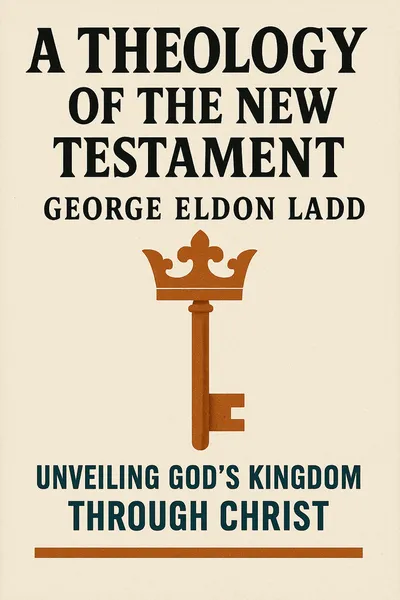
A Theology of the New Testament
Unveiling God's kingdom through Christ
Description
Ladd's comprehensive theological treatise emerges from the evangelical scholarly tradition of the mid-twentieth century, representing a systematic attempt to synthesize New Testament theological themes. Written during a period of intense debate between liberal and conservative biblical scholarship, this work positions itself as a mediating voice that embraces critical methodology while maintaining theological orthodoxy. The author's extensive background in eschatological studies and kingdom theology informs this ambitious project to demonstrate the theological coherence underlying the diverse New Testament corpus.
The central research question that drives this work is: How do the various New Testament writings contribute to a coherent theological understanding of God's salvific work through Jesus Christ? Ladd's defended thesis maintains that the New Testament presents a unified theology centered on the kingdom of God as both present reality and eschatological hope, manifested through Christ's person and redemptive work. The main stake of this argument is to demonstrate that despite apparent diversity, the New Testament possesses fundamental theological unity that validates its canonical authority and doctrinal coherence.
Ladd's theological synthesis achieves remarkable coherence by demonstrating how diverse New Testament writings contribute to a unified vision of God's redemptive purposes. The kingdom motif provides both chronological framework and thematic focus, allowing the author to integrate historical, christological, pneumatological, and ethical dimensions into a comprehensive theological statement. This achievement represents a significant contribution to evangelical scholarship's engagement with critical biblical studies while maintaining commitment to canonical authority and doctrinal orthodoxy. The work's intellectual strength lies in its ability to navigate complex hermeneutical questions while producing practically relevant theological conclusions. Ladd's methodology successfully bridges the gap between descriptive exegesis and constructive theology, offering a model for how careful biblical scholarship can inform systematic reflection without sacrificing either historical accuracy or theological conviction.
Table of contents
01 Kingdom Theology as Hermeneutical Framework
Ladd constructs his theological edifice upon the foundation of kingdom theology, positioning this concept as the organizing principle for understanding New Testament thought. This hermeneutical choice reflects a sophisticated attempt to transcend traditional systematic categories by grounding theological reflection in what the author perceives as the central biblical metaphor. The kingdom functions not merely as one theological theme among others, but as the interpretive lens through which all other doctrinal elements gain coherence and meaning.
The theoretical framework employed here draws heavily from redemptive-historical methodology, emphasizing the progressive revelation of God's purposes through distinct yet interconnected phases of salvation history. This approach allows Ladd to navigate the tension between historical particularity and theological universality, arguing that the kingdom's "already but not yet" character provides the key to understanding apparent contradictions within New Testament eschatology. The author's engagement with contemporary German scholarship, particularly the work of Rudolf Bultmann and Oscar Cullmann, demonstrates his commitment to serious critical dialogue while maintaining evangelical convictions.

02 Christological Centrality and Soteriological Implications
The second major axis of Ladd's theological construction centers on the person and work of Christ as the definitive revelation of God's kingdom purposes. This christological focus serves both descriptive and normative functions, as the author seeks to demonstrate how New Testament writers consistently interpret Jesus' identity and mission in terms of kingdom inauguration and fulfillment. The theological implications extend beyond traditional soteriological categories to encompass cosmic and eschatological dimensions of redemption.
Ladd's treatment reveals the social and political ramifications of New Testament christology, particularly in its challenge to existing power structures and cultural assumptions. The kingdom's present reality through Christ creates alternative communities that embody different values and relationships, while its future consummation promises the transformation of all earthly authorities. This analysis illuminates how early Christian communities understood themselves as participants in a revolutionary movement that transcended ethnic, social, and political boundaries while maintaining distinct theological convictions about Jesus' unique role in salvation history.
03 Pneumatological Dynamics and Ecclesiological Tensions
The third analytical dimension explores the complex relationship between Spirit, church, and eschatological fulfillment within New Testament theology. Ladd identifies significant tensions between institutional development and charismatic spontaneity, between universal mission and particular identity, between present experience and future hope. These tensions reflect deeper theological questions about the nature of religious authority, the boundaries of community membership, and the relationship between divine action and human response.
04 Ethical Transformation and Eschatological Hope
The final major axis addresses the ethical implications of New Testament theology, particularly the relationship between present moral transformation and future eschatological consummation. Ladd argues that kingdom ethics cannot be separated from kingdom theology, as the anticipation of God's ultimate victory shapes current behavioral expectations and community standards. This integration of theological conviction and ethical practice reflects the author's concern to demonstrate the practical relevance of New Testament teaching for contemporary Christian life.
05 Critical Assessment and Contemporary Relevance
Despite its considerable achievements, Ladd's work exhibits several significant limitations that constrain its theological vision. The privileging of kingdom theology as the organizing principle, while hermeneutically productive, may impose artificial unity upon genuinely diverse theological traditions within the New Testament corpus. This methodological choice potentially obscures alternative interpretive frameworks that might yield different theological conclusions about the relationship between continuity and discontinuity in early Christian thought.
Furthermore, the author's evangelical presuppositions, while explicitly acknowledged, sometimes prevent full engagement with the implications of critical scholarship for traditional doctrinal formulations. The tension between historical description and theological prescription occasionally resolves too quickly in favor of harmonistic interpretations that minimize genuine theological development and conflict within the apostolic period.
Related books