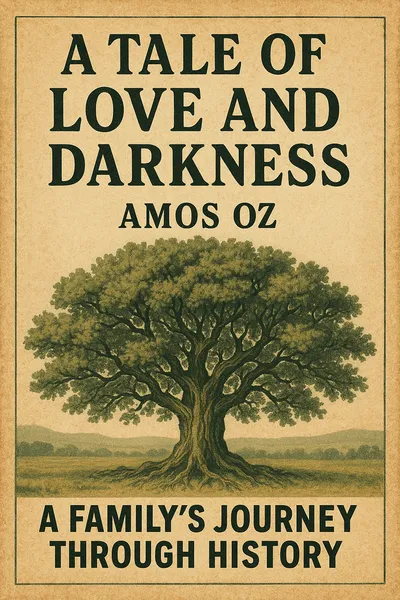
A Tale of Love and Darkness
A family's journey through history
Description
Amos Oz delivers his magnum opus through this autobiographical narrative, weaving together personal memoir and historical testimony. The work emerges from decades of literary maturation, representing both culmination and departure in his oeuvre. Situated within the broader context of Israeli literature's coming-of-age, the text transcends conventional memoir boundaries to engage with fundamental questions of identity formation, collective memory, and national consciousness during Israel's foundational period.
The central research question examines how individual psychological development intersects with collective national formation in the context of Israel's early statehood. Oz defends the thesis that personal identity and national identity constitute mutually constitutive processes, where family trauma and historical transformation create the foundational matrix of modern Israeli consciousness. The main stake is to demonstrate that understanding Israeli society requires excavating the psychological and emotional substrata beneath political and historical narratives.
Oz achieves remarkable synthesis between intimate psychological exploration and broad historical analysis, demonstrating their fundamental inseparability. The work establishes that understanding social formation requires attention to emotional and psychological dimensions typically excluded from conventional historical analysis. Through masterful narrative technique, the author reveals how personal memory and collective history constitute mutually reinforcing processes, where individual stories become building blocks of national consciousness. The analysis successfully challenges artificial boundaries between private and public experience, suggesting that social understanding emerges through integration rather than separation of these domains. The intellectual contribution lies in demonstrating methodology for examining social formation through personal narrative while maintaining analytical rigor and avoiding purely subjective interpretation.
Table of contents
01 Memory as National Construction
Oz constructs memory not as passive recollection but as active cultural production. The narrative demonstrates how personal remembrance becomes the raw material for national mythology, transforming private experiences into collective significance. Through meticulous attention to linguistic details and cultural practices, the author reveals how immigrant communities forge new identities by selectively preserving and discarding elements of their diasporic past.

02 Language and Cultural Transformation
The linguistic dimension occupies central importance in Oz's analysis of cultural metamorphosis. Hebrew emerges not merely as communication tool but as instrument of psychological and social transformation, capable of reshaping consciousness itself. The author demonstrates how language acquisition involves simultaneous processes of cultural adoption and rejection, where embracing Hebrew necessitates distancing from European linguistic heritage.
03 Trauma and Social Foundation
Mental illness and psychological distress permeate the narrative as constitutive elements rather than peripheral complications of social formation. Oz positions his mother's depression within broader patterns of displacement, loss, and cultural disruption affecting immigrant communities. The analysis suggests that individual psychological trauma reflects collective historical trauma, where personal suffering becomes symptomatic of broader social transformations.
04 Ethical Implications of National Formation
The ethical dimensions of nation-building receive sustained examination through personal lens rather than abstract political analysis. Oz confronts moral complexities inherent in Zionist settlement, acknowledging both necessity and cost of national establishment. The narrative reveals how individual ethical choices become implicated in broader political processes, where personal decisions about residence, language, and cultural affiliation carry collective consequences.
05 Critical Assessment and Contemporary Relevance
Despite its considerable achievements, the work exhibits certain limitations that merit examination. The focus on Ashkenazi intellectual experience potentially marginalizes other formative experiences in Israeli society, particularly those of Mizrahi and Sephardic communities whose integration processes differed significantly. The emphasis on psychological analysis, while illuminating, occasionally obscures structural and economic factors shaping social development. Additionally, the narrative's retrospective perspective may inadvertently romanticize certain aspects of early Israeli society while overlooking contemporary alternatives to dominant cultural patterns.
Related books