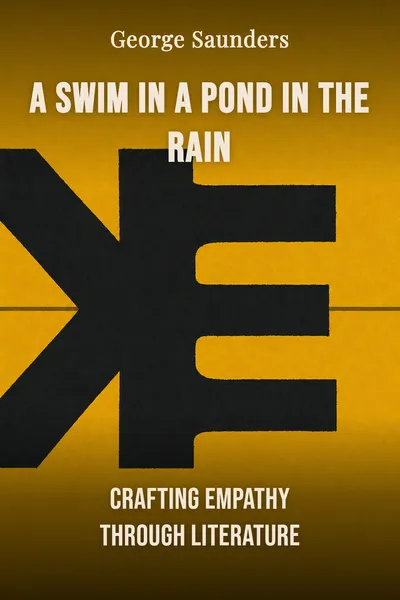
A Swim in a Pond in the Rain
Crafting empathy through literature
Description
Saunders, leveraging his dual expertise as accomplished fiction writer and seasoned educator, presents a masterclass examination of Russian literary tradition through pedagogical lens. The work emerges from his Syracuse University seminars, transforming classroom discussions into broader meditation on literature's capacity to refine human consciousness. Rather than conventional literary criticism, this represents an innovative hybrid of craft instruction, close reading methodology, and philosophical inquiry into fiction's transformative potential.
The central research question explores how engagement with literary masterworks functions as a technology for developing moral perception and empathetic intelligence. The defended thesis positions literature as an active training ground for consciousness, requiring readers to exercise and strengthen their capacity for nuanced human understanding. The main stake demonstrates that close reading constitutes a form of moral education essential for navigating contemporary ethical complexities.
Saunders constructs a compelling framework positioning literature as sophisticated cognitive apparatus rather than passive entertainment medium. Through analysis of Russian masters, he demonstrates how great fiction demands active mental participation, forcing readers to continuously recalibrate their assumptions about human motivation and behavior. This perspective challenges traditional boundaries between aesthetic appreciation and ethical development, suggesting that literary engagement constitutes a form of consciousness training. The author's approach reveals how narrative techniques—point of view shifts, temporal manipulation, linguistic precision—function as instruments requiring readers to exercise interpretive muscles essential for real-world moral reasoning. This technological metaphor for literature transforms reading from consumption to active cognitive exercise.
Table of contents
01 Russian Literature as Moral Laboratory
The selection of Russian literary tradition serves strategic purposes beyond aesthetic preference, functioning as extended case study in literature's capacity to navigate extreme historical circumstances. Saunders demonstrates how Tolstoy, Chekhov, Turgenev, and Gogol developed narrative techniques specifically suited to examining human behavior under social and political pressure. These authors created fictional laboratories for testing moral intuitions against complex scenarios where conventional ethical frameworks prove inadequate.

02 Contemporary Ethical Applications and Democratic Potential
Saunders articulates compelling connections between nineteenth-century Russian literary techniques and contemporary ethical challenges, demonstrating literature's ongoing relevance for navigating current moral complexities. The work suggests that skills developed through close reading—attention to nuance, tolerance for ambiguity, capacity to hold multiple perspectives simultaneously—prove essential for addressing polarization, misinformation, and empathy deficits characterizing current cultural moment. This application extends beyond individual development to propose literature as resource for collective ethical reasoning.
03 Critical Assessment and Future Directions
Saunders successfully constructs a comprehensive argument for literature's essential role in developing human consciousness capable of sophisticated moral reasoning. The work demonstrates remarkable coherence in connecting technical literary analysis with broader philosophical claims about fiction's transformative potential. By grounding abstract arguments in concrete textual engagement, the author avoids both elitist aestheticism and populist anti-intellectualism, charting middle course that makes serious literary study accessible without sacrificing analytical rigor. The pedagogical framework proves particularly effective in modeling the collaborative interpretive processes the work advocates, creating meta-textual demonstration of its central thesis about literature's democratic potential.
Related books