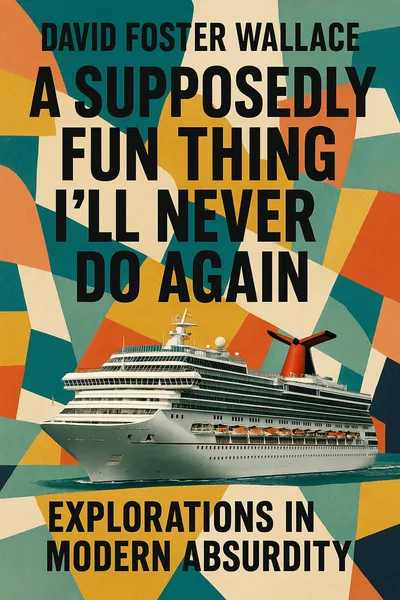
A Supposedly Fun Thing I'll Never Do Again
Explorations in modern absurdity
Description
David Foster Wallace's collection of essays represents a crucial intervention in contemporary cultural criticism, examining the intersection of postmodern American society with questions of authenticity and human connection. Published during the height of 1990s consumer capitalism, the work positions Wallace as both participant and critic of the cultural phenomena he dissects. His unique position as a philosophically trained novelist allows him to approach nonfiction with both analytical rigor and literary sensitivity, creating a hybrid form of cultural commentary that transcends traditional academic boundaries.
The central research question driving Wallace's analysis concerns how contemporary American leisure and media culture simultaneously promise and prevent authentic human experience and meaningful connection. His defended thesis argues that modern entertainment and consumer culture create a paradox of hyper-stimulation and profound isolation, where the pursuit of pleasure becomes a mechanism of alienation. The main stake of his argument is to expose the mechanisms by which late capitalist culture transforms genuine human needs for connection and meaning into commodified experiences that ultimately deepen existential loneliness.
Wallace's collection presents a comprehensive critique of contemporary American culture that transcends simple cultural pessimism to offer a nuanced analysis of how late capitalism transforms human consciousness and social possibility. His argument demonstrates that the crisis of contemporary culture is not merely economic or political but fundamentally phenomenological, concerning how experience itself is structured and made available. The work's theoretical contribution lies in its demonstration of how consumer capitalism operates not merely through external coercion but through the colonization of consciousness itself.
The intellectual coherence of Wallace's argument emerges through his consistent focus on the relationship between authentic human connection and contemporary culture's systematic undermining of the conditions necessary for such connection. His analysis reveals how seemingly disparate cultural phenomena share common structural features that prevent genuine human flourishing while maintaining the appearance of providing it.
Table of contents
01Television and the Phenomenology of Mediated Experience
Wallace's investigation into television culture reveals the fundamental contradiction of contemporary media consumption as both escape from and intensification of isolation. His analysis demonstrates how televisual experience creates what might be termed a phenomenology of vicarious living, where authentic engagement with reality becomes increasingly mediated through commercial representations. The author exposes television's promise of connection as fundamentally deceptive, creating audiences who mistake passive consumption for active participation in human community.

02Consumer Capitalism and the Commodification of Experience
The collection's exploration of leisure industries, particularly through the cruise ship essay, illuminates how late capitalism transforms even pleasure into alienated labor. Wallace's analysis reveals the cruise experience as paradigmatic of contemporary consumer culture, where authentic enjoyment becomes impossible precisely because it has been so thoroughly organized and commodified. The passengers find themselves trapped within systems designed to manufacture fun, yet these very systems prevent the spontaneous human connections that might generate genuine pleasure.
03Postmodern Irony and the Crisis of Sincerity
Wallace's engagement with postmodern literary theory and cultural production reveals his central concern with what might be termed the crisis of sincerity in contemporary American culture. His analysis demonstrates how postmodern irony, while initially liberating from false earnestness and cultural authority, has evolved into a cultural dead end that prevents genuine emotional and intellectual engagement. The essays reveal irony's transformation from critical tool to cultural prison, where sincere engagement becomes increasingly difficult to sustain or even recognize.
04Ethics of Attention and Authentic Engagement
The collection's various subjects coalesce around questions of attention and authentic engagement as ethical and political problems. Wallace's analysis suggests that contemporary culture systematically undermines the capacity for sustained attention necessary for genuine human connection and meaningful experience. His examination of phenomena from tennis to state fairs reveals how even potentially authentic experiences become colonized by commercial and mediated logic that transforms participants into consumers.
05Critical Evaluation and Contemporary Relevance
Wallace's analysis, while penetrating in its cultural diagnosis, occasionally suffers from a romantic nostalgia for authentic experience that may itself be historically naive. His critique of contemporary culture sometimes implies the existence of a golden age of authentic human connection that may be more mythical than historical. Additionally, his position as an educated, privileged observer occasionally limits his analysis of how class, race, and gender intersect with the cultural phenomena he examines.
The work's theoretical framework, while sophisticated in its engagement with postmodern theory, sometimes lacks sufficient attention to the material conditions that produce the cultural phenomena it critiques. Wallace's focus on consciousness and experience occasionally obscures the economic and political structures that shape contemporary culture.
Related books