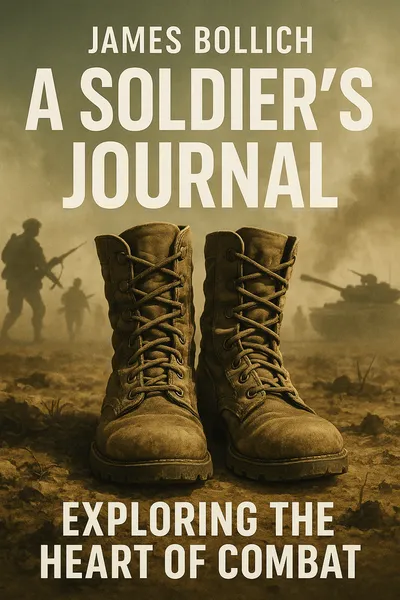
A Soldier's Journal
Exploring the heart of combat
Description
James Bollich presents a compelling sociological examination of contemporary military experience through his analysis of soldier narratives. Drawing upon his extensive background in military sociology, the author situates his work within current debates surrounding veteran reintegration and the psychological costs of modern warfare. This contribution emerges at a critical juncture when society grapples with understanding the human dimension of prolonged military engagements and their lasting social consequences.
The central research question driving this work asks: How do individual soldier experiences illuminate broader tensions within contemporary military institutions and their relationship to civilian society? Bollich defends the thesis that the modern soldier's psychological journey reveals irreconcilable contradictions between institutional military expectations and the lived reality of combat experience. The main stake lies in demonstrating that current military-civilian integration models fail to address fundamental structural incompatibilities between military and civilian worldviews.
Bollich's comprehensive analysis demonstrates that contemporary military experience reveals fundamental contradictions within modern democratic societies. The author successfully weaves together psychological, sociological, and ethical dimensions to present a compelling critique of current military-civilian relationships. His central contribution lies in showing how individual soldier experiences illuminate broader structural problems that resist simple policy solutions. The work's intellectual coherence emerges from its consistent focus on contradiction and tension rather than seeking resolution. Bollich avoids false comfort by refusing to propose easy solutions, instead insisting that readers confront the uncomfortable realities these contradictions reveal about contemporary society's relationship with violence and security.
Table of contents
01Institutional Dissonance and Identity Formation
Bollich's analysis reveals the profound psychological fractures that emerge when institutional military identity encounters the brutal realities of contemporary warfare. The author demonstrates how military training creates specific cognitive frameworks designed to facilitate combat effectiveness, yet these same frameworks become problematic when soldiers attempt to process traumatic experiences. This institutional programming, while necessary for operational success, generates what Bollich terms "adaptive dissonance" - the psychological tension between trained responses and human emotional needs.

02The Civilian-Military Divide
The second analytical axis examines how military experience creates an unbridgeable chasm between soldier and civilian worldviews. Bollich argues that contemporary warfare produces experiential knowledge that cannot be translated into civilian frameworks of understanding. This translation failure generates profound social isolation among veterans and perpetuates mutual incomprehension between military and civilian populations.
03Temporal Disruption and Narrative Coherence
Bollich's third major theme explores how combat experience disrupts conventional temporal frameworks and narrative coherence. The author demonstrates that military trauma is not simply about specific events but involves a fundamental alteration of temporal consciousness. Veterans struggle not merely with memories but with the collapse of progressive temporal structures that organize civilian life.
04Ethical Implications and Social Responsibility
The final analytical dimension addresses the ethical consequences of society's relationship with its military personnel. Bollich argues that civilian society maintains a form of "ethical distance" that allows it to benefit from military protection while avoiding confrontation with the moral costs of warfare. This arrangement creates what he terms "complicit innocence" - a social position that enables moral disengagement from the consequences of state violence.
05Critical Assessment and Future Directions
Despite its analytical strengths, Bollich's work exhibits certain theoretical limitations. The analysis relies heavily on male combat veteran experiences while inadequately addressing how gender dynamics might alter the proposed frameworks. Additionally, the author's focus on psychological and social dimensions sometimes overshadows important economic factors that influence military service decisions and post-combat outcomes.
The work also demonstrates potential cultural bias in its emphasis on American military experience, limiting the universalizability of its conclusions. Cross-cultural analysis would strengthen the theoretical framework by revealing which contradictions are culturally specific versus structurally inherent to modern military institutions.
Related books