A Shot To Save The World
Profits hidden in a crisis
Description
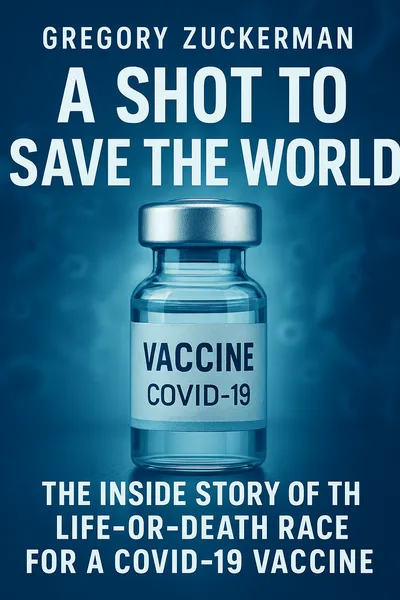
Gregory Zuckerman's "A Shot To Save The World" examines the COVID-19 vaccine development as an unprecedented fusion of scientific innovation, financial speculation, and geopolitical strategy that fundamentally transformed the relationship between public health imperatives and market-driven pharmaceutical research. The work demonstrates how the pandemic created conditions for an unprecedented financialization of scientific research, where traditional barriers between public funding and private profit were systematically dismantled. This transformation involved socializing research and development risks while privatizing potential profits, creating a new template for state-sponsored innovation under crisis conditions.
The central research question explores how the unprecedented convergence of scientific innovation, financial investment, and political intervention reshaped the traditional pharmaceutical development paradigm during the COVID-19 pandemic. Zuckerman argues that the vaccine development process represents a new model of crisis capitalism where emergency conditions legitimized extraordinary public-private partnerships that fundamentally altered the risk-reward calculus of pharmaceutical innovation. The main stake is to demonstrate that COVID-19 vaccine development constitutes a paradigmatic shift in how societies organize scientific research, distribute financial risk, and manage global health governance under conditions of existential threat.
Zuckerman constructs a compelling argument that the COVID-19 vaccine development represents a watershed moment in the evolution of technoscientific capitalism. His analysis demonstrates how emergency conditions enabled the creation of new institutional arrangements that blur traditional boundaries between public and private, scientific and commercial, national and global. The work reveals how the pandemic accelerated existing trends toward the commodification of health while creating new forms of corporate concentration and state dependency. The author's synthesis highlights how the vaccine development process established precedents that extend far beyond pandemic response, potentially reshaping how societies organize innovation, distribute risk, and govern emerging technologies.
Table of contents
01 The Financialization of Scientific Urgency
Zuckerman's analysis reveals how the pandemic created conditions for an unprecedented financialization of scientific research, where traditional barriers between public funding and private profit were systematically dismantled. The author demonstrates that Operation Warp Speed and similar initiatives represented not merely accelerated drug development but a fundamental restructuring of pharmaceutical economics. This transformation involved socializing research and development risks while privatizing potential profits, creating a new template for state-sponsored innovation under crisis conditions.

02 Geopolitical Competition and Technological Nationalism
The author's examination extends beyond individual corporate strategies to analyze how vaccine development became a vehicle for projecting geopolitical power and technological sovereignty. Zuckerman demonstrates how the pandemic accelerated trends toward technological nationalism, with nations viewing vaccine capabilities as strategic assets comparable to military or energy resources.
03 Regulatory Transformation and Democratic Accountability
Zuckerman identifies a critical tension between the legitimate need for regulatory flexibility during health emergencies and the erosion of democratic oversight mechanisms. The work examines how emergency use authorizations, fast-track approvals, and liability protections created a new regulatory environment that privileged speed over traditional safety protocols.
04 Ethical Implications and Global Justice
The work confronts the profound ethical contradictions embedded in the vaccine development process, particularly the tension between intellectual property rights and global health equity. Zuckerman analyzes how pharmaceutical companies leveraged public investment and regulatory support to create privately owned technologies that remained inaccessible to much of the global population.
05 Critical Perspectives and Future Implications
Despite its analytical sophistication, Zuckerman's work exhibits limitations characteristic of financial journalism applied to complex social phenomena. The analysis tends to privilege institutional actors and market mechanisms while underemphasizing grassroots resistance movements, alternative scientific paradigms, and non-market forms of knowledge production. The author's focus on elite decision-making processes occasionally obscures the experiences of communities most affected by vaccine inequity.
Furthermore, the work's emphasis on American and European pharmaceutical companies reflects a geographic bias that minimizes innovations emerging from the Global South. Zuckerman's financial background, while providing valuable insights into market dynamics, sometimes leads to an overemphasis on economic explanations for phenomena that may have equally important cultural, political, or social dimensions.
Related books