

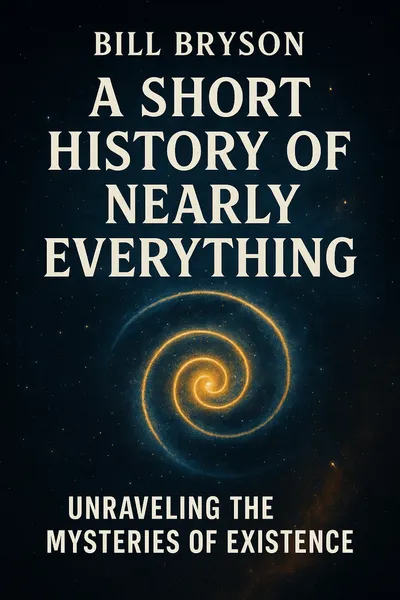
A Short History of Nearly Everything
Unraveling the mysteries of existence
Description
Bryson's ambitious undertaking represents a singular attempt to synthesize the entirety of scientific knowledge into a coherent narrative accessible to non-specialist readers. The author leverages his established expertise in popular writing to tackle domains traditionally reserved for academic specialists, positioning himself as an intermediary between scientific communities and public understanding. This work emerges within contemporary debates regarding scientific literacy and the democratization of knowledge, reflecting broader societal tensions between expertise and populist accessibility.
The central research question driving this work asks: How can the complete trajectory of scientific discovery, from cosmic origins to human civilization, be rendered comprehensible and engaging for general audiences? Bryson's defended thesis maintains that scientific complexity need not preclude public understanding when mediated through compelling narrative and human-centered storytelling. The main stake of this endeavor is to demonstrate that scientific literacy can be achieved through biographical and anecdotal approaches rather than purely technical exposition.
Bryson contends that scientific knowledge, while monumentally complex, can be democratized through narrative storytelling that reveals both the wonder of discovery and the human drama behind scientific advancement. This approach fundamentally challenges traditional academic boundaries by privileging narrative accessibility over disciplinary rigor, reflecting broader cultural shifts toward knowledge democratization while simultaneously raising questions about the integrity of scientific translation.
Table of contents
01The Politics of Wonder and Scientific Authority
Bryson's narrative strategy embeds implicit political assumptions about the relationship between scientific establishments and public knowledge. His portrayal of scientists as simultaneously brilliant and eccentric figures reinforces romantic notions of individual genius while potentially obscuring the social and economic structures that enable scientific research. This representation carries significant implications for public understanding of how science operates within broader power structures.
The author's emphasis on historical anecdotes and personality-driven explanations reflects a distinctly Anglo-American approach to science popularization that privileges individual agency over systemic analysis. This methodological choice aligns with neoliberal ideologies that celebrate entrepreneurial thinking while potentially marginalizing discussions of scientific funding, institutional politics, and global inequalities in research access. The work's commercial success suggests public appetite for such approaches, yet critical examination reveals how these narratives may inadvertently depoliticize scientific practice.

02The Challenge of Cosmic Compression
The ambitious scope of Bryson's project creates inevitable tensions between comprehensiveness and depth that illuminate broader challenges in contemporary knowledge production. His attempt to compress cosmic and biological evolution into digestible segments necessitates radical simplifications that may distort the genuine complexity of scientific understanding. This compression reflects broader cultural tendencies toward information acceleration and attention fragmentation.
The work's structure reveals assumptions about cognitive processing and learning that merit critical examination. Bryson's confidence that complex phenomena can be rendered accessible through clever analogies and engaging anecdotes may underestimate the genuine intellectual labor required for scientific comprehension. This approach risks creating pseudo-understanding that satisfies curiosity without developing critical thinking capabilities. The tension between accessibility and rigor raises fundamental questions about educational philosophy and the purposes of popular science writing.
03Ethics and Responsibility in Knowledge Translation
Bryson's enterprise raises significant ethical questions about intellectual responsibility and the politics of knowledge translation. His position as a non-specialist interpreter of specialist knowledge grants him considerable power to shape public understanding, yet this power operates largely without institutional oversight or accountability mechanisms. The author's good intentions cannot fully address concerns about misrepresentation, oversimplification, or the potential reinforcement of scientific misconceptions.
04Achievement and Limitation: A Critical Assessment
Bryson's "A Short History of Nearly Everything" represents both a remarkable achievement in science communication and a problematic example of knowledge commodification. The work succeeds in demonstrating that scientific concepts can be rendered engaging and accessible through skilled narrative technique, potentially inspiring readers toward deeper scientific engagement. However, this success operates within broader cultural and economic systems that privilege entertainment value over educational rigor.
The author's synthesis reveals genuine insights into the interconnectedness of scientific disciplines while simultaneously illustrating the limitations of individual-centered approaches to understanding collective knowledge production. The work's popularity suggests significant public hunger for scientific understanding, yet its commercial success may reflect demand for intellectual satisfaction rather than genuine learning. This tension captures broader contradictions within contemporary knowledge economies that prioritize accessibility over accuracy.