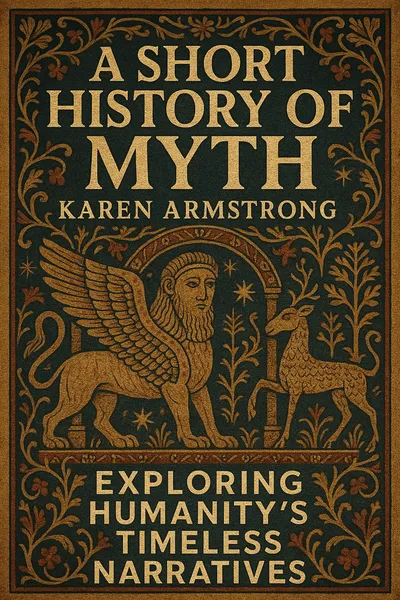
A Short History of Myth
Exploring humanity's timeless narratives
Description
Karen Armstrong's "A Short History of Myth" emerges within a contemporary intellectual landscape marked by the tension between scientific materialism and spiritual quest. Drawing upon her expertise in comparative religion and her interdisciplinary approach, the author positions herself as a mediator between rationalist skepticism and mythological wisdom. This concise treatise represents an ambitious synthesis that seeks to rehabilitate mythological thinking within modern consciousness, challenging the predominant secular paradigm that relegates myth to the realm of primitive superstition.
The central research question driving Armstrong's investigation is: How have myths functioned as essential vehicles for human meaning-making throughout history, and what role might they play in contemporary society? Her defended thesis proposes that myths represent an irreducible form of human knowledge that addresses existential dimensions of experience beyond the reach of rational-scientific discourse. The main stake of her argument is to demonstrate that the dismissal of mythological consciousness represents a fundamental impoverishment of human experience and to argue for the continued relevance of mythical thinking.
Armstrong's comprehensive analysis establishes mythology as an irreducible dimension of human consciousness that addresses existential needs beyond the scope of rational discourse. Her interdisciplinary approach successfully demonstrates the anthropological universality, sociological functionality, and ethical necessity of mythological thinking. The work presents a compelling case for the continued relevance of mythological consciousness within contemporary culture, challenging both the scientific materialism that dismisses myth as superstition and the religious literalism that reduces myth to historical fact. The author's synthetic vision proposes a mature integration of mythological and rational consciousness that honors both intellectual rigor and spiritual wisdom. This integration appears essential for addressing the contemporary crisis of meaning and for developing authentic responses to the existential challenges facing modern civilization.
Table of contents
01 The Anthropological Foundation of Mythical Consciousness
Armstrong's theoretical framework rests upon a fundamental anthropological premise: the human psyche possesses an inherent capacity for mythological thinking that emerges from our confrontation with existential finitude and the mystery of existence. This analysis reveals how the author situates mythical consciousness not as a primitive precursor to rational thought, but as a parallel and complementary mode of understanding that addresses dimensions of experience that remain inaccessible to empirical investigation.

02 The Social Architecture of Mythological Systems
The sociological dimension of Armstrong's analysis reveals how mythological systems function as foundational structures for social cohesion and cultural transmission. Her examination of diverse civilizations demonstrates how myths operate as collective memory banks that preserve and transmit essential cultural values across generations. This perspective illuminates the political and social functions of mythological narratives, showing how they legitimate social hierarchies, define group boundaries, and provide frameworks for collective action.
03 The Dialectical Relationship Between Myth and Rationality
A central tension emerges in Armstrong's analysis regarding the relationship between mythological and rational modes of consciousness. Rather than accepting the conventional opposition between myth and reason, the work reveals a complex dialectical relationship wherein each mode of understanding both complements and challenges the other. This analysis demonstrates how the emergence of philosophical and scientific thinking did not simply replace mythological consciousness but created new forms of tension and synthesis.
04 The Ethical Imperative of Mythological Recovery
The ethical dimension of Armstrong's argument emerges from her conviction that the dismissal of mythological consciousness represents not merely an intellectual error but a moral failure that impoverishes human experience and undermines our capacity for wisdom and compassion. This analysis reveals how mythological narratives traditionally functioned as vehicles for ethical formation, providing models of exemplary behavior and frameworks for moral reasoning that transcend utilitarian calculation.
05 Critical Assessment and Future Directions
Despite its synthetic ambitions, Armstrong's work exhibits certain theoretical limitations that constrain its analytical power. The author's comparative methodology, while illuminating universal patterns, occasionally obscures the specific historical and cultural contexts that give particular mythological systems their distinctive character and transformative power. This tendency toward generalization risks reducing the radical particularity of mythological narratives to abstract psychological categories.
Furthermore, Armstrong's romantic idealization of pre-modern consciousness may underestimate the genuine intellectual achievements of rational-scientific culture and the legitimate reasons for the historical decline of mythological authority. Her analysis occasionally displays an insufficiently critical attitude toward the political and social functions of mythological systems, particularly their role in legitimating oppressive power structures and excluding marginalized voices.
Related books