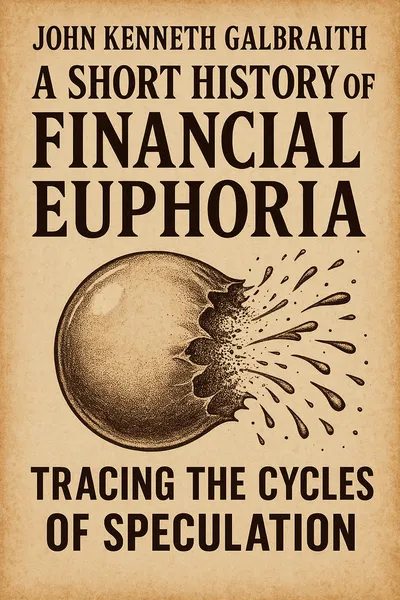
A Short History of Financial Euphoria
Tracing the cycles of speculation
Description
Galbraith's concise treatise emerges from his extensive experience as both academic economist and policy advisor, offering a historical synthesis of speculative manias spanning four centuries. Written in the early 1990s, the work reflects the author's characteristic skepticism toward market efficiency theories while drawing upon his deep understanding of institutional economics and behavioral patterns in financial markets.
The central research question driving this analysis asks: Why do financial markets repeatedly experience euphoric episodes that culminate in devastating crashes despite historical precedent and supposed rational actor behavior? Galbraith's defended thesis presents speculative bubbles as inevitable manifestations of human psychology and institutional dynamics rather than aberrant market failures, following predictable patterns across different historical contexts. The main stake of this argument is to demonstrate that financial euphoria constitutes a structural feature of capitalist economies, challenging beliefs in market rationality and self-regulation.
Galbraith's synthesis presents financial euphoria as an endemic feature of market economies rather than an exceptional aberration, challenging fundamental assumptions about market efficiency and rational actor behavior. The work demonstrates that speculative bubbles follow predictable patterns driven by psychological, institutional, and structural factors that remain constant across historical periods despite changing technological and regulatory contexts. The intellectual contribution lies in the integration of historical analysis with behavioral insights and institutional critique, providing a comprehensive framework for understanding speculative episodes that transcends traditional economic models focused on equilibrium and rational expectations. The author's coherent narrative reveals the systematic nature of apparently chaotic market phenomena while highlighting the collective capacity for self-deception that enables repeated cycles of euphoria and collapse.
Table of contents
01 The Psychology of Collective Financial Delusion
Galbraith's analysis unveils the psychological mechanisms underlying speculative behavior, revealing how individual rationality transforms into collective irrationality through social contagion and cognitive biases. The author demonstrates that financial euphoria emerges when innovative financial instruments or new economic opportunities create an atmosphere of unprecedented possibility, leading participants to abandon traditional risk assessment frameworks.
The theoretical foundation rests upon behavioral economics principles, though Galbraith predates formal behavioral finance theory. His analysis incorporates elements of crowd psychology, showing how the desire for social conformity and fear of missing extraordinary opportunities override prudential judgment. The author illustrates how euphoric episodes typically involve the democratization of speculation, drawing previously conservative investors into increasingly risky ventures through the illusion of universal enrichment.

02 Institutional Dynamics and Market Structure
The institutional analysis reveals how financial euphoria exploits structural weaknesses within market systems and regulatory frameworks. Galbraith demonstrates that speculative episodes typically coincide with financial innovation, deregulation, or the emergence of new market participants lacking historical experience with similar phenomena.
The author examines how institutional incentives promote rather than restrain speculative excess, particularly through the role of financial intermediaries who profit from transaction volume rather than investment outcomes. This creates systemic bias toward encouraging speculative activity regardless of its ultimate sustainability or social utility.
03 Historical Patterns and Cyclical Recurrence
Galbraith's historical survey demonstrates remarkable consistency in the structure and progression of financial euphoria across different centuries, technologies, and economic systems. The pattern invariably begins with genuine innovation or opportunity, progresses through increasing speculation and leverage, reaches peak euphoria characterized by universal participation, and concludes with sudden collapse and widespread recrimination.
The analysis reveals how each generation rediscovers speculation as though it were a novel phenomenon, despite abundant historical precedent suggesting inevitable failure. This collective amnesia represents a crucial element enabling the cyclical recurrence of financial euphoria, as participants convince themselves that contemporary circumstances differ fundamentally from previous episodes.
04 Social and Economic Consequences
The broader implications of financial euphoria extend far beyond immediate market participants to encompass entire societies and economic systems. Galbraith analyzes how speculative episodes distort resource allocation, diverting capital from productive investments toward purely speculative activities that generate no genuine economic value.
The social stratification effects prove particularly pernicious, as euphoric episodes typically concentrate wealth among early participants while imposing losses upon those who join the speculation later or suffer collateral damage from the subsequent collapse. This pattern reinforces existing inequalities while creating new forms of economic instability that affect broader populations.
05 Critical Assessment and Contemporary Relevance
Despite its analytical insights, Galbraith's work exhibits certain limitations that constrain its explanatory power. The deterministic framework risks overlooking the genuine innovations and productive investments that sometimes emerge from speculative periods, potentially underestimating the complex relationship between financial speculation and technological progress. The analysis lacks systematic engagement with alternative theoretical frameworks that might explain why some speculative episodes generate lasting economic benefits while others produce only destruction.
The institutional analysis, while compelling, insufficient addresses the evolution of regulatory responses and their varying effectiveness across different contexts. Additionally, the work's focus on Anglo-American financial history limits its applicability to other economic systems and cultural contexts where different institutional arrangements might alter the dynamics of speculative behavior.
Related books