

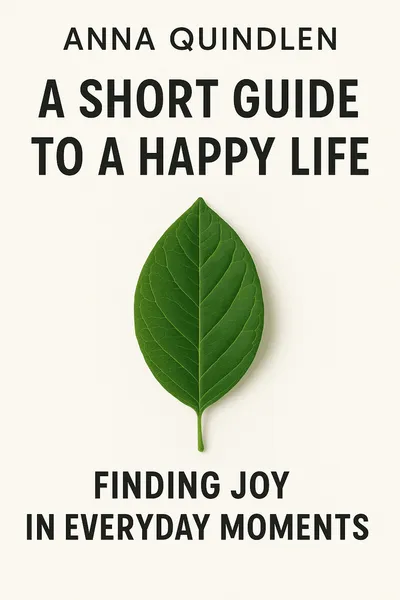
A Short Guide to a Happy Life
Finding joy in everyday moments
Description
Anna Quindlen's *A Short Guide to a Happy Life* represents a synthesis of her journalistic acuity and humanistic perspective, offering a meditation on contemporary existence within an increasingly fragmented social landscape. Written as a reflective essay rather than a systematic treatise, the work emerges from her extensive observation of American society and personal encounters with mortality and meaning. The text positions itself as a counterpoint to the achievement-oriented, consumption-driven narratives that dominate contemporary discourse about fulfillment and success.
The central research question driving this work asks: How can individuals discover authentic happiness and meaning within the constraints and distractions of modern life? Quindlen's defended thesis argues that genuine contentment derives from mindful attention to present experiences, appreciation of life's transient nature, and rejection of external validation systems. The main stake is to reorient readers toward intrinsic sources of meaning that transcend material success and social expectations.
Quindlen's intellectual contribution lies in her integration of existential philosophy with accessible prose, creating a framework for meaning-making that neither requires specialized knowledge nor dismisses life's complexity. Her argument demonstrates internal coherence through its consistent emphasis on direct experience over theoretical abstraction, suggesting that wisdom emerges from attentive living rather than conceptual mastery. The work's strength resides in its practical applicability—readers can immediately implement its suggestions—while maintaining philosophical depth about fundamental questions of value and purpose. The synthesis of journalistic observation with humanistic reflection produces insights that illuminate both individual psychology and broader cultural patterns, revealing how personal struggles reflect systemic challenges that require both individual and collective responses.
Table of contents
01The Power of Presence: Living in the Moment
Quindlen's foundational argument centers on the transformative power of mindful attention to immediate experience. Her philosophical framework draws implicitly from phenomenological traditions that privilege direct encounter over abstract theorizing. The author constructs presence not as passive observation but as active engagement with sensory and emotional reality.

02Mortality as Teacher: Learning from Life's Finitude
The confrontation with finitude operates as Quindlen's central pedagogical strategy, functioning not as morbid preoccupation but as clarifying principle. Her sociological insight recognizes that contemporary American culture systematically obscures death through technological mediation, institutional sequestration, and therapeutic discourse that pathologizes grief. By foregrounding mortality's inevitability, the author challenges what sociologist Zygmunt Bauman identified as "liquid modernity"—the illusion of infinite possibility and perpetual deferral.
03The Radical Act of Simplicity: Critiquing Modern Complexity
The advocacy for simplified living operates as implicit critique of late capitalist complexity and its psychological consequences. Quindlen's approach to simplicity transcends mere lifestyle aesthetics to engage with fundamental questions about value creation and social organization. Her analysis suggests that contemporary society's emphasis on optimization, efficiency, and accumulation produces what David Harvey might term "time-space compression"—an acceleration of experience that paradoxically diminishes its quality.
04Love as Foundation: The Ethical Dimension of Happiness
Quindlen's treatment of love transcends romantic convention to establish it as the fundamental ethical orientation toward existence. Her conceptual framework positions love not as emotion but as practice—a deliberate choice to engage with others and the world through appreciation rather than instrumentality. This approach resonates with Emmanuel Levinas's ethics of infinite responsibility, where the encounter with the Other becomes the foundation of moral consciousness.
05Critical Perspectives: Limitations and Future Directions
The work's primary limitation stems from its individualistic focus, which potentially obscures structural inequalities that constrain many people's ability to achieve the simplicity and presence Quindlen advocates. Her perspective reflects class privilege—the luxury of choosing simplicity presupposes sufficient resources to reject material striving safely. Additionally, the text's cultural specificity limits its applicability across diverse social contexts, particularly for communities where survival requires constant vigilance rather than mindful presence. The absence of systematic engagement with power dynamics, institutional racism, or economic inequality represents a significant blind spot that undermines the work's broader social relevance.