

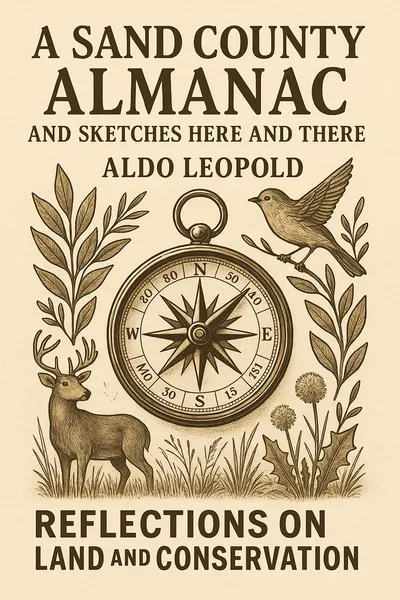
A Sand County Almanac and Sketches Here and There
Reflections on land and conservation
Description
Leopold's seminal work emerged during the post-war period when American society grappled with unprecedented technological advancement and its environmental consequences. Drawing from his extensive experience as a forester and wildlife manager, Leopold presents a philosophical treatise that challenges anthropocentric worldviews dominating Western thought. The work synthesizes scientific observation with ethical reflection, positioning itself within broader debates about humanity's relationship with nature that gained momentum throughout the twentieth century.
The central research question that drives Leopold's work is: How should humanity reconceptualize its moral relationship with the natural world to ensure ecological sustainability and ethical coherence? His defended thesis argues that a fundamental ethical transformation is necessary, expanding moral consideration from individual organisms to entire ecological communities through the development of a "land ethic." The main stake of his argument is to demonstrate that environmental degradation stems from flawed ethical frameworks and that ecological health requires recognizing the intrinsic value of natural systems.
Leopold argues that humanity must develop a land ethic that recognizes the intrinsic value of natural communities and extends moral consideration beyond human interests to encompass the entire biotic community. This ethical framework represents a radical expansion of moral philosophy's scope and foundation, challenging Western philosophy's traditional boundaries by including soils, waters, plants, and animals within the moral community. The famous maxim that actions are right when they preserve the integrity, stability, and beauty of the biotic community constitutes a revolutionary ethical principle that requires reconceptualizing human identity and agency within ecological contexts.
Table of contents
01Phenomenological Observation and Ecological Consciousness
Leopold's methodological approach reveals a profound epistemological shift in environmental thinking. Rather than adopting purely scientific detachment, he employs phenomenological observation that integrates sensory experience with ecological understanding. This approach challenges traditional scientific objectivity by acknowledging the observer's embeddedness within natural systems.
The author's seasonal observations function as more than descriptive nature writing; they constitute a pedagogical framework for developing ecological consciousness. Through detailed attention to phenological patterns, Leopold demonstrates how intimate knowledge of place generates ethical responsibility. This methodology implicitly critiques modern society's alienation from natural processes, suggesting that environmental destruction results partly from experiential disconnection.

02Critique of Anthropocentric Ethics and Economic Rationality
The work presents a systematic critique of anthropocentric ethical systems that limit moral consideration to human interests. Leopold argues that traditional ethics fail to address environmental problems because they exclude natural communities from moral consideration. This exclusion enables destructive practices justified through narrow economic rationality that ignores ecological interdependence.
Leopold's analysis reveals how market mechanisms systematically undervalue ecological services and long-term sustainability. His critique extends beyond simple opposition to economic development, addressing fundamental assumptions about progress, efficiency, and human superiority. The author demonstrates how anthropocentric worldviews create conceptual blind spots that prevent recognition of ecological limits and interdependence.
03The Land Ethic as Philosophical Revolution
Leopold's proposal for a land ethic represents a radical expansion of moral philosophy's scope and foundation. This ethical framework challenges Western philosophy's traditional boundaries by including soils, waters, plants, and animals within the moral community. The famous maxim that actions are right when they preserve the integrity, stability, and beauty of the biotic community constitutes a revolutionary ethical principle.
This ethical transformation requires reconceptualizing human identity and agency within ecological contexts. Leopold argues that humans must understand themselves as "plain members and citizens" of biotic communities rather than their conquerors. This reconceptualization challenges fundamental assumptions about human exceptionalism that underlie Western civilization's dominant narratives.
04Conservation as Cultural Transformation
Leopold's vision extends beyond technical conservation measures to encompass broader cultural transformation. He argues that effective environmental protection requires fundamental changes in education, values, and social organization. This perspective positions conservation as a civilizational challenge rather than merely a policy issue.
The work emphasizes the crucial role of aesthetic appreciation in developing environmental consciousness. Leopold suggests that beauty serves as a bridge between scientific understanding and ethical commitment, enabling emotional engagement with ecological concepts. This integration of aesthetic, scientific, and ethical dimensions challenges disciplinary boundaries that often fragment environmental thinking.
05Critical Assessment and Contemporary Relevance
Leopold's work exhibits certain limitations rooted in its historical context and philosophical assumptions. His emphasis on wilderness preservation sometimes conflicts with indigenous land use practices and environmental justice concerns. The land ethic's focus on ecological wholes potentially marginalizes individual rights and experiences, creating tension with democratic values and social justice principles.
The work's idealization of rural life and traditional agriculture may obscure complex relationships between environmental protection and social equity. Leopold's critique of modern society sometimes relies on nostalgic narratives that romanticize past relationships with nature while overlooking historical environmental destruction and social inequality.