
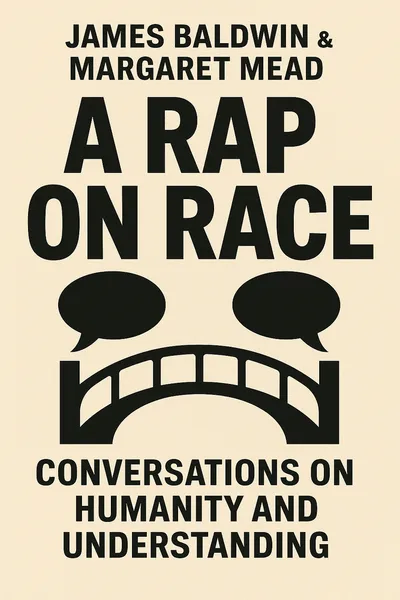
A Rap on Race
Conversations on humanity and understanding
Description
Published in 1971, *A Rap on Race* emerges from a singular intellectual encounter between two towering figures of American social thought. The work captures a series of recorded conversations conducted in August 1970, wherein Baldwin's experiential knowledge of racial oppression intersects with Mead's anthropological perspective on cultural patterns. This dialogical format represents an unprecedented attempt to bridge the gap between academic analysis and lived reality, situating the discussion within the turbulent context of the civil rights era and its aftermath.
The central research question explores how intellectual dialogue can transcend racial boundaries to illuminate the complex mechanisms through which race operates as a defining force in American society. The defended thesis argues that meaningful progress in racial understanding requires the synthesis of anthropological objectivity with subjective experience of racial oppression. The main stake is to demonstrate that cross-racial dialogue, despite its inherent tensions and limitations, remains essential for confronting the deep-seated nature of American racial dynamics.
*A Rap on Race* represents a unique experiment in intellectual dialogue that illuminates both the possibilities and limitations of cross-racial communication. The work demonstrates how meaningful engagement across racial lines requires acknowledgment of fundamental differences in experience and perspective while maintaining commitment to continued conversation. Baldwin and Mead's exchange reveals the complex interplay between academic knowledge and lived experience, suggesting that neither approach alone can fully capture the dynamics of racial oppression. The work's enduring significance lies not in its resolution of racial tensions but in its honest exploration of the difficulties inherent in such dialogue. Their conversation models a form of intellectual engagement that respects difference while seeking common ground, offering insights into the ongoing challenges of building democratic discourse across racial divisions.
Table of contents
01 The Anthropological Gaze and Racial Reality
The dialogue reveals fundamental tensions between Mead's anthropological framework and Baldwin's experiential knowledge of racial oppression. Mead approaches race through the lens of cultural relativism, seeking to understand racial dynamics as manifestations of broader cultural patterns susceptible to scientific analysis. Her perspective reflects the discipline's commitment to objective observation and comparative methodology, positioning race as one among many cultural variables worthy of systematic study.

02 Language, Power, and Cultural Translation
The conversational format exposes the complex dynamics of cross-racial communication, particularly the ways language itself becomes a site of cultural negotiation. Mead's anthropological vocabulary encounters Baldwin's literary and experiential discourse, creating moments of both connection and profound misunderstanding. These linguistic tensions reflect deeper questions about who possesses the authority to define racial experience and how knowledge about race circulates within different intellectual communities.
03 Historical Memory and Contemporary Struggle
Central to the dialogue is the question of how historical trauma shapes contemporary racial consciousness. Baldwin's perspective emphasizes the continuity between slavery, segregation, and contemporary forms of racial exclusion, arguing that these historical experiences remain embedded within American cultural patterns. His analysis reveals how racial memory operates not merely as individual psychology but as collective cultural inheritance that shapes social relations across generations.
04 The Ethics of Interracial Dialogue
The work grapples with fundamental ethical questions about the possibility and limits of cross-racial understanding. Baldwin's participation in the dialogue reflects both hope for meaningful communication and skepticism about its ultimate effectiveness. His willingness to engage reflects a strategic commitment to dialogue while maintaining critical distance from liberal assumptions about racial progress through conversation alone.
05 Critical Assessment and Contemporary Relevance
The work's primary limitation lies in its reproduction of certain assumptions about the neutrality of academic discourse and the universal possibility of rational dialogue. Mead's anthropological perspective, despite its sophistication, occasionally minimizes the structural nature of racial oppression by treating it as a cultural problem amenable to intellectual solution. The dialogue format, while innovative, may inadvertently suggest that racial understanding can be achieved through conversation alone, potentially obscuring the need for material changes in social relations.
Related books