

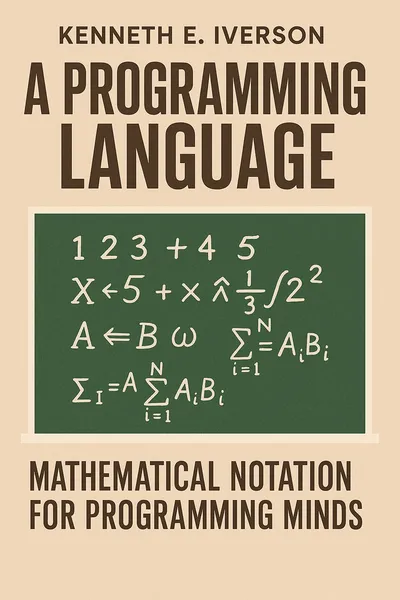
A Programming Language
Mathematical notation for programming minds
Description
Kenneth Iverson's seminal work emerges from the intellectual ferment of early computing, when the boundaries between mathematics and machine instruction remained fluid. Published in 1962, this treatise represents a radical departure from prevailing computational paradigms, proposing that programming languages constitute extensions of mathematical notation rather than degraded forms of human communication adapted for mechanical execution. Iverson's mathematical sophistication and institutional position at IBM Research enabled him to envision computational tools as cognitive amplifiers, challenging the instrumentalist conception of programming that dominated early computer science.
The central research question driving Iverson's work asks: How can mathematical notation be systematically extended to create programming languages that enhance rather than constrain human analytical capacity? His defended thesis argues that programming languages should be designed as rigorous mathematical notations that serve human cognitive processes, making complex algorithmic thinking more accessible and precise. The main stake of this argument is to establish a theoretical foundation for programming language design that prioritizes mathematical elegance and cognitive clarity over mere mechanical functionality.
Iverson's fundamental contribution lies in reconceptualizing programming languages as extensions of mathematical notation systems, thereby challenging the prevailing mechanistic understanding of computation. Rather than viewing code as degraded natural language adapted for machines, he positions programming languages within the tradition of mathematical symbolism that has historically amplified human analytical capacity. This perspective transforms the programmer from a mere translator between human intention and machine capability into a mathematician operating within extended notational systems. The theoretical framework underlying this position draws from cognitive science and mathematical philosophy, suggesting that notation systems actively shape thought processes rather than merely recording them.
Table of contents
01Mathematical Notation as Cognitive Architecture
Iverson's fundamental contribution lies in reconceptualizing programming languages as extensions of mathematical notation systems, thereby challenging the prevailing mechanistic understanding of computation. Rather than viewing code as degraded natural language adapted for machines, he positions programming languages within the tradition of mathematical symbolism that has historically amplified human analytical capacity. This perspective transforms the programmer from a mere translator between human intention and machine capability into a mathematician operating within extended notational systems.

02Democratizing Algorithmic Thinking
The social implications of Iverson's approach extend far beyond technical considerations, potentially revolutionizing access to computational thinking across disciplinary boundaries. By designing programming languages that mirror mathematical notation, he envisions computational tools accessible to mathematicians, scientists, and analysts without extensive programming training. This democratizing potential challenges the emerging division between programming specialists and domain experts, suggesting that computational thinking should be integrated into general intellectual practice rather than confined to technical specialists.
03Tensions Between Elegance and Implementation
Iverson's theoretical vision encounters significant tensions when confronted with the material constraints of computational implementation. While mathematical elegance provides clear criteria for notational design, the requirements of mechanical execution introduce competing demands that potentially compromise theoretical coherence. The gap between mathematical abstraction and machine capability creates persistent tensions that challenge the seamless integration Iverson envisions between mathematical thinking and computational practice.
04Ethical Implications of Cognitive Amplification
The broader societal consequences of Iverson's vision raise profound ethical questions about the distribution of cognitive enhancement and the transformation of intellectual labor. If programming languages indeed amplify human analytical capacity, their design and accessibility become matters of social justice, determining who gains access to enhanced cognitive tools. Iverson's emphasis on mathematical elegance may inadvertently privilege certain forms of analytical thinking while marginalizing alternative approaches to problem-solving, potentially reinforcing existing intellectual hierarchies rather than democratizing computational thinking.
05Critical Analysis and Future Implications
Iverson's framework suffers from several significant limitations that constrain its practical applicability and theoretical completeness. His emphasis on mathematical elegance may obscure the genuine cognitive differences between mathematical reasoning and computational implementation, leading to oversimplified assumptions about the transferability of mathematical intuitions to programming contexts. Additionally, his focus on notational systems may underestimate the importance of semantic and pragmatic considerations that prove crucial in actual programming practice, creating theoretical blind spots that limit the framework's practical utility.
The democratizing potential Iverson champions may also prove illusory, as mathematical sophistication remains a prerequisite for engaging with his proposed notation systems. Rather than eliminating barriers to computational thinking, his approach may simply shift these barriers from programming expertise to mathematical training, potentially excluding practitioners who lack formal mathematical background. This limitation suggests that true democratization requires more fundamental pedagogical and institutional changes than notational reform alone can provide.