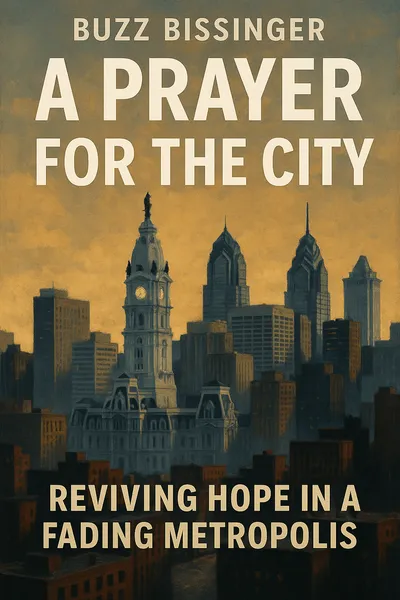
A Prayer for the City
Reviving hope in a fading metropolis
Description
Bissinger's work emerges from the profound urban crisis that characterized American cities during the late twentieth century, when deindustrialization, white flight, and fiscal collapse transformed once-thriving metropolitan centers into symbols of national decline. The author applies his immersive journalistic approach to examine Philadelphia's struggle for survival during the 1990s, focusing on Mayor Edward Rendell's controversial administration. This ethnographic study of municipal governance reveals the complex dynamics between political ambition, economic reality, and social transformation in post-industrial America.
The central research question driving this investigation asks: Can transformational political leadership reverse the seemingly inexorable decline of America's post-industrial cities? Bissinger defends the thesis that urban renewal requires politicians willing to confront established power structures and implement painful but necessary reforms. The main stake involves demonstrating that effective urban governance demands abandoning traditional political calculations in favor of long-term strategic thinking.
Bissinger's intellectual contribution lies in demonstrating how urban crisis represents a fundamental challenge to democratic governance, requiring leadership styles that transcend traditional political categories. The work's coherence emerges through its sustained examination of the tension between democratic responsiveness and administrative effectiveness. The author successfully illustrates how urban renewal demands political courage willing to confront entrenched interests, while acknowledging the ethical costs of transformational change. The analysis reveals urban governance as inherently tragic—requiring leaders to make impossible choices between competing values and constituencies. This framework provides valuable insights into the structural constraints facing contemporary American cities.
Table of contents
01The Archaeology of Urban Decline: Structural Pathology and Municipal Crisis
Bissinger's analysis excavates the layered pathology of urban decay, revealing how Philadelphia's crisis represents a microcosm of broader American metropolitan collapse. The theoretical framework employed draws from urban sociology's understanding of structural disinvestment, while incorporating political economy perspectives on municipal finance. The author demonstrates how decades of industrial exodus created cascading effects: tax base erosion, infrastructure deterioration, and social service reduction.

02Political Theater and Transformational Leadership: The Performance of Power
The central analytical tension emerges through Bissinger's portrayal of mayoral leadership as performative necessity rather than mere political calculation. Rendell's governance style represents a departure from consensus-building models, embracing confrontational approaches that challenge both labor unions and business elites. This examination reveals how effective urban leadership requires theatrical elements—public drama that mobilizes citizen attention while creating space for unpopular but necessary policies.
03The Social Cartography of Urban Inequality: Space, Power, and Democratic Deficits
Bissinger maps the human geography of urban crisis, revealing how spatial segregation reinforces economic and racial hierarchies. The theoretical apparatus incorporates environmental justice frameworks alongside traditional class analysis, demonstrating how municipal service provision reflects and reproduces inequality. The author's investigation reveals how neighborhoods become laboratories for different governance approaches—some receiving intensive intervention while others experience systematic neglect.
04The Moral Economy of Municipal Sacrifice: Justice, Legitimacy, and Tragic Choices
The final analytical axis examines how urban reform demands sacrifice from different constituencies, raising questions about distributive justice and political legitimacy. Bissinger's framework reveals how austerity politics create moral hierarchies—distinguishing between deserving and undeserving recipients of public resources. The author demonstrates how fiscal constraint becomes ideological justification for dismantling social protections, with economic necessity masking political choices.
05Critical Assessment and Contemporary Relevance: Limitations and Future Directions
Despite its narrative power, the work exhibits significant theoretical limitations. Bissinger's focus on charismatic leadership perpetuates "great man" theories that obscure structural factors driving urban decline. The analysis lacks sufficient attention to federal policy contexts that constrained municipal options, particularly housing and transportation policies that enabled suburban development. The work's emphasis on mayoral agency understates the role of capital mobility and regional economic restructuring in determining urban outcomes. Additionally, the author's perspective reflects elite bias, privileging administrative efficiency over community participation and democratic engagement.
Related books