

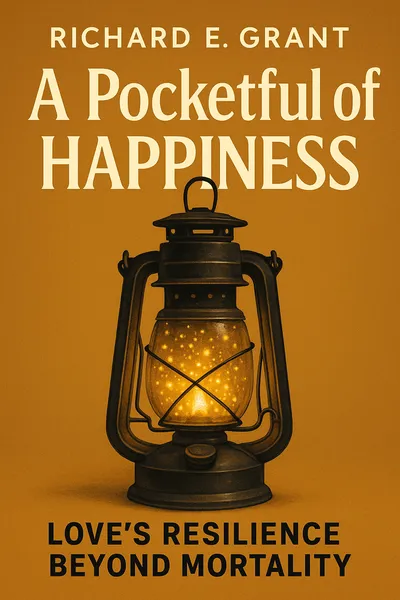
A Pocketful of Happiness
Love's resilience beyond mortality
Description
Grant's memoir emerges from the profound personal crisis of his wife Joan Washington's terminal cancer diagnosis and subsequent death. The work situates itself within the contemporary literary landscape of grief memoirs, yet distinguishes itself through its theatrical sensibility and unflinching examination of mortality's impact on enduring love. The author leverages his performative background to craft a narrative that oscillates between intimate domesticity and universal themes of loss, positioning the work as both personal testimony and broader meditation on human resilience.
'A Pocketful of Happiness' argues that profound love can transcend mortality through memory, shared experience, and the transformative power of grief channeled into creative expression and human connection. The central research question explored is: How does profound marital love adapt, persist, and ultimately transcend the finality of death? Grant defends the thesis that authentic love creates lasting happiness that survives physical loss through memory, creative expression, and continued emotional connection. The main stake is to demonstrate that grief, when approached with openness and creativity, can become a vehicle for celebrating rather than merely mourning lost love.
Grant successfully demonstrates that authentic love possesses transformative power capable of transcending physical mortality. The memoir's central achievement lies in its portrayal of grief as creative opportunity rather than mere loss, showing how profound partnership creates lasting happiness that survives individual death. The work establishes that such transcendence requires active engagement—memory, creativity, and continued openness to connection—rather than passive endurance of absence.
Table of contents
01The Architecture of Enduring Love
Grant constructs his narrative around the foundational premise that exceptional partnerships create their own temporal logic, existing beyond conventional chronological constraints. The author employs theatrical metaphors to examine how his marriage functioned as both intimate relationship and collaborative performance, wherein daily rituals became sacred acts of mutual creation. This framework reveals love as an active, creative force that generates meaning through shared experience rather than mere emotional attachment.

02Terminal Diagnosis as Existential Accelerant
The cancer diagnosis functions not merely as tragic circumstance but as catalyst that intensifies and clarifies the relationship's essential dynamics. Grant explores how proximity to death paradoxically enhances life's texture, making ordinary moments luminous with significance. The author demonstrates how crisis strips away social performances, revealing the bedrock of genuine connection beneath conventional marital roles.
03Grief as Creative Transformation
Grant's most innovative contribution lies in his exploration of grief as generative rather than merely destructive force. The author demonstrates how profound loss, when approached with artistic sensibility, becomes raw material for new forms of expression and connection. The memoir reveals how mourning can evolve into active celebration, transforming absence into presence through creative remembrance.
04Legacy and the Ethics of Remembrance
The memoir's final movement addresses the ethical dimensions of survival and remembrance. Grant confronts the survivor's responsibility to honor the deceased while continuing to live authentically. The work explores how carrying forward another's love requires balancing fidelity to shared past with openness to future possibility.
05Critical Assessment and Future Implications
Grant's analysis remains somewhat constrained by its autobiographical specificity, potentially limiting its broader applicability to different forms of loss or partnership. The work's theatrical metaphors, while illuminating, occasionally risk aestheticizing experiences that might benefit from more direct emotional engagement. Additionally, the memoir's focus on exceptional love might inadvertently marginalize more ordinary but equally valid forms of relationship and grief.