

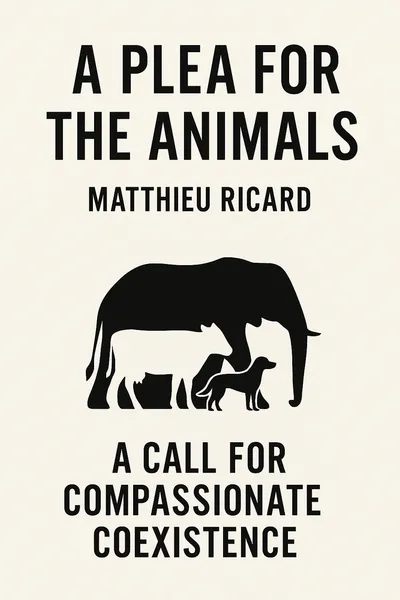
A Plea for the Animals
A call for compassionate coexistence
Description
Matthieu Ricard leverages his unique position as both former scientist and Buddhist monk to address one of contemporary society's most pressing ethical dilemmas: humanity's relationship with the animal kingdom. This work emerges within a broader intellectual context where traditional anthropocentric paradigms face increasing scrutiny from environmental, ethical, and scientific perspectives. The author's dual expertise in biological sciences and contemplative traditions positions him to offer a distinctive synthesis between empirical evidence and moral philosophy in examining human-animal relations.
The central research question driving this work asks: How can humanity fundamentally transform its relationship with animals from one of exploitation to one of respect and compassion? Ricard's defended thesis argues that the systematic mistreatment of animals represents a moral failure that contradicts both scientific evidence of animal sentience and universal ethical principles of compassion. The main stake is to establish a new ethical framework that recognizes animals as subjects deserving moral consideration rather than mere objects for human use.
Ricard's comprehensive treatment weaves together scientific evidence, ethical reasoning, structural analysis, and contemplative wisdom to construct a compelling case for fundamental transformation of human-animal relationships. The work's strength lies in its refusal to compartmentalize these dimensions, instead revealing their essential interconnection. The author successfully demonstrates how animal exploitation represents not merely a peripheral ethical issue but a central challenge to creating just and sustainable societies. The argument's coherence emerges from consistent application of compassion as organizing principle, while its intellectual contribution lies in bridging traditionally separated domains of scientific rationality and contemplative wisdom. The work challenges readers to examine taken-for-granted assumptions about human superiority while providing concrete pathways for ethical transformation.
Table of contents
01The Scientific Deconstruction of Human Exceptionalism
Ricard's argumentation fundamentally challenges anthropocentric assumptions by mobilizing contemporary scientific discoveries that blur traditional boundaries between human and non-human consciousness. The author systematically dismantles the Cartesian mechanistic view of animals as mere automata, drawing upon ethological research, neuroscience, and cognitive studies to demonstrate the complexity of animal emotional and intellectual life.
The theoretical framework employed here synthesizes Buddhist concepts of sentience with Western scientific methodology, creating a hybrid epistemological approach that transcends conventional academic boundaries. This convergence reveals how scientific materialism, paradoxically, supports contemplative traditions' recognition of universal consciousness and suffering. The author's former scientific training lends particular credibility to this deconstruction, as he cannot be dismissed as merely a religious idealist opposing rational inquiry.

02The Political Economy of Animal Exploitation
The analysis expands from individual ethics to structural critique, examining how economic systems institutionalize animal suffering through market mechanisms that externalize moral costs. Ricard exposes the industrial-agricultural complex as a system that transforms sentient beings into production units, revealing the dehumanizing effects of commodifying life itself.
This critique operates on multiple levels, connecting animal exploitation to broader patterns of domination and alienation characteristic of capitalist relations. The author demonstrates how consumer choices become complicit in systems of violence, while market dynamics create incentives for increasingly intensive exploitation. The geographical and temporal displacement of production from consumption enables moral disengagement, allowing consumers to maintain psychological distance from the consequences of their choices.
03Cultural Narratives and Moral Blindness
Ricard investigates the cultural mechanisms that normalize animal exploitation through language, tradition, and symbolic systems that obscure moral reality. The analysis reveals how euphemistic language ("harvesting," "processing") linguistically transforms violence into neutral economic activity, while cultural traditions invoke historical continuity to justify contemporary practices that technological development has rendered unnecessary.
The examination of speciesism as ideological construct parallels analyses of racism and sexism, revealing how arbitrary biological characteristics become basis for moral exclusion. This comparative approach illuminates the psychological mechanisms through which dominant groups construct hierarchies that justify subordination of others. The author exposes how scientific discourse itself can become instrumentalized to rationalize exploitation while appearing objective and value-neutral.
04Toward Compassionate Ethics and Social Transformation
The constructive dimension of Ricard's argument develops an alternative ethical framework grounded in compassion as universal principle transcending species boundaries. This approach draws upon Buddhist concepts of interdependence while remaining accessible to secular audiences through emphasis on suffering as common denominator of sentient experience.
The practical implications encompass individual lifestyle choices, institutional reforms, and civilizational reorientation toward sustainability and respect for life. The author envisions transformation occurring through multiple pathways: consumer pressure, legal evolution, technological innovation, and cultural shift toward recognizing intrinsic value of all sentient beings. The integration of contemplative practices with social engagement offers a model for sustained ethical commitment beyond mere intellectual adherence to principles.
05Critical Assessment and Future Directions
Despite its comprehensive scope, the work exhibits certain limitations that constrain its transformative potential. The emphasis on individual ethical choice, while necessary, may insufficient address structural forces perpetuating animal exploitation. The author's privileged position as affluent Western intellectual may limit appreciation of economic constraints facing those with fewer options for ethical consumption.
The synthesis between Buddhist philosophy and Western science, while innovative, occasionally appears forced, potentially alienating readers committed to either purely secular or purely religious approaches. The optimistic vision of transformation may underestimate entrenched interests and psychological resistances that sustain current practices despite growing awareness of their harmful consequences.