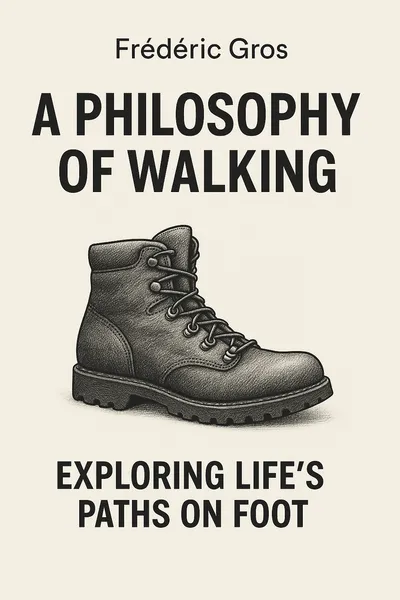
A Philosophy of Walking
Exploring life's paths on foot
Description
Frédéric Gros presents a philosophical meditation that transforms the mundane act of walking into a lens for understanding contemporary human condition. Drawing from his expertise in political philosophy and phenomenology, the author constructs a theoretical framework that positions pedestrian movement as both practice and metaphor for authentic existence. The work emerges within a broader intellectual context questioning technological acceleration and social alienation, proposing walking as a form of resistance to contemporary malaise.
The central research question explores how walking functions as a revelatory practice that unveils fundamental dimensions of human experience and freedom. Gros defends the thesis that walking represents a privileged mode of being that enables authentic self-encounter and resistance to the dehumanizing forces of modernity. The main stake involves demonstrating that pedestrian practices constitute forms of philosophical praxis capable of transforming our relationship to time, space, and selfhood.
Gros constructs a compelling philosophical argument that positions walking as a fundamental practice for accessing authentic human experience and developing resistance to the dehumanizing aspects of contemporary existence. The work successfully demonstrates how this apparently simple activity encompasses complex philosophical, political, and ethical dimensions that reveal its significance for contemporary human flourishing. The intellectual contribution lies in the author's ability to synthesize phenomenological analysis with social critique, revealing how embodied practices carry transformative potential often overlooked by more abstract theoretical approaches.
Table of contents
01 Walking as Phenomenological Experience
Gros establishes walking as a phenomenological practice that transforms consciousness through embodied engagement with space and temporality. The author draws upon existential philosophy to demonstrate how pedestrian movement generates a specific form of awareness distinct from sedentary contemplation or mechanized transport. This analysis reveals walking as a practice of presence, where the rhythmic engagement between body and environment produces altered states of consciousness.
The theoretical framework employed synthesizes Heideggerian concepts of being-in-the-world with more contemporary phenomenological insights. Walking emerges as a practice that dissolves the artificial separation between mind and body, subject and object, revealing instead an integrated mode of existence. This dissolution enables what Gros identifies as authentic temporal experience, where clock time gives way to lived duration structured by bodily rhythm and environmental encounter.

02 The Politics of Pedestrian Movement
The second analytical axis examines walking's political dimensions, revealing how different forms of pedestrian practice embody distinct relationships to power and social organization. Gros demonstrates that the simple act of walking becomes politically charged when situated within contemporary urban environments designed to privilege automotive transport and commercial consumption. The pedestrian emerges as a figure of resistance against spatial arrangements that reflect broader power structures.
Pilgrimage represents one manifestation of walking's political potential, constituting a form of temporal sovereignty that refuses the acceleration imperatives of modern life. Similarly, protest marches transform pedestrian movement into collective political expression, claiming public space through embodied presence. These practices reveal walking's capacity to generate alternative forms of social organization based on shared physical experience rather than abstract political representation.
03 Solitude and Social Transformation
Gros explores the paradoxical relationship between walking's solitary character and its potential for social transformation. The practice generates a specific form of solitude that differs fundamentally from isolation or withdrawal, constituting instead an active engagement with selfhood that prepares the ground for authentic social encounter. This analysis challenges conventional assumptions about the relationship between individual and collective experience.
The solitude generated through walking enables critical distance from social conditioning and habitual patterns of thought and behavior. This distancing function reveals walking as a practice of desubjectification, temporarily suspending social roles and identities to access more fundamental dimensions of human experience. The author demonstrates how this temporary suspension creates possibilities for genuine transformation rather than mere escape or retreat.
04 Ethics of Embodied Existence
The final analytical axis addresses the ethical implications of walking as a practice that reconnects human beings with embodied existence and environmental interdependence. Gros positions walking as an ethical practice that challenges the disembodied rationality characteristic of modern philosophical and political discourse. The practice reveals forms of knowledge and value that emerge through sustained bodily engagement with the world.
Environmental consciousness emerges naturally from pedestrian practice as individuals experience their fundamental dependence on natural systems and seasonal cycles. This experiential knowledge generates ethical obligations that remain abstract within more mediated forms of environmental awareness. Walking thus functions as a practice of environmental education that transforms theoretical understanding into embodied commitment.
05 Critical Assessment and Future Directions
Despite its philosophical richness, Gros's analysis suffers from certain theoretical limitations that constrain its critical potential. The work tends toward romantic idealization of walking that obscures the material conditions necessary for sustained pedestrian practice. The author's focus on individual transformation risks depoliticizing walking by emphasizing personal authenticity over collective action and structural change.
The analysis also reflects a somewhat privileged perspective that assumes leisure time and physical capacity for extended walking practice. This assumption limits the work's applicability to populations constrained by economic necessity or physical disability, potentially reproducing forms of exclusion the author seeks to challenge.
Related books