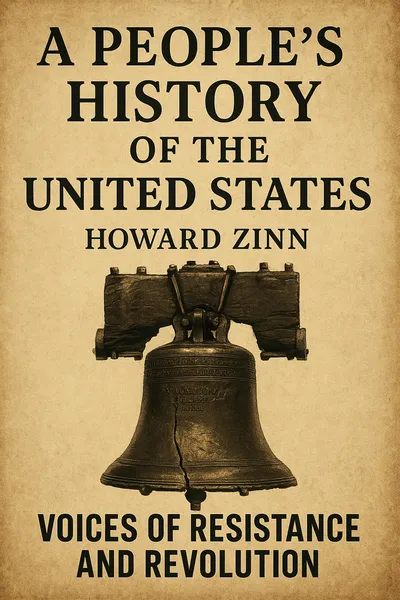
A People's History of the United States
Voices of resistance and revolution
Description
Howard Zinn presents a radical reinterpretation of American historical narrative, positioning himself as both historian and activist. His expertise in social movements and grassroots organizing informs this comprehensive examination of American society from pre-Columbian times through the late twentieth century. The work emerges from the intellectual ferment of the 1960s civil rights movement and anti-war protests, reflecting broader scholarly efforts to democratize historical knowledge and challenge traditional power structures.
• Central research question: How can American history be understood when viewed from the perspective of the exploited rather than the exploiters? • Defended thesis: The true American story lies in the continuous struggle of ordinary people against oppressive systems of power and privilege • Main stake: To demonstrate that popular resistance movements, not elite leadership, constitute the authentic engine of social progress and democratic transformation
Zinn constructs a compelling counter-narrative demonstrating that American history's authentic protagonists were ordinary people struggling against systematic oppression rather than celebrated leaders managing existing institutions. His synthesis reveals persistent patterns of elite domination accompanied by equally persistent popular resistance. The work's intellectual contribution lies in demonstrating history's political dimensions while providing historical grounding for contemporary social movements.
The historian successfully challenges mythological narratives about American exceptionalism, revealing how democratic rhetoric masked ongoing exploitation and violence. His documentation of grassroots movements provides inspiration and strategic lessons for current activists while demonstrating ordinary people's capacity for extraordinary social transformation.
Table of contents
01 Counter-Hegemonic Historical Methodology
Zinn employs a deliberately subversive methodological framework that inverts traditional historical hierarchies. Rather than celebrating presidential achievements or military conquests, he excavates testimonies from slaves, factory workers, indigenous peoples, and social outcasts. This approach reflects influence from Marxist historiography and Antonio Gramsci's concept of counter-hegemonic discourse. The historian positions himself as archaeological excavator of suppressed voices, utilizing primary sources typically marginalized in mainstream scholarship.

02 Economic Exploitation and Labor Resistance
The work systematically exposes how American prosperity depended upon systematic exploitation of workers, slaves, and indigenous populations. Zinn demonstrates how industrial development required violent suppression of labor organizing, from early textile strikes through twentieth-century union battles. Corporate power consistently enlisted state apparatus to crush worker resistance, revealing democracy's limitations when confronting economic interests.
03 Imperial Violence and Anti-War Movements
Zinn reframes American foreign policy as continuous imperial expansion disguised through democratic rhetoric. From westward expansion's genocidal consequences through twentieth-century military interventions, the work documents how war served elite economic interests while imposing devastating costs upon ordinary Americans and international victims. The Spanish-American War, both World Wars, and Vietnam conflict receive analysis emphasizing their class dimensions and popular opposition.
04 Cultural Resistance and Democratic Possibilities
Beyond economic and political analysis, Zinn examines cultural dimensions of popular resistance. Art, literature, music, and grassroots education served as vehicles for challenging dominant ideologies and imagining alternative social arrangements. The work celebrates cultural workers who used creative expression to build solidarity and inspire social movements.
Educational institutions receive critical scrutiny for their role in reproducing elite dominance through selective historical narratives and disciplinary practices. However, Zinn also documents educational spaces where democratic possibilities flourished through student activism, alternative curricula, and community organizing. These examples suggest how cultural transformation accompanies political change.
05 Critical Assessment and Contemporary Relevance
While Zinn's partisan approach serves important political functions, it sometimes sacrifices analytical complexity for moral clarity. The work occasionally reduces historical complexity to simple conflicts between oppressors and oppressed, potentially obscuring contradictory dynamics within social movements themselves. His focus on resistance movements, though valuable, may inadvertently minimize how thoroughly dominant ideologies penetrated popular consciousness.
The historical narrative sometimes lacks sufficient attention to international contexts shaping American developments. Additionally, theoretical frameworks remain largely implicit, limiting engagement with sophisticated analytical tools from social theory, anthropology, and cultural studies that might deepen the analysis.
Related books