

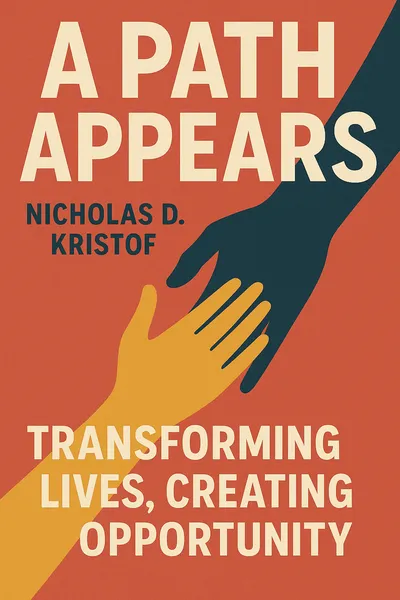
A Path Appears
Evidence over good intentions
Description
Kristof presents a comprehensive examination of contemporary philanthropy and social intervention mechanisms, drawing from extensive field research and case studies across diverse global contexts. The work emerges from growing concerns about aid effectiveness and the transformation of charitable giving in the twenty-first century. Positioned within development studies discourse, the analysis challenges conventional wisdom about benevolence while proposing alternative frameworks for meaningful social impact.
The central research question explores how philanthropic efforts and social interventions can achieve genuine, sustainable impact rather than perpetuating dependency cycles. Kristof defends the thesis that evidence-based giving, direct community engagement, and long-term capacity building represent more effective approaches than traditional charitable models. The main stake involves transforming public understanding of effective altruism and establishing new paradigms for social change financing.
Kristof constructs a coherent argument for transforming philanthropic practice through evidence-based methodologies, community engagement, and systematic evaluation. The work successfully bridges academic research with practical implementation, offering concrete recommendations for improving charitable effectiveness. His synthesis demonstrates how individual actions can contribute to systemic change when guided by rigorous analysis and ethical reflection. The intellectual contribution lies in democratizing complex development theories while maintaining analytical sophistication. Kristof's approach makes evidence-based philanthropy accessible to general audiences without sacrificing theoretical depth or empirical rigor.
Table of contents
01The Evidence-Based Philanthropy Paradigm
Kristof's theoretical framework centers on empirical validation of charitable effectiveness, challenging emotionally-driven giving patterns that dominate contemporary philanthropy. The author constructs a compelling argument for systematic evaluation methodologies, drawing from randomized controlled trials and impact measurement techniques borrowed from social sciences. This approach represents a fundamental epistemological shift from intuitive benevolence toward scientific philanthropy.

02Community Agency and Participatory Development
The second analytical axis explores the tension between external intervention and indigenous agency. Kristof advocates for participatory development models that prioritize community voice and local ownership over paternalistic aid delivery systems. This perspective challenges the savior complex prevalent in Western philanthropic traditions while highlighting successful examples of community-driven change initiatives.
03Individual Action and Collective Impact
Kristof addresses the paradox of individual responsibility within systemic challenges, exploring how personal philanthropic choices intersect with broader social transformation. The analysis examines the psychological motivations behind charitable giving while questioning whether individual altruism can effectively address structural inequalities.
04Ethical Implications and Global Responsibility
The final analytical dimension examines the moral obligations of privileged individuals and nations toward global suffering. Kristof's ethical framework combines utilitarian effectiveness with justice-based considerations, arguing that philanthropic choices carry significant moral weight requiring careful deliberation.
05Critical Analysis and Future Directions
The work exhibits certain limitations regarding structural analysis of global inequality. While emphasizing individual and organizational solutions, Kristof insufficient addresses how philanthropic approaches might inadvertently legitimize systems generating the problems they attempt to solve. The framework occasionally displays Western-centric assumptions about development pathways and success metrics.