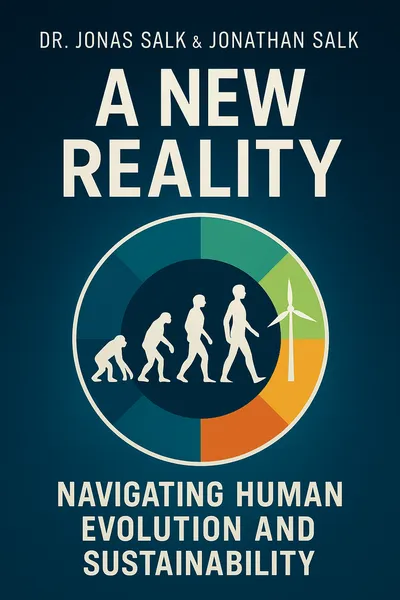
A New Reality
Navigating human evolution and sustainability
Description
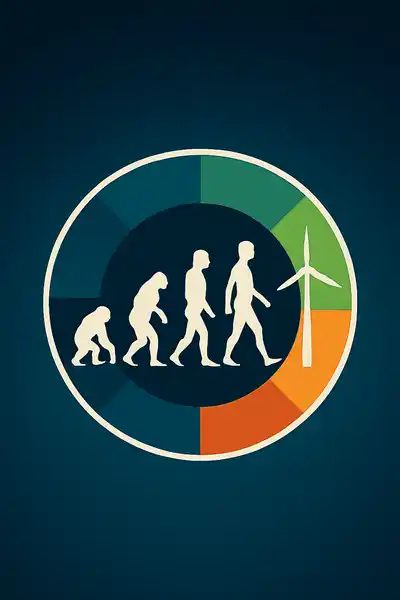
"A New Reality" by Dr. Jonas Salk and Jonathan Salk positions humanity at a critical evolutionary juncture where traditional biological adaptation mechanisms prove insufficient for addressing accelerating global crises. The authors propose a fundamental reconceptualization of human evolution, advocating for conscious, directed transformation rather than passive biological adaptation. Their central thesis argues that human survival depends on transitioning from unconscious biological evolution to deliberate cultural-ethical evolution.
The Salks fundamentally challenge Darwinian determinism by proposing evolutionary consciousness as humanity's distinctive adaptive mechanism. Their framework transcends traditional biological evolution, suggesting that cognitive awareness enables species-level self-direction. This perspective positions human consciousness as both evolutionary product and evolutionary agent, drawing from systems theory and complexity science.
Their conceptualization of meta-evolution—evolution aware of itself—introduces profound epistemological implications. The capacity for self-reflection enables humans to anticipate adaptive requirements rather than merely responding to selective pressures. This anticipatory evolution represents a qualitative leap from reactive biological processes toward proactive cultural design.
The authors examine sustainability not merely as environmental protection but as fundamental species survival strategy requiring comprehensive worldview transformation. Their analysis reveals how industrial civilization's growth paradigms contradict planetary carrying capacity, necessitating radical conceptual shifts in human-environment relationships. They propose that sustainability demands evolving beyond anthropocentric frameworks toward ecological integration.
The work explores tensions between biological programming and ethical evolution, arguing that moral development must outpace instinctual drives. The authors suggest that ethical evolution represents humanity's next adaptive frontier, requiring conscious cultivation of cooperative, empathetic responses that override competitive instincts. This moral transformation demands individual psychological development alongside collective cultural shifts.
The Salks confront the ethical implications of conscious evolution, arguing that awareness of evolutionary capacity creates unprecedented moral responsibility. If humans can direct their development, they become accountable for species trajectory and planetary impact. Their framework addresses the paradox of freedom within evolutionary constraints, suggesting that conscious choice operates within biological and physical limitations while transcending deterministic programming.
Table of contents
01 Evolutionary Consciousness and Adaptive Transformation
The Salks fundamentally challenge Darwinian determinism by proposing evolutionary consciousness as humanity's distinctive adaptive mechanism. Their framework transcends traditional biological evolution, suggesting that cognitive awareness enables species-level self-direction. This perspective draws from systems theory and complexity science, positioning human consciousness as both evolutionary product and evolutionary agent.
The authors construct a theoretical architecture where awareness becomes the primary evolutionary tool, capable of superseding genetic adaptation timescales. They argue that cultural transmission represents a faster, more flexible evolutionary mechanism than biological inheritance. This proposition challenges deterministic interpretations of human development, suggesting that conscious choice can redirect species trajectory.

02 Sustainability Imperatives and Systemic Transformation
The authors examine sustainability not merely as environmental protection but as fundamental species survival strategy requiring comprehensive worldview transformation. Their analysis reveals how industrial civilization's growth paradigms contradict planetary carrying capacity, necessitating radical conceptual shifts in human-environment relationships.
The Salks propose that sustainability demands evolving beyond anthropocentric frameworks toward ecological integration. This transformation requires dismantling exploitative mentalities embedded in contemporary economic and social structures. Their systemic approach recognizes that environmental crisis reflects deeper philosophical failures in understanding human-nature interdependence.
03 Cultural Evolution and Ethical Development
The Salks explore tensions between biological programming and ethical evolution, arguing that moral development must outpace instinctual drives. Their analysis reveals how ancient survival mechanisms—competition, territorial behavior, in-group preference—create contemporary dysfunction in interconnected global contexts.
They propose that ethical evolution represents humanity's next adaptive frontier, requiring conscious cultivation of cooperative, empathetic responses that override competitive instincts. This moral transformation demands individual psychological development alongside collective cultural shifts. The authors suggest that wisdom traditions, properly integrated with scientific understanding, provide frameworks for this ethical evolution.
04 Responsibility and Conscious Choice
The authors confront the ethical implications of conscious evolution, arguing that awareness of evolutionary capacity creates unprecedented moral responsibility. If humans can direct their development, they become accountable for species trajectory and planetary impact. This responsibility extends beyond individual choices to collective decision-making about civilizational direction.
The Salks examine how conscious evolution challenges traditional concepts of human nature as fixed essence, suggesting instead that humanity represents a dynamic, self-creating process. This perspective empowers but also burdens contemporary generations with choices that will determine species survival. They argue that accepting this responsibility represents maturation from adolescent species behavior toward adult planetary citizenship.
05 Critical Analysis and Future Directions
The Salks present a compelling synthesis that repositions human evolution as conscious process rather than unconscious biological drift. Their framework integrates scientific understanding with ethical imperative, arguing that species survival demands deliberate cultural-moral evolution. The work demonstrates remarkable coherence in connecting individual psychological development with species-level transformation and planetary sustainability.
However, the Salks' optimistic framework may underestimate resistance to conscious evolution from entrenched power structures and psychological attachments to familiar patterns. Their emphasis on rational choice potentially overlooks unconscious forces that drive human behavior. Additionally, the work lacks detailed mechanisms for implementing suggested transformations at scale, remaining somewhat abstract in practical application.
Related books