

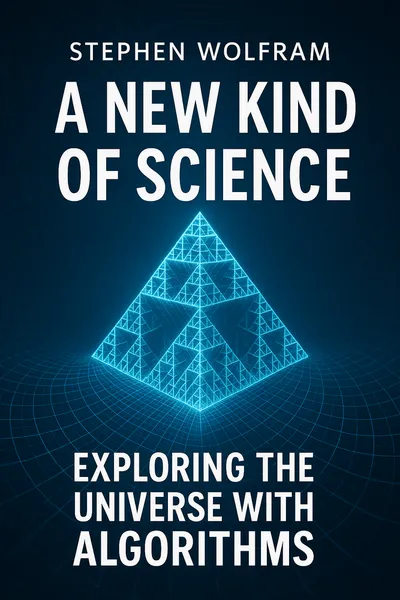
A New Kind of Science
Exploring the universe with algorithms
Description
Stephen Wolfram presents a revolutionary computational framework that challenges the mathematical foundations of modern science. Drawing from decades of research in cellular automata and complex systems, this work proposes that simple computational programs can explain the emergence of complexity across all natural phenomena. The author positions his approach as a paradigmatic shift comparable to the mathematical revolution initiated by Newton, arguing for the primacy of computational processes over traditional mathematical equations in understanding reality.
The central research question asks: Can simple computational rules account for all complex phenomena observed in nature, from physical processes to biological evolution and consciousness? Wolfram defends the thesis that the universe operates fundamentally as a computational system, where simple programs generate the apparent complexity we observe across all scientific domains. The main stake is to establish a new scientific paradigm that replaces equation-based mathematics with rule-based computation as the primary tool for understanding natural phenomena.
Wolfram's work reveals fundamental tensions within scientific epistemology by positioning computation as potentially superior to traditional mathematics for understanding natural phenomena. This creates a methodological rupture that challenges the authority of mathematical proof as the gold standard of scientific knowledge. The author suggests that many mathematical approaches fail precisely because they impose continuous, analytical frameworks on fundamentally discrete, computational processes.
Table of contents
01The Computational Universe Paradigm
Wolfram's foundational argument rests on the radical proposition that computation, rather than mathematics, constitutes the fundamental language of nature. This paradigmatic shift challenges three centuries of Newtonian thinking by suggesting that discrete computational processes, exemplified by cellular automata, better capture natural phenomena than continuous mathematical functions. The author demonstrates how elementary computational rules can generate patterns of extraordinary complexity, arguing that this computational irreducibility explains why traditional reductionist approaches have failed to predict or fully understand natural systems.

02Complexity and Emergence Across Domains
The sociological implications of Wolfram's thesis extend far beyond academic science, potentially reshaping how society approaches technological development, economic modeling, and social organization. By demonstrating that simple rules generate complex behaviors across biological, physical, and social systems, the work suggests that emergent complexity cannot be controlled or predicted through traditional hierarchical management approaches. This insight challenges fundamental assumptions underlying contemporary governance structures, economic theories, and technological design principles.
03The Mathematics-Computation Dialectic
Wolfram's work reveals fundamental tensions within scientific epistemology by positioning computation as potentially superior to traditional mathematics for understanding natural phenomena. This creates a methodological rupture that challenges the authority of mathematical proof as the gold standard of scientific knowledge. The author suggests that many mathematical approaches fail precisely because they impose continuous, analytical frameworks on fundamentally discrete, computational processes.
04Ethical and Existential Consequences
The ethical implications of Wolfram's computational universe are profound and troubling. If consciousness, free will, and human agency emerge from computational processes no different from those governing weather patterns or crystal growth, traditional concepts of moral responsibility require fundamental reconceptualization. The work suggests that human ethical systems, based on assumptions of autonomous agency, may be elaborate fictions masking underlying computational determinism.
05Critical Assessment and Future Directions
Wolfram presents a coherent and ambitious theoretical framework that attempts to unify scientific understanding through computational principles. The work's intellectual contribution lies not merely in its specific discoveries about cellular automata but in its systematic challenge to mathematical reductionism and its proposal for a new scientific methodology based on computational exploration. The author demonstrates remarkable consistency in applying computational principles across diverse phenomena, from microphysics to consciousness, creating a genuinely interdisciplinary synthesis.
The coherence of Wolfram's argument stems from its fundamental simplicity: if the universe operates computationally, then computational methods provide the most direct access to natural phenomena. This elegant premise allows the work to address seemingly disparate questions—randomness, complexity, intelligence, determinism—within a unified framework that avoids the fragmentation characteristic of contemporary specialized science.