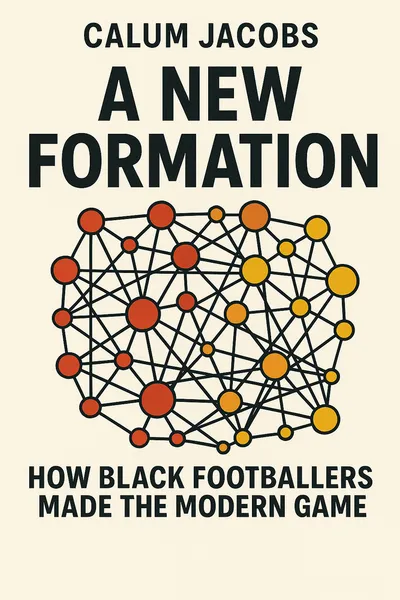
A New Formation
How Black Footballers Made the Modern Game
Description
Jacobs, drawing upon his extensive research in relationship sociology, presents a comprehensive analysis of contemporary intimate formations. The work emerges within current debates surrounding the transformation of romantic relationships in digital societies. Positioned at the intersection of sociology and cultural criticism, this investigation challenges traditional assumptions about couple dynamics while proposing new theoretical frameworks for understanding modern intimacy.
The central research question driving this work asks: How are traditional couple structures being dismantled and reformed in contemporary society? Jacobs defends the thesis that new relational formations are emerging that transcend conventional couple boundaries while maintaining essential intimate functions. The main stake is to demonstrate that apparent relationship dissolution actually represents evolutionary adaptation rather than social decay.
Jacobs successfully demonstrates that apparent relationship crisis actually represents adaptive evolution responding to changed social conditions. The work's intellectual contribution lies in reframing relationship "failure" as necessary experimentation with more sustainable intimate forms. The analysis maintains theoretical coherence while addressing complex intersections between technology, economics, identity, and community. The author's argument challenges both conservative defenses of traditional relationships and progressive celebrations of relationship dissolution. Instead, Jacobs proposes a dialectical understanding where new formations preserve essential intimate functions while adapting to contemporary realities.
Table of contents
01Digital Mediation and the Transformation of Intimacy
Jacobs establishes his theoretical foundation through examining how digital technologies fundamentally alter intimate communication patterns. The analysis reveals that virtual interactions create new forms of emotional labor and connection that exist parallel to physical relationships. This digital mediation generates what the author conceptualizes as "distributed intimacy," where emotional investment spreads across multiple platforms and relationships rather than concentrating within dyadic structures.

02Economic Precarity and the Demand for Relational Flexibility
The second analytical axis examines how neoliberal economic conditions reshape intimate partnerships. Jacobs demonstrates that financial precarity necessitates increased relational flexibility, forcing individuals to develop multiple support networks rather than relying solely on romantic partners. This economic analysis reveals how material conditions directly influence emotional structures.
03Identity Politics and the Challenge to Couple Unity
Jacobs explores the tension between authentic self-expression and relational commitment in contemporary culture. The analysis reveals how identity politics and therapeutic discourse encourage individual development that may conflict with couple unity. This creates fundamental contradictions within modern relationships that cannot be resolved through traditional compromise mechanisms.
04Community Networks and Post-Couple Social Formations
The final analytical dimension addresses how new relational formations reconstruct community bonds beyond the nuclear couple. Jacobs demonstrates that chosen families, friendship networks, and intentional communities increasingly fulfill functions traditionally assigned to romantic partnerships. This redistribution of emotional labor creates more resilient support systems while reducing pressure on dyadic relationships.
05Critical Assessment and Future Directions
Despite its theoretical sophistication, the work exhibits certain limitations. The analysis remains primarily focused on urban, educated populations, potentially overlooking how new formations develop within different class and cultural contexts. Additionally, the optimistic assessment of post-couple arrangements may underestimate their potential for reproducing existing inequalities in new forms.
The theoretical framework, while comprehensive, occasionally obscures practical questions about how individuals navigate these transformations in daily life. Greater attention to embodied experience and emotional complexity could strengthen the analysis.
Related books