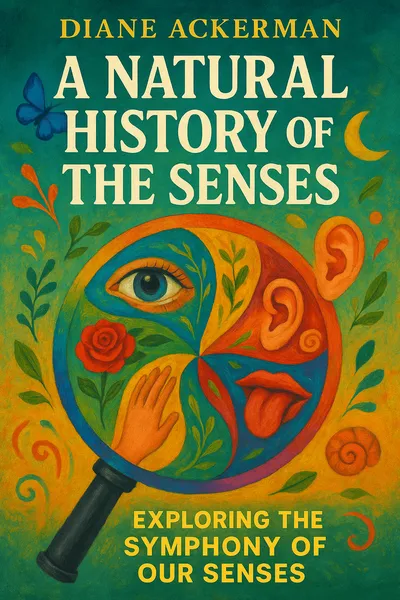
A Natural History of the Senses
Exploring the symphony of our senses
Description
Diane Ackerman approaches sensory experience as both scientist and poet, drawing upon neurological research, anthropological observations, and literary sensibility to examine how the five senses shape human consciousness. Her interdisciplinary methodology challenges traditional academic boundaries, positioning sensory perception as the foundation of human understanding and cultural development. The work emerges from contemporary neuroscience and environmental awareness, reflecting growing interest in embodied cognition and ecological consciousness.
The central research question that drives this work is: How do the five senses function as the primary mediators between human consciousness and the external world? Ackerman defends the thesis that sensory experience represents the foundational mechanism through which humans create meaning, establish relationships, and develop cultural understanding. The main stake of her argument is to demonstrate that privileging intellectual abstraction over sensory engagement impoverishes human experience and disconnects us from natural and social environments.
Ackerman's comprehensive examination establishes sensory experience as the foundational element of human consciousness, knowledge, and ethical capacity. Her interdisciplinary approach successfully demonstrates the artificial nature of traditional separations between mind and body, culture and nature, reason and sensation. The work reveals sensory awareness as simultaneously personal and political, individual and ecological, immediate and historical. Through this integration, Ackerman constructs a compelling argument for sensory restoration as essential for addressing contemporary crises in education, environmental awareness, and social connection.
Table of contents
01The Epistemology of Embodied Knowledge
Ackerman constructs an epistemological framework that challenges Cartesian dualism by positioning sensory experience as the primary source of legitimate knowledge. Her analysis reveals how Western intellectual traditions have systematically devalued bodily perception in favor of abstract reasoning, creating artificial hierarchies between mind and body, culture and nature. The author demonstrates that this philosophical separation obscures the fundamental reality that all knowledge originates through sensory channels, making embodied experience the prerequisite for abstract thought rather than its inferior counterpart.

02Cultural Construction of Sensory Meaning
The work examines how different societies construct varying relationships with sensory experience, revealing the cultural specificity of what appears to be universal biological processes. Ackerman demonstrates that sensory perception operates within socially constructed frameworks that determine which sensations are valued, suppressed, or transformed into cultural meaning. Her analysis reveals how power structures shape sensory hierarchies, with certain senses associated with higher social status while others are marginalized or stigmatized.
03Environmental Crisis and Sensory Disconnection
Ackerman establishes crucial connections between environmental degradation and human sensory alienation, arguing that ecological destruction both results from and perpetuates disconnection from natural sensory experiences. Her analysis demonstrates how technological mediation increasingly replaces direct sensory engagement with natural environments, creating feedback loops that diminish both environmental awareness and sensory capacity. This double alienation weakens human motivation for environmental protection while reducing the perceptual skills necessary for ecological understanding.
04Ethical Implications of Sensory Awareness
The ethical dimensions of Ackerman's thesis emerge through her examination of how sensory awareness shapes moral responsibility and interpersonal connection. Her analysis reveals that ethical behavior depends fundamentally on sensory empathy—the capacity to perceive and respond to others' experiences through embodied understanding rather than abstract moral principles. This perspective repositions ethics as emerging from sensory engagement rather than rational calculation, emphasizing the moral significance of maintaining and developing perceptual sensitivity.
05Critical Assessment and Contemporary Relevance
Ackerman's celebration of sensory experience occasionally romanticizes pre-industrial societies while underestimating the genuine benefits of technological mediation. Her framework risks essentializing sensory experience as inherently positive while neglecting how sensory awareness can also transmit trauma, prejudice, and destructive impulses. The work's emphasis on individual sensory restoration may inadequately address structural forces that create sensory impoverishment, potentially shifting responsibility from institutional to personal levels.
Related books