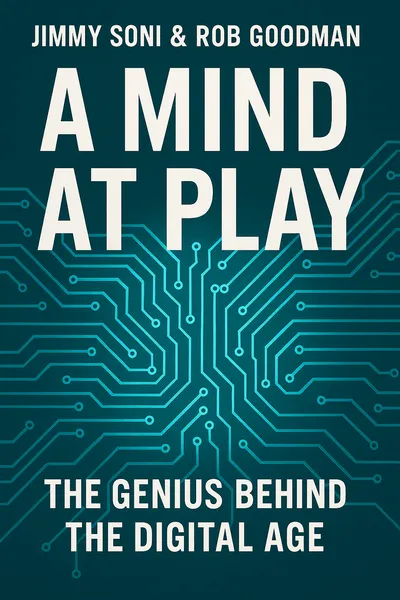
A Mind at Play
The genius behind the digital age
Description
Soni and Goodman present an intellectual biography examining Claude Shannon's revolutionary contribution to twentieth-century thought through the lens of information theory. The authors position Shannon not merely as a mathematician or engineer, but as an interdisciplinary thinker whose seemingly playful approach to problem-solving yielded profound theoretical insights. The work emerges within contemporary biographical discourse that seeks to humanize scientific genius while maintaining analytical rigor regarding its subject's intellectual achievements. The biography situates Shannon's contributions within broader technological and social transformations that defined the transition from industrial to information society.
The central research question explores how Shannon's interdisciplinary methodology and playful intellectual approach generated foundational principles for digital communication. The defended thesis demonstrates that Shannon's integration of mathematical abstraction with practical experimentation established information theory as the theoretical bedrock of contemporary digital civilization. The main stake involves demonstrating that revolutionary scientific breakthroughs emerge from the synthesis of rigorous methodology with creative, seemingly non-utilitarian exploration.
Soni and Goodman successfully demonstrate how Shannon's biographical trajectory illuminates broader patterns in twentieth-century scientific development. Their analysis shows how individual intellectual achievement intersects with institutional support, social context, and historical circumstance to generate transformative technological change. The biography reveals Shannon as both brilliant individual and representative figure whose work crystallized broader intellectual trends toward mathematical modeling and systematic abstraction. The authors' central argument—that playful intellectual exploration generates profound theoretical insights—challenges conventional understanding of scientific methodology. Their biographical approach demonstrates how personality, institutional context, and historical moment combine to enable revolutionary intellectual breakthroughs that reshape human experience.
Table of contents
01 The Epistemological Revolution of Information Theory
Soni and Goodman's analysis reveals how Shannon fundamentally reconceptualized communication by abstracting it from its physical manifestations. The authors demonstrate that Shannon's intellectual breakthrough lay in recognizing information as a quantifiable, manipulable entity independent of its semantic content. This epistemological shift transformed communication from a humanistic concern into a mathematical discipline, establishing binary logic as the universal language of information processing.

02 The Social Architecture of Technological Transformation
The biography examines how Shannon's theoretical work became embedded within institutional frameworks that amplified its social impact. Soni and Goodman analyze Bell Laboratories as a unique intellectual ecosystem that fostered interdisciplinary collaboration and long-term research. This institutional analysis reveals how technological innovation requires not merely individual genius but supportive organizational structures that protect creative exploration from immediate commercial pressures.
03 The Dialectic of Play and Productivity
A central tension emerges in Soni and Goodman's narrative between Shannon's playful approach to intellectual work and the profound practical consequences of his discoveries. The authors explore how Shannon's construction of juggling robots, chess-playing machines, and gambling strategies reflected not mere recreational diversions but systematic exploration of information processing principles. This analysis challenges conventional distinctions between serious scientific work and intellectual play.
04 The Ethical Implications of Information Abstraction
Soni and Goodman's work raises significant questions about the ethical consequences of Shannon's theoretical framework. By reducing all communication to mathematical information, Shannon's approach enabled unprecedented technological capabilities while potentially obscuring human dimensions of communication. The authors examine how information theory's emphasis on transmission efficiency and error correction prioritizes technical performance over communicative meaning or social context.
05 Critical Assessment and Future Implications
While Soni and Goodman provide comprehensive biographical detail, their analysis occasionally lacks critical examination of information theory's broader social implications. The authors tend to celebrate Shannon's achievements without fully exploring how his theoretical framework contributed to contemporary problems of digital surveillance, algorithmic manipulation, and technological alienation. Their focus on individual genius, despite institutional contextualization, potentially underemphasizes collective dimensions of scientific progress.
Related books