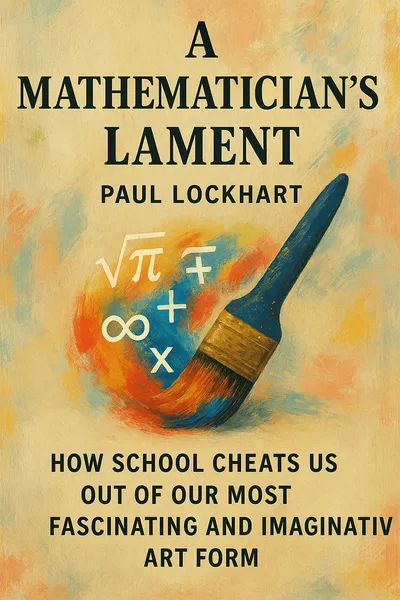
A Mathematician's Lament
Why we stopped teaching math
Description
Paul Lockhart's "A Mathematician's Lament" emerges from a contemporary crisis in mathematical pedagogy, where standardized curricula and assessment-driven instruction have fundamentally distorted the discipline's essential nature. Writing from his dual perspective as research mathematician and secondary educator, Lockhart positions his critique within broader debates surrounding educational reform and the purpose of mathematical learning in democratic society. The work addresses systemic failures in how mathematical knowledge is transmitted, challenging institutional assumptions about pedagogical effectiveness and curricular design.
The central research question driving this educational manifesto asks: How has contemporary mathematics education betrayed the fundamental spirit of mathematical inquiry and what alternative approaches could restore its creative essence? Lockhart's defended thesis argues that mathematics education must be reconceptualized as an artistic practice emphasizing exploration, pattern recognition, and creative problem-solving rather than algorithmic reproduction. The main stake involves transforming educational systems to preserve mathematical thinking as a form of intellectual artistry capable of inspiring lifelong curiosity and reasoning skills.
Lockhart's comprehensive critique demonstrates systematic failures within contemporary mathematics education that stem from fundamental misunderstandings about the discipline's nature and purpose. The work successfully integrates aesthetic, institutional, cultural, and ethical analyses to construct a compelling case for pedagogical transformation. Through his multifaceted approach, Lockhart reveals how current practices systematically undermine mathematical thinking while proposing alternative frameworks that could restore the discipline's intellectual vitality. The argument's coherence derives from its consistent emphasis on authenticity—authentic mathematical practice, authentic student engagement, and authentic educational purpose.
Table of contents
01 Mathematics as Aesthetic Experience: Repositioning Mathematical Knowledge
Lockhart's foundational argument rests upon repositioning mathematics within aesthetic rather than utilitarian frameworks. This theoretical reorientation challenges dominant instrumental approaches that reduce mathematical learning to skill acquisition and procedural competency. By invoking artistic metaphors, Lockhart constructs an alternative epistemological foundation where mathematical activity becomes synonymous with creative expression and pattern appreciation.

02 Institutional Corruption: How Educational Systems Undermine Mathematical Thinking
The work's institutional analysis exposes systematic mechanisms through which educational bureaucracies distort mathematical learning. Lockhart identifies standardization, assessment regimes, and curricular fragmentation as primary forces corrupting authentic mathematical engagement. These structural elements create pedagogical environments that prioritize measurable outcomes over conceptual understanding, transforming classrooms into sites of intellectual conformity rather than creative exploration.
03 Cultural Alienation: The Divide Between School Mathematics and Mathematical Culture
Lockhart's examination reveals fundamental tensions between creative mathematical thinking and standardized educational expectations. This analysis exposes cultural assumptions about knowledge transmission, student capability, and educational purpose that inform contemporary pedagogical practices. The author demonstrates how these assumptions systematically underestimate student intellectual capacity while overemphasizing procedural compliance.
04 The Ethics of Educational Malpractice: Moral Responsibilities in Mathematical Pedagogy
The work's ethical dimension addresses moral responsibilities inherent in educational practice and the consequences of pedagogical choices for human development. Lockhart frames current mathematics education as a form of intellectual harm that systematically diminishes students' natural curiosity and reasoning capacity. This ethical framework positions educators as moral agents whose pedagogical decisions carry significant responsibilities for student intellectual development.
05 Critical Assessment and Future Directions
Despite its passionate advocacy, Lockhart's analysis exhibits several theoretical limitations. The work's aesthetic framework, while compelling, remains underdeveloped regarding practical implementation within existing institutional constraints. The author's dismissal of computational skills risks creating false dichotomies between creativity and technical competency, potentially overlooking how procedural fluency can support rather than hinder mathematical thinking.
Related books