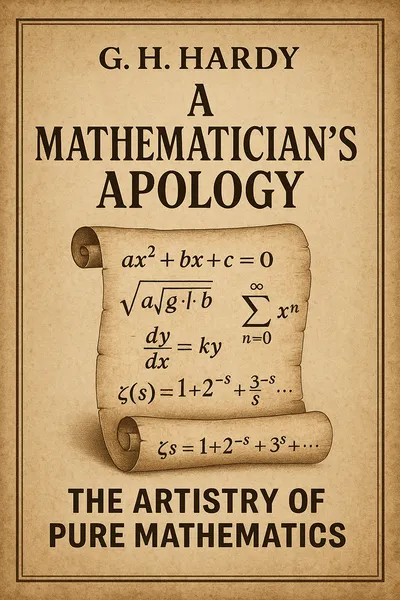
A Mathematician's Apology
The artistry of pure mathematics
Description
Hardy's Apology emerges from the twilight of a distinguished mathematical career, written when the author was sixty-three and acutely conscious of his declining powers. This reflective essay transcends mere autobiography to become a philosophical meditation on the nature of mathematical creation and its place within human culture. Composed during the Second World War, the work carries the weight of an era questioning the relationship between intellectual pursuits and social responsibility, positioning itself as both personal testament and universal manifesto for pure scholarship.
The central research question driving Hardy's work asks: What constitutes the true value and justification of mathematical activity in human civilization? His defended thesis maintains that pure mathematics represents the highest form of creative expression, valuable precisely because of its detachment from practical concerns. The main stake involves establishing mathematics as an art form comparable to poetry or music, worthy of pursuit for aesthetic rather than utilitarian reasons.
Hardy's defense presents a coherent and passionate argument for pure mathematics as humanity's supreme creative achievement, valuable precisely because of its detachment from practical utility. Through aesthetic, metaphysical, and ethical arguments, the author constructs a vision of mathematical activity as fundamentally artistic, concerned with discovering eternal truths rather than solving temporal problems. This framework positions mathematics within broader traditions of human creative expression while claiming for it a privileged status based upon its unique combination of beauty, rigor, and permanence.
Table of contents
01 The Aesthetic Foundation of Mathematical Truth
Hardy constructs his defense of mathematics upon fundamentally aesthetic principles, rejecting the conventional wisdom that intellectual endeavors must demonstrate social utility. His conception of mathematical beauty rests upon criteria of unexpectedness, inevitability, and economy—qualities that align mathematical discovery with artistic creation rather than practical problem-solving. This aesthetic framework positions the mathematician as artist rather than technician, engaged in the contemplation and creation of eternal patterns rather than temporary solutions.

02 The Hierarchy of Mathematical Value and Social Detachment
Hardy establishes a provocative hierarchy that privileges pure over applied mathematics, arguing that the most beautiful mathematical truths possess no practical utility whatsoever. This deliberate uselessness becomes, paradoxically, evidence of mathematics' highest value, as freedom from practical constraints enables the pursuit of absolute rather than contingent truth. The author's celebration of mathematical purity reflects broader anxieties about intellectual autonomy in an increasingly instrumental society.
03 Permanence, Mortality, and Mathematical Legacy
The author's meditation on mathematical permanence reveals deep anxieties about personal mortality and intellectual legacy. Hardy argues that mathematical theorems achieve a form of immortality unavailable to other human creations, surviving the collapse of civilizations and the death of languages. This permanence becomes both consolation for individual mortality and justification for mathematical pursuit, as contributions to mathematical knowledge participate in eternal truth rather than temporal contingency.
04 Ethics, Responsibility, and the Justification of Intellectual Privilege
Hardy's defense of mathematical purity raises fundamental questions about intellectual responsibility in times of social crisis. Writing during wartime, the author must confront challenges to his celebration of useless knowledge, yet he maintains that pure mathematics' value lies precisely in its removal from immediate practical concerns. This position reflects broader debates about intellectual duty and the proper relationship between scholarship and society.
05 Critical Assessment and Contemporary Relevance
Hardy's defense suffers from several significant limitations that compromise its broader philosophical claims. His rigid separation between pure and applied mathematics reflects outdated disciplinary boundaries that obscure the complex relationships between theoretical investigation and practical application. Historical analysis reveals that many supposedly useless mathematical developments later proved essential for technological advancement, undermining claims for mathematics' complete independence from worldly concerns.
Furthermore, Hardy's aesthetic criteria remain largely subjective and culturally specific, reflecting particular traditions of mathematical practice rather than universal standards of beauty or truth. His celebration of mathematical detachment also ignores the social conditions that enable pure research, relying upon institutional support and cultural privilege while denying responsibility for broader social consequences.
Related books