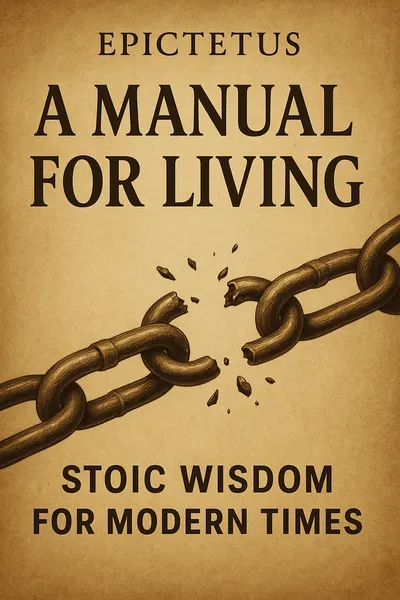
A Manual for Living
Stoic wisdom for modern times
Description
Epictetus presents a systematic guide to Stoic philosophy through concise maxims designed for daily application. Writing from his unique position as a former slave turned philosopher, he offers practical wisdom grounded in the fundamental Stoic principle of distinguishing between what lies within human control and what remains beyond it. The work emerges from a tradition of philosophical therapy, positioning philosophy not as abstract speculation but as a transformative practice for achieving psychological freedom and ethical excellence.
The central research question driving this work asks: How can individuals achieve genuine freedom and happiness regardless of external circumstances? Epictetus defends the thesis that true liberation comes through focusing exclusively on our own judgments, desires, and actions while maintaining complete indifference to external events. The main stake of his argument is to demonstrate that human suffering stems from false beliefs about what we can control, and that philosophical practice can eliminate this suffering.
Epictetus develops a comprehensive philosophical system that addresses fundamental questions about human freedom, happiness, and ethical responsibility through the lens of practical Stoicism. His central insight—that suffering emerges from false beliefs about controllability rather than from external circumstances themselves—provides a framework for psychological liberation that remains theoretically accessible regardless of material conditions. The manual demonstrates remarkable internal consistency by applying this principle across diverse areas of human experience, from interpersonal relationships to mortality anxiety.
The work's enduring influence stems from its successful integration of rigorous philosophical analysis with concrete practical guidance. Epictetus avoids the abstractness that often characterizes philosophical discourse by grounding theoretical insights in everyday situations that readers readily recognize. This accessibility should not obscure the radical nature of his proposals, which challenge fundamental assumptions about value, meaning, and human nature that underpin most social institutions.
The manual's coherence derives from its systematic application of the Stoic worldview to individual psychological development. Each maxim reinforces the others by approaching the same fundamental insight from different angles, creating a cumulative effect that gradually reshapes the reader's conceptual framework. This pedagogical strategy reflects deep understanding of how philosophical transformation actually occurs through repeated exposure to new ways of thinking rather than through sudden intellectual revelation.
Table of contents
01 The Architecture of Mental Freedom
Epictetus constructs his philosophical framework around a radical dichotomy that fundamentally reorients human consciousness. The distinction between what depends on us and what does not represents more than a practical sorting mechanism; it constitutes an ontological restructuring of reality itself. This division challenges conventional assumptions about causality, agency, and responsibility by proposing that external events possess no inherent capacity to harm or benefit the rational mind.
The philosophical architecture here draws heavily from Stoic physics and logic, where the universe operates according to rational principles that remain indifferent to individual preferences. Epictetus translates this cosmic rationality into psychological terms, arguing that mental disturbance arises exclusively from false judgments about external circumstances rather than from the circumstances themselves. This framework positions human consciousness as sovereign within its proper domain while completely subordinated to natural law in all other respects.

02 Social Relations and Ethical Performance
The manual's approach to interpersonal relationships reveals a sophisticated understanding of social dynamics filtered through Stoic ethical principles. Epictetus advocates a form of engaged detachment that maintains social obligations while preventing emotional dependence on others' responses. This position navigates the tension between philosophical withdrawal and civic participation by redefining the nature of social engagement itself.
The concept of role ethics emerges as central to this social philosophy, where individuals must fulfill various social functions—parent, citizen, friend—without deriving their fundamental identity or happiness from these roles. This creates a paradoxical form of authentic performance, where one acts genuinely within social structures while maintaining inner distance from their outcomes. The philosophical challenge lies in executing this performance without falling into either cynical manipulation or naive attachment.
03 Temporal Consciousness and Existential Acceptance
The manual's treatment of temporality reveals deep insights into the relationship between consciousness and time that anticipate later existentialist themes. Epictetus advocates a form of present-moment awareness that neither clings to the past nor anxiously anticipates the future, but this present-centeredness emerges from rational analysis rather than mystical experience. The past exists only as memory and the future only as projection; both become sources of suffering when mistaken for present realities that demand emotional investment.
This temporal philosophy intersects with questions of mortality and loss, where Epictetus proposes treating all relationships and possessions as temporary loans rather than permanent acquisitions. This perspective aims to eliminate the shock and resistance that typically accompany loss by incorporating impermanence into the initial experience of attachment. The psychological sophistication of this approach lies in its recognition that anticipatory grief can coexist with present enjoyment without diminishing either experience.
04 Ethical Transformation and Practical Wisdom
The manual culminates in a vision of ethical transformation that promises complete psychological freedom through disciplined philosophical practice. This transformation involves more than behavioral modification; it requires a fundamental restructuring of desire, judgment, and identity that aligns individual will with universal reason. The process demands rigorous self-examination and consistent application of Stoic principles until they become second nature.
Epictetus presents this transformation as both utterly demanding and completely achievable, creating a productive tension between philosophical ambition and practical accessibility. The ethical ideal of the Stoic sage represents perfect wisdom and virtue, yet the manual addresses ordinary practitioners struggling with everyday challenges. This dual perspective suggests that philosophical progress occurs gradually while maintaining an absolute standard of excellence as its ultimate goal.
05 Critical Assessment and Contemporary Relevance
The manual's greatest limitation lies in its insufficient attention to social and political dimensions of human suffering. While Epictetus acknowledges that external circumstances cannot directly cause psychological distress, his analysis largely ignores how systematic oppression, structural violence, and material deprivation create conditions that make philosophical practice extraordinarily difficult. His personal experience of slavery paradoxically seems to have led him toward an overly individualistic solution that may inadvertently support existing power structures by encouraging acceptance rather than resistance.
The work also displays a troubling gender bias that reflects its historical context but limits its contemporary relevance. The examples and assumptions throughout the manual presuppose male social roles and experiences while largely ignoring how different social positions might require different philosophical approaches. This limitation extends to broader questions about cultural specificity and the universalizability of Stoic principles across different social contexts.
Related books