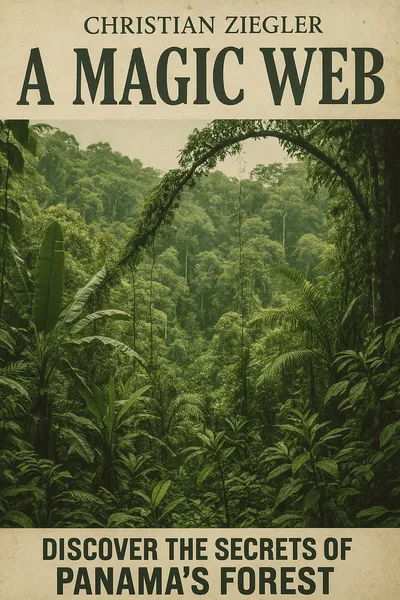
A Magic Web
Discover the secrets of Panama's forest
Description
Christian Ziegler's "A Magic Web" emerges within contemporary ecological discourse emphasizing systemic approaches to forest communities. Drawing from extensive fieldwork on Panama's Barro Colorado Island, the author positions himself within the tradition of naturalist observation while incorporating modern ecological theory. The work addresses fundamental questions about tropical forest functioning, community dynamics, and the intricate relationships binding diverse species within complex ecosystems.
The central research question driving the work is: How do individual organisms and their activities collectively generate and maintain the complex community structure of tropical forests? Ziegler defends the thesis that tropical forests function as integrated webs of interdependence where seemingly isolated species activities create emergent community properties. The main stake is demonstrating that forest communities represent dynamic systems of reciprocal relationships rather than simple collections of competing individuals.
Ziegler constructs a compelling argument for understanding tropical forests as dynamic webs of interdependence that generate emergent community properties through countless individual interactions. The work successfully demonstrates how reductionist approaches fail to capture essential characteristics of forest communities, while systemic perspectives reveal sophisticated coordination mechanisms operating across multiple scales and timescales. The forest emerges as a paradigmatic example of complex adaptive systems where individual success depends fundamentally on community health and relationship maintenance.
Table of contents
01 Ecological Interconnectedness and Community Formation
Ziegler's analysis reveals tropical forests as paradigmatic examples of systemic complexity, where community emerges from countless individual interactions. The theoretical framework draws heavily from ecological systems theory, positioning forests not as static environments but as dynamic networks of energy and material exchange. Each species occupies multiple functional roles simultaneously, challenging traditional ecological categories that separate producers, consumers, and decomposers into discrete units.

02 Temporal Dynamics and Adaptive Strategies
The forest's temporal dimension reveals sophisticated coordination mechanisms operating across multiple timescales. Ziegler examines how seasonal rhythms, reproductive cycles, and resource availability patterns create temporal niches that permit species coexistence within limited spatial frameworks. These temporal arrangements demonstrate community-level organization that transcends individual species' immediate survival needs.
03 Communication Networks and Information Flow
The forest operates through complex information networks spanning multiple sensory modalities and communication systems. Chemical signals, acoustic patterns, and visual displays create multilayered communication webs that coordinate community activities beyond direct species interactions. These information flows enable collective responses to environmental changes, resource fluctuations, and external threats.
04 Conservation Implications and Human Relationships
The web metaphor carries profound implications for conservation philosophy and environmental ethics. Understanding forests as integrated systems rather than resource collections transforms human relationships with natural environments. Conservation strategies must address system-level properties and relationship maintenance rather than focusing exclusively on individual species preservation or habitat protection.
05 Critical Analysis and Future Directions
While Ziegler's web metaphor provides valuable insights, it potentially underemphasizes conflict and competition within forest communities. The emphasis on cooperation and interdependence may obscure important dynamics of resource competition, predation, and species displacement that also shape community structure. Additionally, the work's focus on Barro Colorado Island limits generalizability to other tropical forest contexts with different historical and geographical characteristics.
Related books